
Estimating VO2 Max Without a Lab: Cooper, Rockport and VDOT
What VO2 max measures, how the Cooper run, Rockport walk, heart rate ratio and race-based VDOT estimate it, how accurate each is, and what the FRIEND norms say.
· 10 min read
VO2 max has moved from sports labs onto smartwatches, and with it has come a lot of confusion about what the number means and how much to trust it. This guide explains what VO2 max measures, how the classic field tests estimate it without a lab, how accurate each method is, how to read your result against population norms, and why it is worth improving. The VO2 Max Calculator runs every method described here.
What VO2 max actually measures
VO2 max is the highest rate at which your body can take up and use oxygen during exhausting exercise. It is usually expressed relative to body weight, in millilitres of oxygen per kilogram per minute (mL/kg/min). It depends on how much blood the heart can pump per beat (stroke volume), maximum heart rate, how much oxygen the blood can carry, and how well the muscles extract it.
In a laboratory you run on a treadmill or ride a bike while wearing a mask that measures the oxygen and carbon dioxide in each breath. The workload increases every minute or two until you cannot continue. The test counts as maximal when oxygen uptake stops rising despite more work, or when markers such as a respiratory exchange ratio (RER) of 1.10 or more show you reached a true maximum.
Two related units are worth knowing. One MET is resting oxygen use, defined as 3.5 mL/kg/min, so a VO2 max of 42 equals 12 METs. And because VO2 max is per kilogram, losing fat raises it even if the heart and muscles have not changed.
The field tests
Field tests replace the gas analyser with something easy to record, such as distance, time or heart rate, and use a regression equation from a study in which people did both.
| Test | What you do | Equation | Original study |
|---|---|---|---|
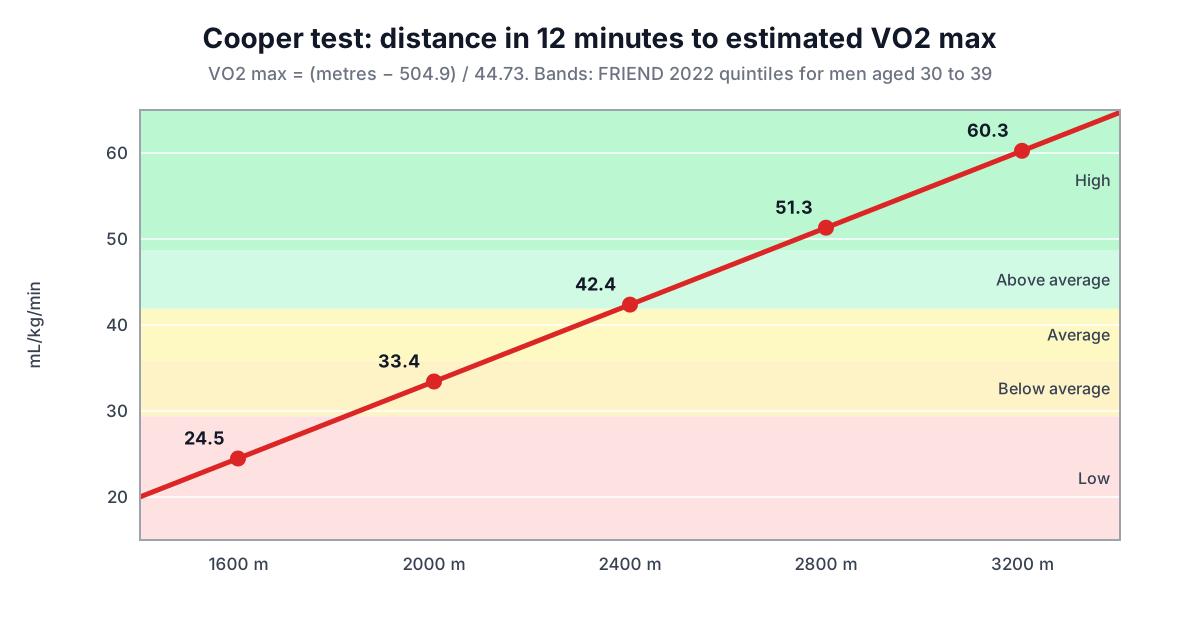
| Cooper 12-minute run | Run as far as possible in 12 minutes | (metres − 504.9) / 44.73 | Cooper, JAMA 1968 |
| Rockport walk | Walk 1 mile as fast as possible; record time and finishing heart rate | 132.853 − 0.0769 × lb − 0.3877 × age + 6.315 × male − 3.2649 × minutes − 0.1565 × HR | Kline et al., Med Sci Sports Exerc 1987 |
| Heart rate ratio | Measure resting and maximum heart rate | 15.3 × HRmax / HRrest | Uth et al., Eur J Appl Physiol 2004 |
| 1.5-mile run | Run 2.4 km as fast as possible | 483 / minutes + 3.5 | Widely used military and school test |
| Race result (VDOT) | Any all-out race between about 1500 m and the marathon | Oxygen cost of race speed / fraction sustainable for that time | Daniels and Gilbert, Oxygen Power 1979 |
Cooper 12-minute run
Kenneth Cooper, a US Air Force physician, tested 115 airmen on both a treadmill and a 12-minute run in 1968 and found a correlation of about 0.90 between distance and measured VO2 max. The line he fitted is VO2 max = (distance in metres − 504.9) / 44.73. Covering 2,400 m gives (2400 − 504.9) / 44.73 = 42.4 mL/kg/min; every extra 45 m adds about 1 mL/kg/min.
The test works best for people who know how to pace a hard 12-minute effort. Beginners who start too fast and walk the last few minutes will underestimate their capacity.
Rockport one-mile walk
For people who should not run, Kline and colleagues developed the Rockport test in 1987 from adults aged 30 to 69. You walk a mile as fast as you can, then take your pulse straight away. The equation rewards a fast time and a low finishing heart rate and adjusts for age, weight and sex. A 45-year-old woman weighing 150 lb who walks the mile in 16:00 with a heart rate of 125 gets 132.853 − 11.535 − 17.447 − 52.238 − 19.563 = 32.1 mL/kg/min.
Heart rate ratio
Niels Uth and colleagues in Copenhagen found in 2004 that VO2 max was proportional to the ratio of maximum to resting heart rate, with a factor of about 15.3, in trained men. No exercise is needed if you know your true maximum heart rate. If you do not, the calculator uses 208 − 0.7 × age (Tanaka, Monahan and Seals, 2001). Age-predicted maximum heart rate has a standard deviation of about 10 beats per minute, which flows straight into the estimate, so this method is best treated as a rough guide.
Race times and VDOT
Jack Daniels and Jimmy Gilbert approached the problem from the other direction. They modelled the oxygen cost of running at a given speed, VO2 = −4.60 + 0.182258 v + 0.000104 v² with v in metres per minute, and the fraction of VO2 max a trained runner can sustain for a given time, which falls from 100% at around 10 minutes to about 80% over several hours. Dividing one by the other turns a race result into VDOT, an "effective VO2 max". A 5K in 19:57 and a marathon in 3:10:49 both give a VDOT of 50.
VDOT folds in running economy and race skill. A runner with excellent economy will have a higher VDOT than their lab VO2 max suggests, which is exactly why it predicts race times so well.
How accurate are they?
Every field test has error. In validation studies, typical errors against laboratory VO2 max are around 3 to 5 mL/kg/min, and individuals can be off by more. Some practical rules:
- Effort matters most. All the run tests assume you went all out with even pacing.
- The walk test suits older and less fit adults and was developed on them. Very fit people will walk the mile too easily for it to discriminate.
- Estimated maximum heart rate is the weakest link in the ratio method; a measured maximum from a hard hill session or race improves it.
- Track trends, not single numbers. A change of 1 to 2 mL/kg/min between two tests is within the noise; a steady rise over months is real.
Smartwatch estimates combine heart rate, pace and your profile with similar logic. They are usually within about 5 mL/kg/min on average but can be biased for individuals, so treat them the same way.
Reading your result: the FRIEND norms
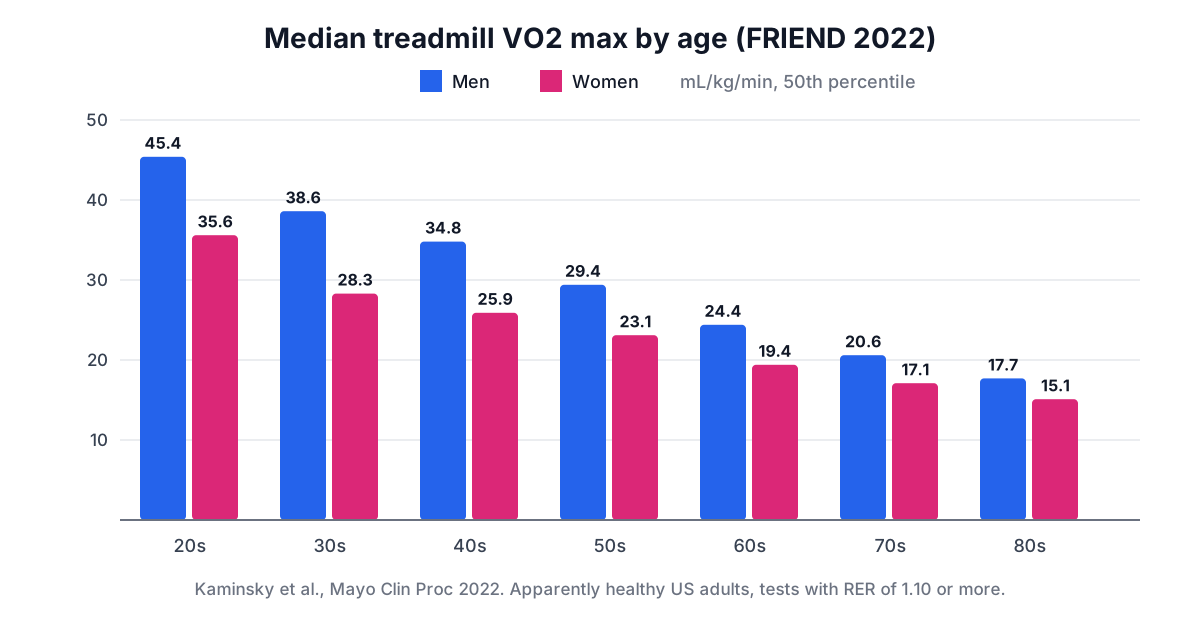
A number alone means little without knowing what is typical for your age and sex. The calculator uses the 2022 reference standards from the Fitness Registry and the Importance of Exercise National Database (FRIEND), published by Kaminsky and colleagues in Mayo Clinic Proceedings. They come from thousands of laboratory treadmill tests in apparently healthy US adults aged 20 to 89, using only tests with an RER of 1.10 or more.
| Age | Men, 50th percentile | Men, 80th | Women, 50th | Women, 80th |
|---|---|---|---|---|
| 20 to 29 | 45.4 | 54.2 | 35.6 | 44.1 |
| 30 to 39 | 38.6 | 48.7 | 28.3 | 36.2 |
| 40 to 49 | 34.8 | 44.0 | 25.9 | 32.8 |
| 50 to 59 | 29.4 | 37.5 | 23.1 | 28.4 |
| 60 to 69 | 24.4 | 31.6 | 19.4 | 24.1 |
| 70 to 79 | 20.6 | 26.3 | 17.1 | 20.6 |
Values are mL/kg/min on a treadmill. The calculator interpolates between the published percentile points and labels results by quintile, from low to high. Remember that you are comparing a field estimate with lab values, so a percentile near a boundary could go either way.
Why the number matters
Cardiorespiratory fitness is one of the strongest predictors of how long people live. A 2009 meta-analysis in JAMA by Kodama and colleagues, covering 33 studies, found that each 1-MET increase in fitness was associated with about 13% lower all-cause mortality and 15% lower cardiovascular events. A 2018 Cleveland Clinic study of more than 120,000 adults who had treadmill tests found that risk kept falling all the way up to the fittest group, with no point at which more fitness stopped helping.
VO2 max falls with age, partly because maximum heart rate drops. In inactive adults the decline is commonly put at about 10% per decade after 30. Regular training does not stop the decline, but it shifts the whole curve up, so a fit 60-year-old can match an average 40-year-old.
How to raise it
- Do more aerobic work. Several hours a week of easy to moderate running, cycling, rowing or brisk walking build the base.
- Add some hard intervals. Efforts of 3 to 5 minutes at close to maximum, with equal recovery, once or twice a week, are a strong stimulus for VO2 max. A Norwegian 4 × 4-minute protocol is a well-studied example.
- Be patient. Untrained people often gain 10 to 20% in a few months; trained athletes gain much less.
- Lose excess fat if you have it; because VO2 max is per kilogram, weight loss raises it directly.
To set training intensities, pair your result with the Target Heart Rate Calculator, and use the Running Pace Calculator to turn a VDOT-level race into training paces. Our running and training guide covers both.
Safety
Maximal tests are hard on the heart. If you have been inactive, have heart or lung disease, chest pain, dizziness or high blood pressure, speak to a doctor before an all-out test and choose the Rockport walk instead of a run. Stop at once if you feel chest pain, severe breathlessness or faintness.
Summary
You do not need a lab to estimate VO2 max. Pick the test that suits you, do it with a real effort under consistent conditions, and use the result as a trend line rather than a precise measurement. Compare it with age and sex norms, and if it is lower than you would like, the remedy is well established: more aerobic exercise with some hard intervals. Try the methods side by side in the VO2 Max Calculator.
Sources: Cooper KH, JAMA 1968;203:201-4; Kline GM et al., Med Sci Sports Exerc 1987;19:253-9; Uth N et al., Eur J Appl Physiol 2004;91:111-5; Tanaka H, Monahan KD, Seals DR, J Am Coll Cardiol 2001;37:153-6; Daniels J, Gilbert J, Oxygen Power, 1979; Kaminsky LA et al., Mayo Clin Proc 2022;97:285-93; Kodama S et al., JAMA 2009;301:2024-35; Mandsager K et al., JAMA Netw Open 2018;1:e183605.
Related searches
- how to estimate vo2 max
- cooper test formula
- rockport walk test
- vo2 max norms by age
- friend registry vo2 max
- vdot vs vo2 max
- vo2 max and longevity
- improve vo2 max training