
Word Count, Character Count and Reading Time Explained
Why word counters disagree, how emoji and accents are counted, reading and speaking speeds that hold up, words per page, and the real rules behind X, Bluesky and SMS limits.
· 10 min read
A word count sounds like the simplest number in writing. Then you paste the same essay into two tools and get 1,482 and 1,497, or a post that shows 270 characters is rejected by X as too long. Both happen because "word" and "character" have more than one reasonable definition, and every platform picks its own. This guide explains the definitions, the reading and speaking speeds that are worth trusting, and the exact rules behind the common limits, using the Word Counter as the worked example.
What counts as a word
Almost every counter starts the same way: split the text wherever there is a space, tab or line break, and count the pieces. The disagreements come from the pieces that are not obviously words.
| Text | Pieces between spaces | Typical treatment |
|---|---|---|
well-known | 1 | One word in most word processors |
don't | 1 | One word everywhere |
3.5 or $1,200 | 1 | Usually one word |
| A long dash typed with spaces around it | 1 | Some tools count it, most do not |
& or / on its own | 1 | Varies |
https://example.com/a/b | 1 | One word, though it reads as several |
東京タワー | 1 | Five words in Word, which counts each CJK character |
The Word Counter uses one clear rule: a piece counts as a word if it contains at least one letter or digit in any script. That keeps hyphenated compounds, contractions and numbers as single words and drops standalone punctuation and emoji. For Chinese and Japanese, which do not separate words with spaces, it counts each Han, Hiragana or Katakana character as a word, the same convention Microsoft Word uses for East Asian text. Korean writes spaces between words, so it is counted like English.
The practical lesson is simple. Differences of one or two percent between tools are normal and come from these edge cases. If a submission portal, a publisher or a court filing system states a limit, its own counter is the one that decides, so leave a small margin.
What counts as a character
Characters are harder than words, because text is stored in layers.
- Bytes. UTF-8, the encoding of almost every web page, uses 1 byte for ASCII letters, 2 for most accented Latin, Greek and Cyrillic letters, 3 for most CJK characters and 4 for emoji. Database columns and some APIs limit bytes.
- Code points. Unicode assigns a number to each symbol.
écan be one code point (U+00E9) or two (e plus a combining acute accent). A thumbs-up with a skin tone is two code points; a family emoji joined with zero-width joiners can be five or more. - UTF-16 code units. JavaScript's
string.lengthcounts these. Code points above U+FFFF, which includes most emoji, take two units each. - Graphemes. What a reader sees as one character. Unicode's segmentation rules (UAX #29) group code points into these clusters.
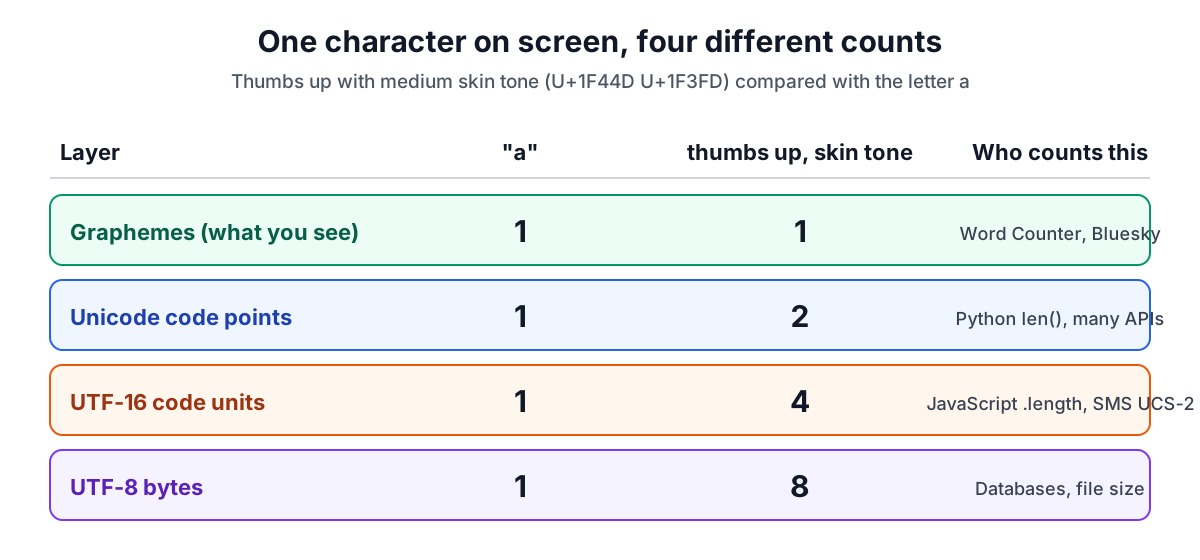
The Word Counter reports graphemes as "characters" because that is what people mean, and shows the UTF-8 byte size separately for anyone filling a database field. Characters without spaces simply drops the whitespace graphemes.
Reading time: which words per minute to use
Many sites use 200 or 250 words per minute without a source. The best summary of the research is Marc Brysbaert's 2019 meta-analysis in the Journal of Memory and Language, which pooled decades of reading-rate studies. For adults reading English silently it found an average of about 238 words per minute for non-fiction and 260 for fiction, with wide individual variation. Earlier claims of 300 wpm and more were mostly from small or unrepresentative samples.
So the Word Counter defaults to 238 wpm. The arithmetic is just words divided by speed:
| Words | Reading time at 238 wpm | Speaking time at 150 wpm |
|---|---|---|
| 300 | 1 min 16 s | 2 min |
| 600 | 2 min 31 s | 4 min |
| 1,000 | 4 min 12 s | 6 min 40 s |
| 1,500 | 6 min 18 s | 10 min |
| 2,500 | 10 min 30 s | 16 min 40 s |
Adjust for the material. Technical articles with code, formulas or tables are read more slowly, and readers skim long marketing pages faster than they read. If you publish an estimated read time on a blog, rounding up to the next whole minute is kinder than rounding down.
Speaking time for talks and scripts
Speaking speed varies more than reading speed. A careful presenter might speak at 120 to 130 words per minute, ordinary conversation runs around 150, and an excited podcast host can pass 180. The tool defaults to 150 and lets you set your own rate. The quickest way to find it is to read one page of your script aloud with a timer and divide the words by the minutes.
Worked example: a five-minute slot at 150 wpm holds about 750 words. Leave room for pauses, slide changes and audience reaction, and a script of 650 to 700 words is safer. For a recorded voice-over with no pauses, 750 is realistic.
Words per page
The traditional rule is about 500 words per single-spaced page and 250 per double-spaced page in 12-point Times New Roman with 1-inch margins on US Letter or A4. It is an estimate; dialogue, short paragraphs, headings and wider fonts such as Arial or Calibri reduce it. The Word Counter shows both figures so you can sanity-check a page limit before you format the document.
Platform limits and how each one counts
Character limits are rarely just "count the characters". The table summarises the limits the tool checks and how each is measured.
| Platform | Limit | How it is counted |
|---|---|---|
| X post (standard account) | 280 | Weighted: most Latin, Greek and Cyrillic 1, CJK and emoji 2, each link 23 |
| Threads | 500 | Characters |
| Bluesky | 300 | Graphemes |
| Mastodon | 500 | Default; each server can change it |
| LinkedIn post | 3,000 | Characters |
| Instagram caption | 2,200 | Characters |
| YouTube title / description | 100 / 5,000 | Characters |
| Search result title | about 60 | Guideline; Google truncates by pixel width |
| Meta description | about 160 | Guideline; snippets are cut near 920 px |
| SMS | 160 or 70 per message | GSM 7-bit or UCS-2, see below |
Why X counts some characters twice
X publishes its counting rules in the open-source twitter-text library. Since the limit went from 140 to 280 in 2017, the text is normalised (Unicode NFC) and each code point gets a weight. Code points from U+0000 to U+10FF, which covers Latin, Greek, Cyrillic, Hebrew, Arabic and most Indic scripts, plus a few punctuation ranges such as curly quotes and dashes, weigh 1. Everything else, including Chinese, Japanese and Korean, weighs 2, which is why a CJK post holds 140 characters. A whole emoji sequence, however many code points it has, weighs 2. Every URL is replaced by a t.co link and counts 23, whether it was short or long.
Example: Launch day 🚀 https://example.com/blog/announcing-our-new-product counts 12 for the letters and spaces, 2 for the rocket and 23 for the link: 37 of 280.
Why an SMS splits
SMS dates from the GSM standards. One message carries 140 bytes of user data. With the 7-bit GSM alphabet (3GPP TS 23.038) that is 160 characters. The alphabet covers basic Latin, some accented letters such as é, ü and ñ, and a few Greek capitals. A handful of characters, including € [ ] { } \ ~ ^ |, live in an extension table and take two septets each.
If any character in the message is outside the GSM alphabet, the whole message switches to UCS-2, a 16-bit encoding, and the limit drops to 70 characters. Long messages are split into parts that each lose a little space to a header: 153 GSM characters or 67 UCS-2 characters per part.
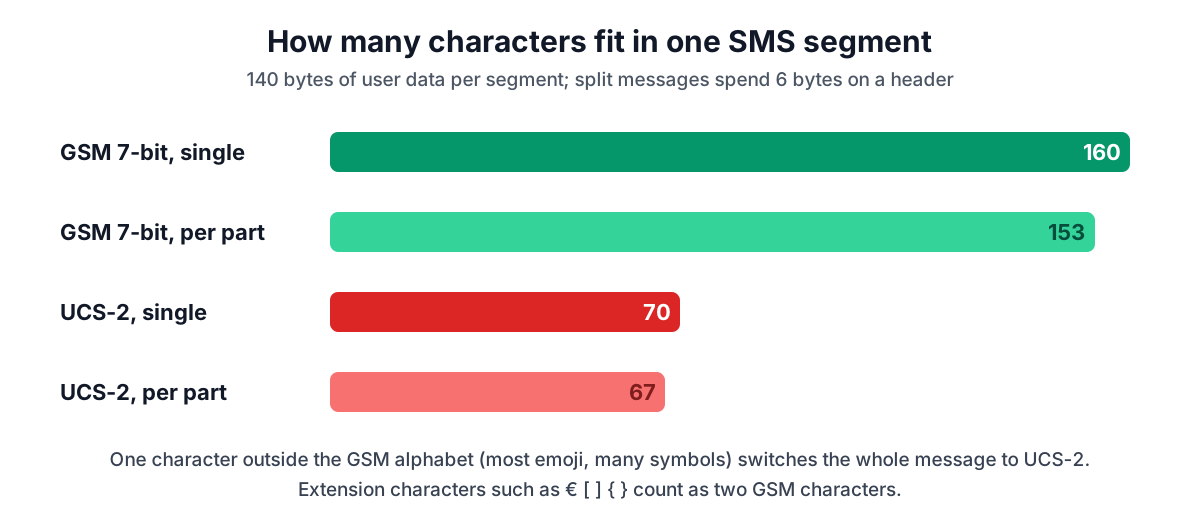
So one emoji, or a curly apostrophe pasted from a word processor that the sending system does not convert, can turn a single 150-character message into three parts. The Word Counter's SMS row shows the encoding and the number of segments, so you can find the culprit and replace it with a plain character.
Sentences and paragraphs
Counting sentences means deciding which full stops end a sentence. The tool splits on ., !, ? and the ideographic 。!?, but not after titles such as Mr., Dr. and Prof., inside abbreviations such as e.g., i.e. and U.S., after single initials like "J. K.", or inside numbers like 3.50. A full stop followed by a lowercase word is treated as an abbreviation.
Line breaks need a choice. In web copy, lists and headings each line is a separate unit and usually has no full stop, so by default a line break ends a sentence. In hard-wrapped plain text, such as an email with a line break every 72 characters, that would split sentences in the middle, so you can turn the option off and only blank lines will end a sentence. Paragraphs are always blocks separated by a blank line.
Common mistakes
- Trusting one tool's count to the word. Edge cases differ; leave a margin under strict limits.
- Using 300 wpm for reading time. The evidence points to roughly 240 for non-fiction.
- Assuming 280 characters on X. Emoji, CJK text and links change the count.
- Pasting smart quotes into SMS campaigns. One non-GSM character cuts the per-message limit from 160 to 70.
- Writing meta descriptions to exactly 160 characters. Google cuts by width, and wide letters like W and M use it up faster.
Using the Word Counter
Paste your text into the Word Counter, set your reading and speaking speeds, and add a goal if you are writing to a length. Check the platform rows before posting, and use the most-used-words list to catch repetition. When the length is right, run the draft through the Readability Checker to see whether it is also easy to read, or the Keyword Density Analyzer if it is web copy. Everything runs in your browser, so drafts stay private.
Sources
- Brysbaert, M. (2019). How many words do we read per minute? A review and meta-analysis of reading rate. Journal of Memory and Language, 109, 104047.
- twitter-text library, configuration v3 (weighted length rules), github.com/twitter/twitter-text.
- 3GPP TS 23.038, Alphabets and language-specific information (GSM 7-bit default alphabet).
- Unicode Standard Annex #29, Unicode Text Segmentation (grapheme clusters).
Related searches
- word counter
- character count with spaces
- how long to read 1000 words
- how many words is a 5 minute speech
- words per page double spaced
- twitter character count emoji
- sms 160 character limit
- grapheme vs code point count
- average reading speed words per minute