
The 50/30/20 Budget: Needs, Wants and Savings in Practice
Where the 50/30/20 rule came from, how to sort real expenses into needs and wants, what to do when housing alone breaks the 50%, and how to size an emergency fund.
· 6 min read
Most budgets fail in the second month, not the first. The first month is enthusiasm: every coffee logged, every category labelled. The second month brings an annual insurance bill, a birthday and a car repair, none of which fit the categories, and the spreadsheet is abandoned. The 50/30/20 rule survives where detailed budgets do not because it asks for only three numbers.
This guide explains where the rule comes from, how to sort real spending into its three buckets, what to do when your rent alone breaks it, and how big an emergency fund should be. It uses the Monthly Budget Planner for the worked example. It is a planning framework, not personal financial advice.
Where the 50/30/20 rule comes from
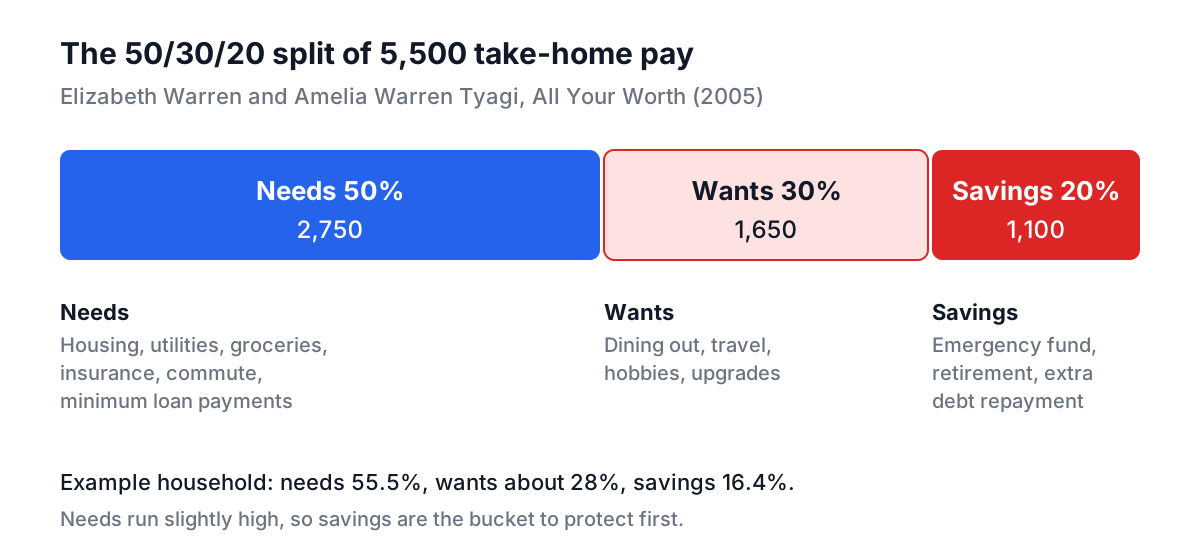
The rule was popularised by Elizabeth Warren, then a Harvard bankruptcy law professor, and her daughter Amelia Warren Tyagi in their 2005 book All Your Worth: The Ultimate Lifetime Money Plan. They called it the Balanced Money Formula. Its starting point is after-tax income, what actually arrives in your account, split three ways:
| Bucket | Share of take-home pay | What goes in it |
|---|---|---|
| Needs | 50% | Housing, utilities, groceries, insurance, transport to work, minimum loan payments |
| Wants | 30% | Eating out, travel, hobbies, streaming, upgrades beyond the basics |
| Savings | 20% | Emergency fund, retirement contributions, extra debt repayment |
The point of the 50% cap on needs is resilience. Needs are the costs you cannot cut quickly when income drops. If they take 50% of pay, losing a job or an earner is survivable; if they take 80%, it is a crisis within a month.
Sorting real spending into needs and wants
The rule is simple; the sorting is where people argue with themselves. A useful test: a need is something you would still have to pay if you lost your income tomorrow, at the cheapest level that keeps you working and healthy. Anything above that level is a want, even if it is inside a "need" category.
- Groceries are a need. The share spent on convenience food and premium brands is a want, but most people sensibly put the whole grocery bill under needs and keep restaurants under wants.
- A car loan for a car you need to get to work is a need. The extra cost of a more expensive car than the job requires is a want.
- Minimum debt payments are needs. Anything you pay above the minimum is savings, because it reduces debt.
- Retirement contributions taken from your pay are savings, even though they never touch your account. Add them back to take-home pay before you calculate the percentages.
- Annual bills such as insurance or a car registration should be divided by 12 and counted every month.
A worked example with the Budget Planner
The Monthly Budget Planner starts with an example household of two adults: 5,000 salary plus 500 of investment income, 5,500 a month in total. Its expenses, sorted into the three buckets:
| Item | Monthly | Bucket |
|---|---|---|
| Rent or mortgage | 1,500 | Needs |
| Utilities | 200 | Needs |
| Car loan | 400 | Needs |
| Life insurance | 150 | Needs |
| Groceries | 600 | Needs |
| Fuel | 200 | Needs |
| Entertainment | 200 | Wants |
| 401(k) contribution | 400 | Savings |
| Savings goal | 500 | Savings |
Needs total 3,050, which is 55.5% of income. Wants are 200 (3.6%) and savings 900 (16.4%). That leaves 1,350 a month that is not assigned to anything. In real life unassigned money gets spent, so in practice this household's wants are probably closer to 28%, and the budget is roughly 55/28/16: needs a little high, savings a little low.
The planner's Analysis tab shows the same picture in its own terms. Total expenses of 3,650 are 66.4% of income, a health rating of excellent, but the savings rate is only 9.1% because it counts just the 500 savings goal. Moving 500 of the unassigned 1,350 into the goal would take savings to 1,400, about 25% of income including the 401(k), and leave 850 for wants.
When housing alone breaks the 50%
In many cities rent takes 35% to 45% of take-home pay before anything else is counted. The rule then looks impossible, and some people give up on it. Better options:
- Keep the 20% and squeeze wants. A 60/20/20 budget is more resilient than 50/40/10. Savings are the bucket that protects you, so protect it first.
- Treat the overrun as a temporary target. If needs are 60%, aim to bring them down at the next lease renewal, job change or loan payoff, and write that date down.
- Look at the second-biggest need. Car costs (loan, insurance, fuel, maintenance) are often the easiest large need to reduce.
- Lower the savings rate only as a last resort, and keep at least enough going in to capture any employer retirement match.
The Budget Planner suggests narrower ranges for individual categories: 25% to 30% of income for housing (20% to 28% for a couple without children), 10% to 15% for food and transport, and 20% to 30% for savings. These are starting points; the category percentages on its Analysis tab show where you are against them.
How big should the emergency fund be?
An emergency fund is cash that turns a lost job or a broken boiler from a debt problem into an inconvenience. Common guidance is three to six months of essential expenses. The planner suggests 4 months for a couple without children (two earners rarely lose their jobs at once) and 6 months for single people and families.
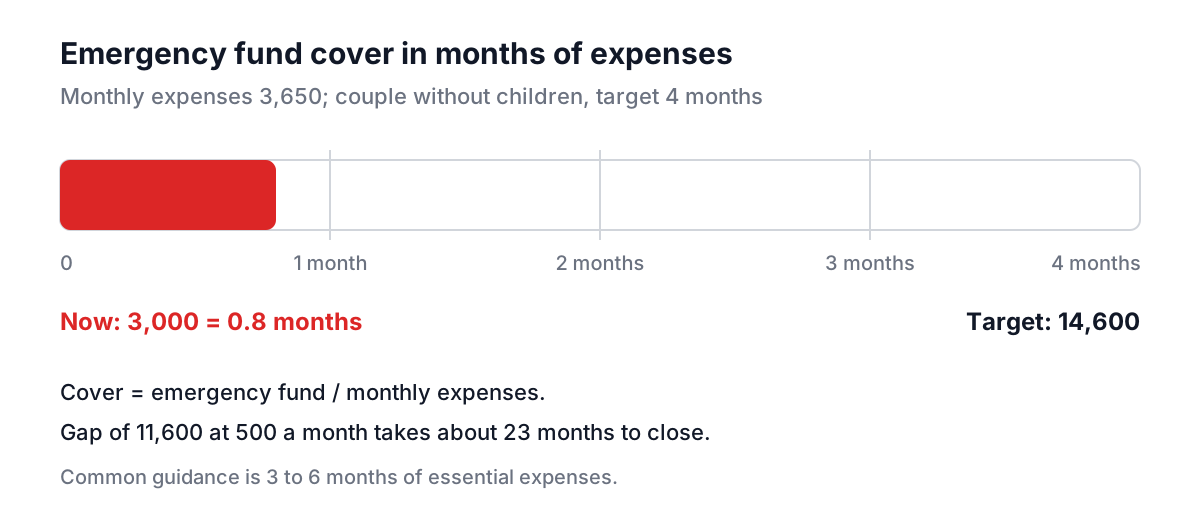
In the example, 3,000 of savings against 3,650 a month of spending covers 0.8 months. The 4-month target is 14,600. At 500 a month it would take about 23 months to close that gap, which is why a new budget often directs the whole savings bucket to the emergency fund first, then switches to retirement and investing once the target is reached. Keep the fund somewhere boring and instantly accessible, such as a high-yield savings account, not in shares.
Common mistakes
- Using gross pay. Percentages of gross salary hide tax and make every category look smaller than it is.
- Forgetting irregular costs. Car repairs, gifts and annual subscriptions are predictable in total even if not in timing. Give them a monthly line.
- Counting savings as spending. In the planner, a savings line entered as an expense raises the expense ratio. Either enter it as the savings goal or remember to read it as savings.
- Making the budget too detailed. Twenty categories you never review are worse than three you check every month.
Making it stick
Enter one month of real numbers into the Monthly Budget Planner, sort each line into needs, wants or savings, and write down the three percentages. Pick one change, usually raising the savings goal, and set up an automatic transfer on payday so it happens before you can spend it. Once the emergency fund is in place, the FIRE Planner and its guide to the FIRE number show what a higher savings rate does to your timeline, and the Compound Interest Calculator shows what the savings bucket grows to. Download the planner's CSV report each month so you can compare next month against this one.