
Your FIRE Number: The 4% Rule and Years to Financial Independence
Where the 4% rule comes from, why savings rate drives your timeline, how inflation changes the target, and the risks a 25x number does not cover.
· 6 min read
Two people earn the same 6,000 a month after tax. One spends 5,400 and saves 600. The other spends 3,000 and saves 3,000. Starting from nothing and earning 5% a year above inflation, the first reaches financial independence in about 51 years. The second gets there in 17. Their salaries are identical; their savings rates are 10% and 50%. That gap, more than any choice of fund, is what the FIRE (financial independence, retire early) movement is built on.
This guide explains the two numbers that matter, your FIRE number and your years to FI, using the same maths as the FIRE Planner. It is an explanation of a planning method, not personal financial advice.
The FIRE number is spending divided by a withdrawal rate
Your FIRE number is the portfolio that can fund your spending indefinitely, or at least for a very long time:
FIRE number = annual spending / safe withdrawal rate
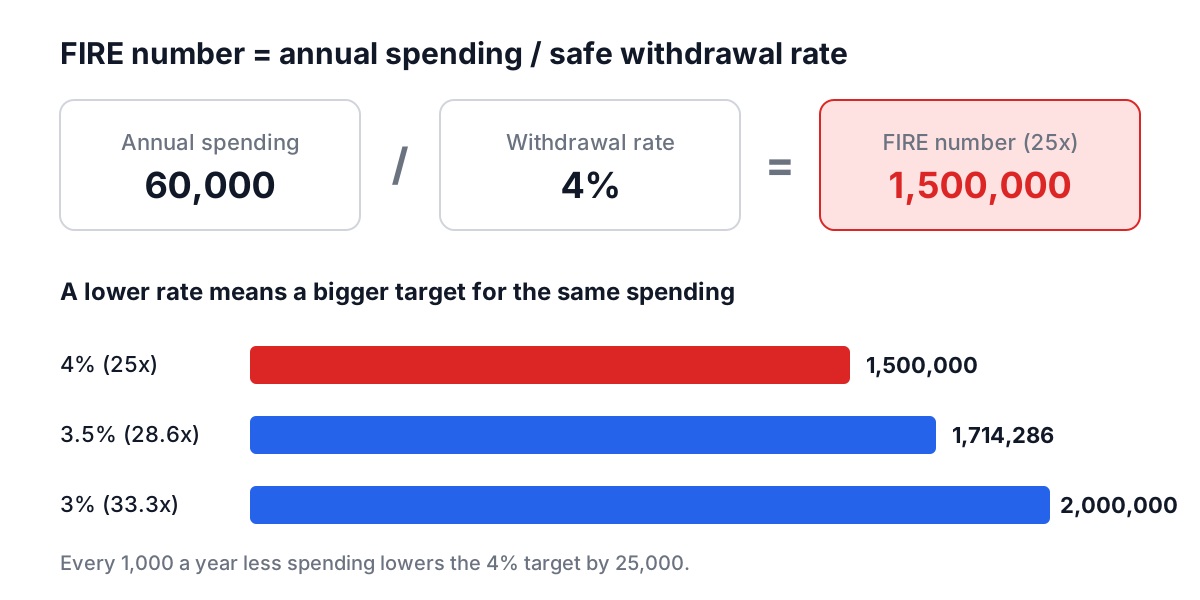
At a 4% withdrawal rate that is 25 times annual spending. Someone who spends 60,000 a year needs 1,500,000. The rate you choose changes the target a lot:
| Safe withdrawal rate | Multiple of spending | Target for 60,000 a year |
|---|---|---|
| 4% | 25x | 1,500,000 |
| 3.5% | 28.6x | 1,714,286 |
| 3% | 33.3x | 2,000,000 |
Notice that the formula has spending in it, not income. That is why frugality is so effective: every 1,000 a year you stop spending lowers the target by 25,000 at 4%.
Where the 4% rule comes from
The 4% figure comes from two pieces of research. In 1994 the financial planner William Bengen published a study in the Journal of Financial Planning that tested withdrawal strategies against US stock and bond returns going back to 1926. He withdrew a fixed percentage of the starting balance in year one, raised that amount with inflation every year after, and looked for the highest starting rate that never ran out within 30 years. The answer was about 4%.
In 1998 three professors at Trinity University, Philip Cooley, Carl Hubbard and Daniel Walz, ran a similar analysis with different stock and bond mixes and reported success rates for each withdrawal rate and period length. Their results, now known as the Trinity study, broadly supported 4% for 30-year retirements with a large stock allocation.
Two details are often lost when the rule is repeated:
- The withdrawal is fixed in real terms. You take 4% of the starting balance, then increase that amount with inflation. You do not take 4% of whatever the balance happens to be each year.
- The horizon was 30 years. Someone retiring at 40 may need 50 years. Longer horizons have lower historical safe rates, which is why many early retirees plan with 3% to 3.5%.
The FIRE Planner uses the first convention after your target age: it withdraws your chosen rate times the balance in the first year of retirement, then raises that withdrawal with your inflation rate.
Inflation moves the target
If you are 30 and plan to stop at 50, your spending at 50 will not be today's spending. The planner inflates current expenses to your target age before applying the withdrawal rate. With its defaults:
- Spending today: 5,000 a month, 60,000 a year
- Inflation: 2.5% for 20 years, a factor of 1.6386
- Spending at 50: 98,317 a year
- FIRE number at 4%: 2,457,925
That 2.46 million looks frightening next to the 1.5 million you would calculate at today's prices, but they describe the same lifestyle. The common mistake is mixing the two: a nominal target with a real return, or a real target with a nominal return. Either keep everything nominal (enter an expected return that includes inflation, such as 7%, and an inflation rate) or keep everything real (enter 0% inflation and a return above inflation, such as 4% to 5%). Both work; mixing them does not.
Years to FI: savings rate beats returns
Years to financial independence is the first year in which your portfolio reaches that year's FIRE number. The planner finds it with a simple loop:
balance = starting investments
for each year:
    target = spending that year / withdrawal rate
    if balance >= target: done
    balance = (balance + this year's savings) x (1 + return)
Run that from zero at a 5% real return and a 4% withdrawal rate, and only the savings rate matters, because both the savings and the target scale with income:
| Savings rate | Years to FI |
|---|---|
| 10% | 51 |
| 20% | 36 |
| 30% | 28 |
| 40% | 21 |
| 50% | 17 |
| 60% | 12 |
| 70% | 9 |
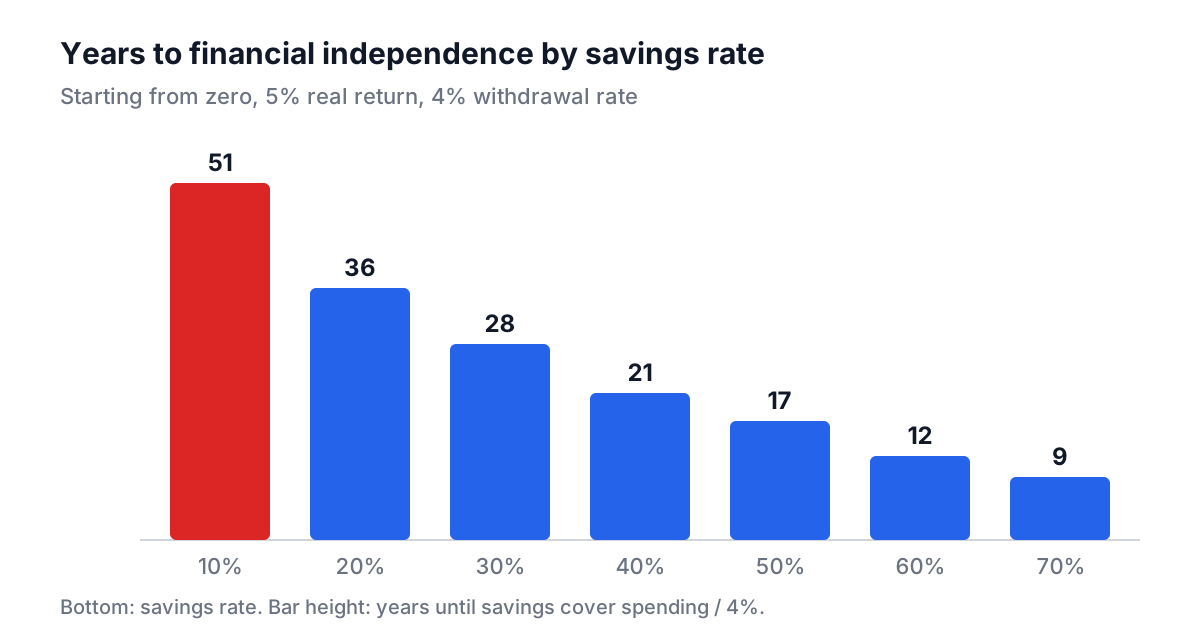
Moving from 10% to 20% saves 15 years. Moving from 50% to 60% saves five. Returns matter too, but less than people expect: in the planner's default scenario, one extra point of return brings FI forward by about two years, while saving 500 more a month or cutting spending by 10% does as much or more.
A worked example with the FIRE Planner
Open the FIRE Planner with its defaults: age 30, target age 50, 75,000 already invested (50,000 net worth plus 25,000 investments), 8,000 monthly income, 5,000 monthly expenses, 7% return, 2.5% inflation, 4% withdrawal rate.
- Savings rate: 3,000 / 8,000 = 37.5%
- FIRE number at 50: 2,457,925
- Projected portfolio at 50: 1,869,373
- Years to FI: 25, so age 55
- Status: Need Plan, because the portfolio falls about 590,000 short at the target age
The Scenarios tab re-runs the same model with different assumptions. A return 2 points higher and inflation half a point lower brings FI to 49. A return 2 points lower and inflation 1 point higher pushes it to 78, which is the scenario worth staring at. The What-If panel shows that saving 500 more a month gives age 53 and spending 10% less gives age 51, because lower spending both increases savings and lowers the target.
What a FIRE number does not cover
The 25x number is a useful target, not a guarantee. These are the gaps that catch people:
- Sequence of returns. The planner assumes the same return every year. In reality a crash in the first five years of retirement does far more harm than the same crash at 75, because you are selling shares at low prices to fund spending. Flexible spending in bad years is the most reliable defence.
- Healthcare before pension age. Early retirees in the US often pay for health insurance for a decade or more before Medicare. Put it in your expenses.
- Taxes on withdrawals. Money in pre-tax accounts is taxed when you take it out. Add expected tax to your spending, or your number will be too small.
- Counting the house. Home equity does not pay for groceries unless you sell or borrow against it. Enter only invested assets as your starting balance.
- Double counting. The FIRE Planner adds Current Net Worth and Current Investment/Savings together. If your net worth already includes your investments, put the total in one field and zero in the other.
If you want a traditional retirement target with pensions and a fixed retirement age rather than an early exit, the Retirement Calculator and its companion guide to building a retirement number take that route. For the compounding maths behind every projection here, see how compound interest works.
Putting it to work
Start with a year of real spending from your bank statements, not a guess. Enter it in the Monthly Budget Planner to see where it goes, then carry the total into the FIRE Planner at 4% and again at 3.5%. Those two numbers bracket your target. Then change one thing at a time, income, spending or return, and watch which one moves your FI age most. For almost everyone, it is spending.