
Anatomy of a Privacy Policy: Every Section, and What Each One Must Say
A generated policy naming services you do not use is worse than none: it is a written claim that is false. The sections a privacy policy needs, and how to find what your app actually collects.
By Redbison Dev · · 11 min read
This is not legal advice. It is an explanation of what the sections of a privacy policy are for, written so you understand the document instead of pasting one you have not read. Privacy law varies by country, by state and by what your app does, and the consequences of getting it wrong are regulatory rather than cosmetic. Have a qualified lawyer review your policy before you rely on it, particularly if you handle health data, financial data, biometrics or anything belonging to children.
With that said: the most common mistake in a vibe-coded app is not a missing privacy policy. It is a generated one that describes an app you did not build. A policy naming analytics you never installed, omitting the model provider you send every prompt to, and promising a retention period nothing enforces, is worse than no policy, because it is a specific written claim that is false. Regulators treat a published policy as a promise.
Before you write anything: find out what you actually collect
You cannot describe data flows you have not looked at. Spend twenty minutes building the inventory first, because every section below is just a view of it.
- Open the Network tab on your own app, click through a normal session, and list every third-party domain that receives a request. Each one is a company receiving data about your visitors.
- List your tables and their columns. Anything identifying a person is personal data, and that includes an email, an IP address, a device id and a user id that can be linked back.
- List your vendors: hosting, database, authentication, email, payments, analytics, error tracking, model providers, support chat.
- Check what your logs keep. Error trackers routinely capture full URLs, IP addresses and request bodies, which is how personal data ends up somewhere nobody listed.
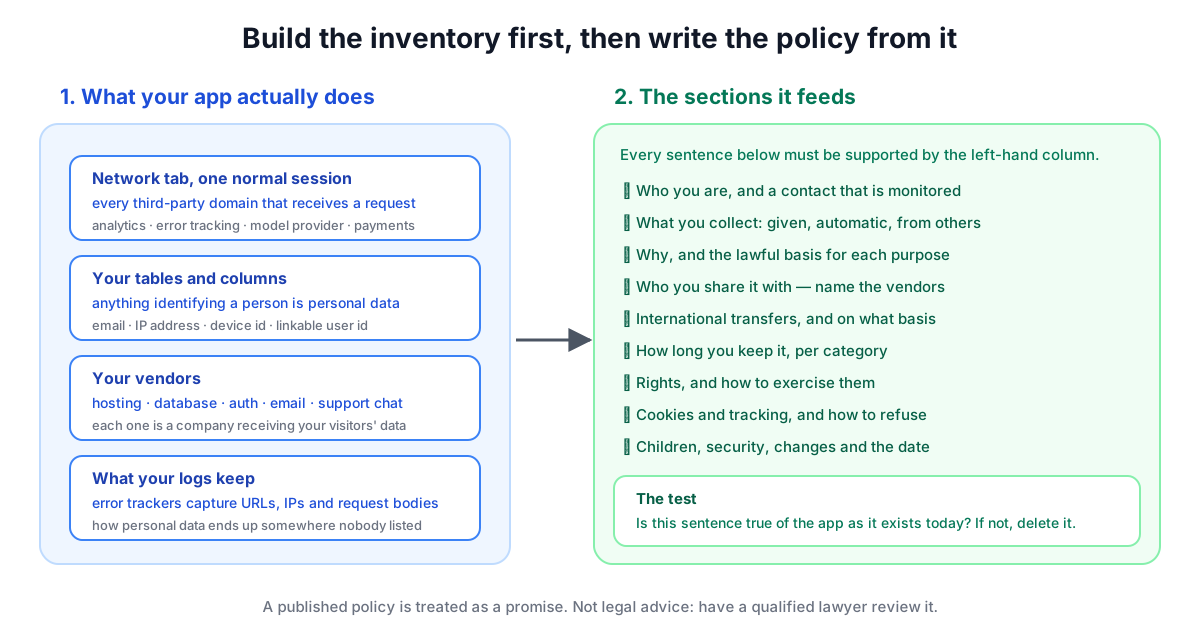
That inventory is the source of truth. If a sentence in your policy is not supported by it, delete the sentence or change the app.
Section by section
Who you are, and how to reach you
The identity of the organisation or person responsible for the data, and a working contact route for privacy questions. "Data controller" is the legal term in Europe and the UK for whoever decides why and how data is used, which is you even when a vendor does the storing. If you have an EU or UK representative or a data protection officer, this is where they are named. A contact address that nobody monitors is a problem, because rights requests arrive with deadlines attached.
What you collect
Describe categories, specifically enough that a reader recognises their own data. Useful shape:
- What they give you: account email, name, profile details, payment details, support messages, whatever they type into the product.
- What you collect automatically: IP address, device and browser, pages visited, timestamps, cookie or device identifiers.
- What you get from others: social sign-in profile data, payment processor confirmations, enrichment services.
Be honest about inference and about content. If the text a user enters is sent to a model provider, that is collection and disclosure, and it belongs here in plain words.
Why you use it, and your legal basis
For each category, say what it is used for: operating the account, processing payments, security and fraud prevention, support, product analytics, marketing. Under the GDPR and UK GDPR you also need a lawful basis for each purpose, most often performance of a contract, legitimate interests, consent or legal obligation. Where the basis is consent, the user must be able to withdraw it as easily as they gave it, which has design consequences. Where it is legitimate interests, you should be able to explain the balancing you did.
Vague purposes defeat the point. "To improve our services" covers nothing and reassures nobody.
Who you share it with
The section readers care about most and generated policies get most wrong. List the categories of recipient and, better, name the actual vendors: your hosting provider, database, email sender, payment processor, analytics, error tracking, model providers. These are usually processors, acting on your instructions, and a published subprocessor list is now ordinary practice for anything business-facing.
Also cover the non-vendor cases: disclosure required by law, and transfer of data if the business is sold.
International transfers
If data leaves the UK or the European Economic Area, say so and say on what basis, such as an adequacy decision or standard contractual clauses. For a small app using American hosting this is not optional detail; it is the ordinary situation, and your vendors publish the mechanism they rely on.
How long you keep it
Give retention periods or the criteria you use to set them, per category where they differ. Account data for the life of the account plus a defined window, logs for a set number of days, backups on their own cycle. The honest version of this section is the one you can actually perform. Before publishing a number, make sure something deletes the data when it expires.
Rights, and how to exercise them
Depending on where your users live, they may have rights to access, correct, delete, port, object or restrict, plus rights to opt out of sale or sharing and of targeted advertising. Say how to make a request, how you verify identity and how long you take. Europe and the UK work to about a month; several US state laws run to forty-five days with an extension.
Then do the operational part: work out how you would delete one person's data, and run it once on a test account. Requests arrive with deadlines, and improvising under time pressure is how related rows in other tables get missed.
Cookies and tracking
What you set, what each is for, how long it lasts and how to refuse. Analytics and advertising cookies generally need consent before they are set in the EU and UK, which a banner placed after the scripts have already run does not achieve. If you sell or share personal information as US state laws define those terms, the opt-out belongs here and in your interface.
Children
If your service is not for children, say so and say what you do if you discover a child's account. In the United States, services directed to children under thirteen fall under COPPA, which brings parental consent requirements that are not a paperwork detail. Several other jurisdictions set the line at a different age.
Security
Describe the measures in general terms: encryption in transit, access controls, who on your side can see what. Do not promise perfection, and do not describe controls you have not implemented. If a breach notification duty applies to you, knowing your timeline in advance is more useful than a sentence about taking security seriously.
Changes, and the date
Say how you will notify material changes, and carry a revision date that you genuinely revise. Keeping previous versions is cheap and occasionally very useful.
The test that matters
Read your finished policy next to your inventory, line by line, and ask of every sentence: is this true of the app as it exists today? Delete anything you cannot support. A short, accurate policy beats a long, generic one in every way that counts, including with a regulator.
Then put it somewhere findable, linked from the footer and from sign-up, and keep it consistent with your terms of service, which is a different document doing a different job. If you are about to launch, What to Check Before Launching an App You Vibe-Coded covers the surrounding work.
Frequently asked questions
Do I need a privacy policy if my app is free and small?
Almost certainly yes. The obligation follows from processing personal data, not from charging money or reaching a size threshold, and an email address alone is personal data. Several laws also require one before you may lawfully collect anything at all.
Is a generated privacy policy good enough?
Only as a starting skeleton you then correct. Generators produce clauses about services you may not use and omit the ones you do, and a published policy is treated as a promise about your actual practices, so an inaccurate one creates the exposure it was meant to prevent.
Do I have to name every vendor that receives data?
Naming them is not universally mandatory, but categories of recipient must be disclosed, and naming actual vendors is now ordinary practice and far easier to keep honest. A published subprocessor list is also what business customers ask for first.
What is a lawful basis, and do I need one?
Under the GDPR and UK GDPR, every purpose needs a justification such as contract, legitimate interests, consent or legal obligation. Consent must be as easy to withdraw as to give, which affects how you build the interface, not only what the document says.
How long should I keep user data?
Long enough for the purpose you collected it for and no longer, with periods stated per category. The number matters less than whether something actually enforces it, so pick a retention you can perform and verify that deletion really runs.
Sources and further reading
- Art. 13 GDPR: Information to be provided where personal data are collected from the data subject, GDPR text. The required contents of a privacy notice.
- Art. 14 GDPR: Information to be provided where personal data have not been obtained from the data subject, GDPR text.
- Right to be informed, Information Commissioner's Office. What a UK privacy notice must cover.
- Right of access, Information Commissioner's Office. Responding to requests and timescales.
- California Consumer Privacy Act (CCPA), California Attorney General. Disclosure duties and opt-out rights.
- Complying with COPPA: Frequently Asked Questions, Federal Trade Commission. Services directed to children under thirteen.
- Privacy and Security, Federal Trade Commission. Enforcement against claims a business does not keep.