
Anatomy of Terms of Service: The Clauses That Actually Do Something
Most of a terms document is boilerplate and a few clauses carry the weight. What each clause is for, which ones courts have thrown out, and how people agree to them in a way that holds.
By Redbison Dev · · 11 min read
This is not legal advice. It explains what each clause in a terms of service document is for, so that you can read one rather than paste one. Contract law, consumer protection rules and what courts will enforce all vary by country and by state, and several clauses below are routinely struck out when they are drafted badly or hidden well. Have a qualified lawyer review your terms before you rely on them, especially once you take payments, host user content or sell outside your own country.
A privacy policy is a disclosure: it describes what you do with data, and law dictates most of its contents. Terms of service are a contract: they set out the deal between you and the user. That difference drives everything else, including the fact that a contract only binds someone who agreed to it.
Getting agreement that holds
The clauses matter less than whether anyone agreed to them. Courts in the United States draw a fairly consistent line:
- Clickwrap, where the user ticks a box or clicks a button directly beside a clear statement that they accept terms, with the terms linked. This is routinely enforced.
- Browsewrap, where a link sits in the footer and continued use is deemed acceptance. This is frequently not enforced, because the user was never given reasonable notice.
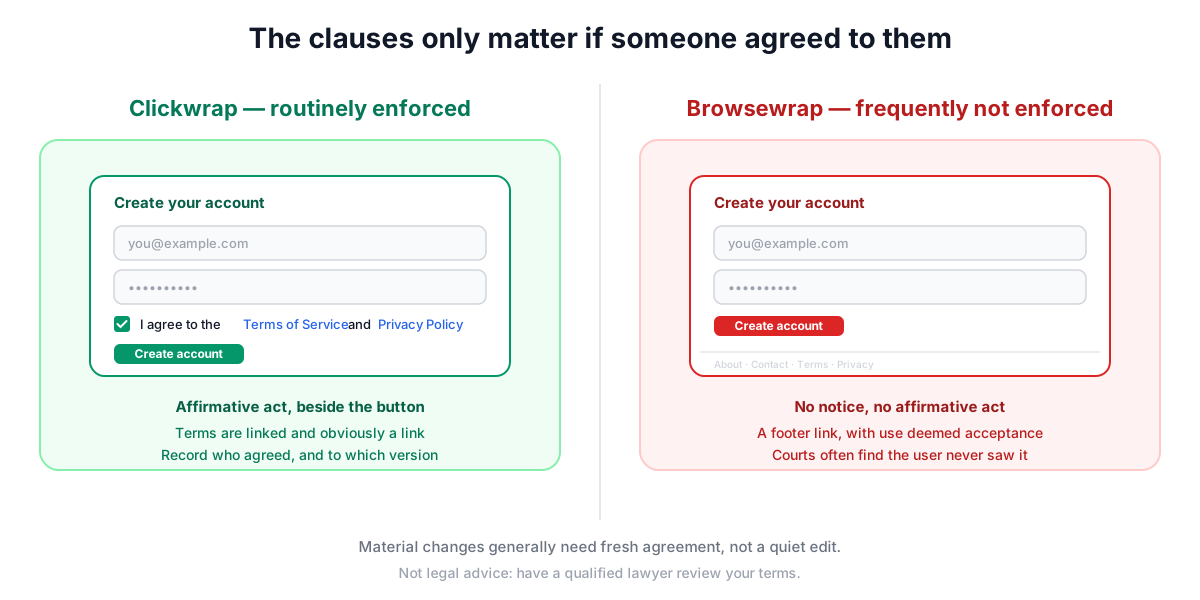
The practical version: put the acceptance next to the sign-up button, make the link obviously a link, and keep a record of who agreed and to which version. If you later change the terms materially, you generally need fresh agreement rather than a quiet edit, which is why the changes clause below matters.
The clauses, and what each is doing
Acceptance and eligibility
Who may use the service, and the age floor. Minors generally cannot be bound by contract in the ordinary way, and an under-13 user pulls you into COPPA in the United States, so this clause has consequences beyond formality. If you exclude certain countries for sanctions or licensing reasons, say so here.
The account
Registration requirements, the user's duty to keep credentials secure, responsibility for activity under the account, and your right to suspend or close it. Pair it with the termination clause so the two agree about notice.
Acceptable use
What the user may not do: break the law, infringe rights, harass, scrape, reverse engineer, resell, overload the service, upload malware. Keep it specific enough to act on. This clause is what you point at when you remove content or close an account, so a vague one leaves you arguing.
User content and the licence you take
If users upload anything, two things need saying. First, they keep ownership. Second, you need a licence to do the obvious technical work: store it, copy it between servers, back it up, resize it, and display it to whoever they shared it with.
Write that licence no broader than the job. Sweeping grants naming any purpose and any medium forever are the single most reliable way to make your users angry, and have caused public reversals at large companies. If you want to use customer content to train models, that is a separate decision requiring its own clear disclosure, not something to slip inside a storage licence.
Add a takedown route. In the United States, a registered DMCA agent and a published process gives a safe harbour for infringing material posted by users.
Your intellectual property
Your code, brand and content remain yours, and the user gets a limited, revocable right to use the service. Short and uncontroversial.
Payments, renewals and refunds
Where consumer law bites hardest. Cover price, billing cycle, taxes, what happens on failed payment, and your refund position.
If anything renews automatically, the rules are strict and getting stricter: clear disclosure of the renewal terms before purchase, consent to the recurring charge, and a cancellation route that is as easy as signing up. US federal law on negative option marketing and a growing number of state statutes all point the same way, and so do EU and UK consumer rules. A subscription that takes two clicks to start and an email to a support address to stop is the pattern regulators are actively pursuing.
Consumers in the EU and UK also have statutory cancellation rights for distance contracts, with specific rules for digital content delivered immediately. You cannot write those away.
Disclaimers of warranty
The "as is, without warranties" clause. It must usually be conspicuous to be effective, which is why it is traditionally in capitals. Note that consumer guarantees in many countries cannot be excluded at all, so this clause limits what it can and should say so rather than pretending otherwise.
Limitation of liability
The clause that actually protects you: a cap on what you can owe, often the amount paid in the preceding period, and an exclusion of indirect and consequential losses. Two caveats worth knowing. Liability for death, personal injury caused by negligence, and fraud cannot be excluded in the UK and much of Europe. And in consumer contracts, a limitation that is unreasonable can be struck down entirely, leaving you with none of it rather than a smaller version.
Indemnity
The user agrees to cover your costs if their use of the service causes a third party to come after you. Standard for anything hosting user content. Mutual indemnities appear in business contracts; one-way indemnities against consumers are viewed less favourably.
Termination
How either side ends it, what notice applies, and what happens to data afterwards: an export window and a deletion timeline. Say which clauses survive termination, usually liability, indemnity and dispute resolution.
Governing law and disputes
Which country's or state's law applies and where disputes are heard. Be aware that a consumer generally keeps the protection of their home jurisdiction regardless of what your clause says, so this is less decisive for a consumer product than it looks.
Arbitration clauses and class action waivers are common in United States terms and are enforced there far more readily than in Europe, where they are heavily restricted against consumers. This is a clause to take advice on rather than copy.
Changes to the terms
How you will notify changes and when they take effect. "We may change these at any time, continued use is acceptance" is weak for material changes. Notify, date the version, and for significant changes ask for agreement again.
Contact, and the boring essentials
A real contact address, your legal entity name, and in many jurisdictions company registration details and a VAT number. Keep the terms consistent with your privacy policy: the two documents contradicting each other is a bad look and an easy thing to check before launch.
What to do with this
Draft from your actual product: what you charge, what users upload, what you promise. Then have a lawyer review it, because the clauses that matter most, liability and disputes and anything consumer-facing, are exactly the ones most often unenforceable when they are copied from a template built for a different jurisdiction and a different business.
Frequently asked questions
Do I need terms of service for a free app?
You still benefit from them. Terms set the acceptable use rules you rely on to remove content or close accounts, disclaim warranties and limit liability. Being free removes the payment clauses but none of the reasons the rest of the document exists.
What is the difference between terms of service and a privacy policy?
Terms are a contract setting out the deal between you and the user, and they bind only someone who agreed. A privacy policy is a disclosure describing how personal data is handled, with most of its required contents dictated by law rather than negotiated.
Is a footer link to my terms enough to bind users?
Often not. Agreement placed beside the sign-up button with a clear statement and a visible link is routinely enforced, while a footer link relying on continued use is frequently rejected because the user never received reasonable notice.
Can I take a broad licence to user content?
You can ask, but keep it to what running the service requires, such as storing, copying, backing up and displaying. Sweeping perpetual grants cause public backlash, and using customer content to train models is a separate decision needing its own clear disclosure.
Can I limit my liability to nothing at all?
No. Liability for death or personal injury caused by negligence and for fraud cannot be excluded in the UK and much of Europe, and an unreasonable limitation in a consumer contract can be struck out entirely, leaving you worse off than a moderate cap.
Sources and further reading
- 15 U.S. Code § 8403: Negative option marketing on the Internet, Cornell Legal Information Institute. Disclosure and consent for recurring charges.
- Complying with COPPA: Frequently Asked Questions, Federal Trade Commission. Age limits and parental consent.
- Unfair contract terms, Competition and Markets Authority. Terms considered unfair against UK consumers.
- Consumer rights on digital content and distance selling, European Commission. Statutory cancellation and consumer guarantee rules.
- Privacy and Security, Federal Trade Commission. Enforcement against promises a business does not keep.