
Asphalt Tonnage: From Square Feet and Inches to Tons of Hot Mix
Why asphalt is estimated at 145 lb/ft³ and 110 lb per square yard per inch, loose versus compacted thickness, tons versus tonnes, waste, trucks and when you need a pavement design.
· 9 min read

Asphalt is designed by the square foot and the inch but bought by the ton. The bridge between the two is density, and getting it wrong is the most common reason a paving crew runs out of material halfway along a driveway or sends a truck back half full. This post explains where the usual estimating numbers come from, how compaction changes the picture, and what an asphalt estimate does not tell you. The examples can be reproduced in the Asphalt Calculator.
Area times thickness times density
The calculation has three steps:
volume (ft³) = area (ft²) x compacted thickness (in) / 12
mass (lb)    = volume x density (lb/ft³)
tons         = mass / 2,000
For a single-car driveway 50 ft long and 12 ft wide, paved 3 in thick:
- Area = 50 x 12 = 600 ft².
- Volume = 600 x 3 / 12 = 150 ft³.
- Mass = 150 x 145 = 21,750 lb.
- Tons = 21,750 / 2,000 = 10.9 short tons, or 11.4 with 5% for waste.
In metric the same steps use metres and kg/m³: a 200 m² car park patch at 50 mm and 2,320 kg/m³ is 10 m³ and 23.2 tonnes, 24.4 with 5% added.
Shapes other than rectangles only change the area: pi x d² / 4 for a circular turnaround, base x height / 2 for a triangle, the mean of the parallel sides times the distance between them for a flared apron. Complicated outlines are easiest to split into these pieces and add.
Where 145 lb/ft³ and 110 lb/yd²/in come from
Hot mix asphalt is about 95% aggregate by mass, held together by 4 to 7% asphalt binder. Its density in place depends on the specific gravity of the stone and on how well the mat is compacted. Dense-graded surface and binder mixes, compacted to the usual target of around 92 to 93% of their maximum theoretical density (about 7% air voids), typically come out at 140 to 150 lb/ft³, or 2,240 to 2,400 kg/m³. Estimators use 145 lb/ft³ as a middle value. Mixes with heavy aggregates such as trap rock or slag can be denser, and open-graded friction courses and porous asphalt are much lighter.
Plants and agency specifications usually talk in spread rate rather than density. One square yard one inch thick is 9 x 1/12 = 0.75 ft³, and at 145 lb/ft³ that is 108.75 lb:
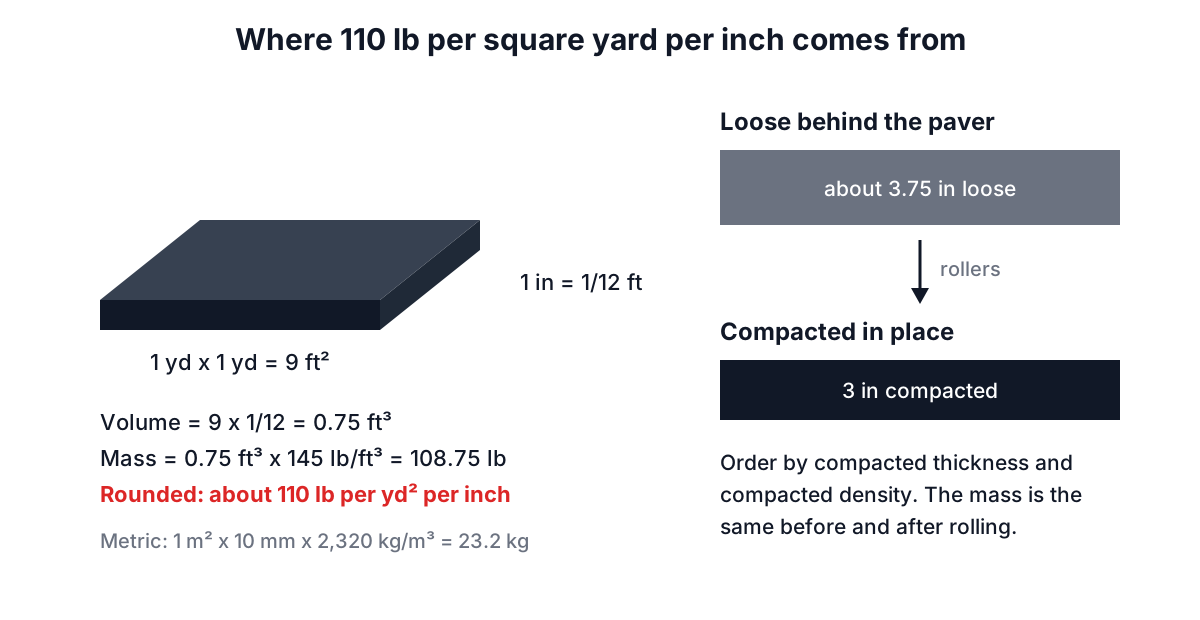
That is the origin of the field rule of "110 pounds per square yard per inch". To use it, multiply 110 by the area in square yards and the thickness in inches, then divide by 2,000. The metric equivalent is about 23 kg per square metre for each 10 mm. When a mix design reports a bulk specific gravity (Gmb) of, say, 2.35 for compacted specimens, the in-place density is about 2.35 x 62.4 = 147 lb/ft³ at the design air voids, a little less in the field.
Loose versus compacted thickness
The paver lays a loose mat that the rollers then compress. As a rule of thumb, the loose mat is about 1.2 to 1.25 times the compacted thickness, so a 3 in finished driveway is laid at roughly 3-3/4 in. The mass does not change when the mat is rolled, so estimates should always use the compacted thickness and the compacted density. Using the loose thickness with the compacted density overestimates the tonnage by 20 to 25%; using the compacted thickness with a loose density (around 110 to 120 lb/ft³ in the truck) underestimates by a similar amount.
Tons, tonnes and trucks
US plants sell by the short ton of 2,000 lb (907.2 kg). Most of the world uses the metric tonne of 1,000 kg (2,204.6 lb). A tonne is 1.102 short tons, so a price per tonne looks about 10% higher than the same cost per short ton. The calculator converts the price and the truck capacity when you switch units, so comparisons stay fair.
Truckloads matter for scheduling more than for cost. A tandem dump typically carries 10 to 15 tons and a tri-axle 15 to 20, depending on local weight limits. Hot mix has to be placed and rolled while it is still hot enough to compact, so a long gap between trucks leaves a cooled edge and a weak cold joint. For larger jobs, plan the truck cycle time so the paver never stops.
Waste and the extra the estimate does not show
The volume formula assumes a perfectly flat base at exactly the design grade. Real bases have low spots that the paver fills, edges that need extra material to form a taper, and hand work around drains and thresholds. Allow 3 to 5% on a new, well-graded base and 5 to 10% on overlays of old, rutted pavement. For overlays, a separate leveling course is often specified to fill ruts before the surface course.
Material is also not the whole cost. A residential driveway price includes excavation, compacted aggregate base, the paving crew and rollers, mobilisation, and often a plant minimum or small-load charge. A three-ton patch can cost nearly as much to deliver as a ten-ton driveway.
How thick should it be?
For cars and light trucks on a firm, well-drained subgrade, residential driveways are commonly 2 to 3 in (50 to 75 mm) of compacted surface course over 4 to 8 in of compacted crushed stone base. Heavy delivery trucks, soft clay subgrades and freeze-thaw climates call for thicker sections or a binder course under the surface. Parking lots, access roads and anything carrying regular truck traffic need a pavement design, for example by the AASHTO method or an agency's design guide, based on traffic loading and subgrade strength. An estimate of tons is not a substitute for that design.
Common mistakes
- Forgetting to convert inches to feet (dividing by 12) and getting an answer 12 times too large.
- Mixing up short tons and tonnes on a quote.
- Using the loose thickness, or a density from a different mix.
- Ignoring base preparation. Asphalt does not fix a soft base; it follows it.
The same area and thickness logic applies to the stone base under the asphalt, which the Gravel and Mulch Calculator converts to tons. If the site needs regrading first, work out the earthwork with the Cut and Fill Calculator and read Cut and Fill Earthwork Volumes. For a concrete driveway instead of asphalt, see the Concrete Calculator.