
Body Surface Area Formulas: Mosteller, Du Bois and Why They Differ
Where the BSA equations came from, how mg/m² dosing and cardiac index use them, when the formulas disagree, and why some drugs are no longer dosed by surface area.
· 9 min read

Body surface area (BSA) is one of those numbers that quietly decides a lot in medicine. It sets the dose of most chemotherapy drugs, turns cardiac output into cardiac index, and is the reason kidney function is reported "per 1.73 m²". Yet nobody measures it. Every BSA you see on a chart comes from an equation that takes height and weight, and there are at least a dozen of them. This guide explains where the main formulas came from, how they are used, when they disagree, and how to work one out by hand. The Body Surface Area Calculator runs nine of them side by side.
What BSA is and why medicine uses it
BSA is the area of your skin in square metres. A typical adult man is around 2.0 m² and a typical woman around 1.8 m²; a newborn is about 0.2 m². US survey data from 2011 to 2014 put the adult averages at 2.06 m² for men and 1.83 m² for women.
Medicine adopted BSA in the early twentieth century because many physiological rates, such as resting heat production, scaled better with surface area than with weight. A large person has more surface to lose heat through, so needs a faster metabolism to keep warm. That idea did not hold up perfectly, but BSA stuck as a size measure that sits between height and weight.
Three uses dominate today:
- Drug dosing. Cytotoxic drugs have a narrow gap between an effective and a toxic dose. In the 1950s, researchers found that doses translated between mice, dogs and humans better by surface area than by weight, so cancer drugs came to be prescribed in mg/m².
- Indexing heart measurements. Cardiac output divided by BSA gives cardiac index; left ventricular mass and valve areas are also often indexed.
- Normalising kidney function. Estimated GFR is reported per 1.73 m², an average adult BSA from a 1928 study, so that results from people of different sizes can be compared.
The equations, oldest to newest
Every formula has the same structure: a constant times weight to one power times height to another. They differ because each was fitted to a different set of people measured in a different way.
| Formula | Year | Equation (W in kg, H in cm, BSA in m²) | Based on |
|---|---|---|---|
| Du Bois and Du Bois | 1916 | 0.007184 × W^0.425 × H^0.725 | 9 people covered in paper moulds |
| Takahira | 1925 | 0.007241 × W^0.425 × H^0.725 | Japanese adults |
| Boyd | 1935 | 0.0003207 × H^0.3 × Wg^(0.7285 − 0.0188 log10 Wg), Wg in grams | Direct measurements across ages |
| Fujimoto | 1968 | 0.008883 × W^0.444 × H^0.663 | Japanese adults |
| Gehan and George | 1970 | 0.0235 × W^0.51456 × H^0.42246 | 401 measurements from Boyd's data |
| Haycock | 1978 | 0.024265 × W^0.5378 × H^0.3964 | Newborns to adults |
| Mosteller | 1987 | √(H × W / 3600) | Simplification of Gehan and George |
| Shuter and Aslani | 2000 | 0.00949 × W^0.441 × H^0.655 | Refit of the Du Bois form |
| Schlich | 2010 | Women 0.000975482 × W^0.46 × H^1.08; men 0.000579479 × W^0.38 × H^1.24 | Separate equations by sex |
The Du Bois equation is a remarkable survivor. Eugene and Delafield Du Bois fitted it to just nine people, and it remained the standard for seventy years. Boyd's monograph in 1935 pooled several hundred direct measurements and proposed an equation in which the weight exponent falls slightly as weight rises. In 1970 Edmund Gehan and Stephen George refitted 401 of those measurements with a standard power law. Haycock, Schwartz and Wisotsky published their version in the Journal of Pediatrics in 1978, deliberately including infants and children, which is why many paediatric units still use it.
Then in 1987 Raymond Mosteller wrote a short letter to the New England Journal of Medicine pointing out that Gehan and George's exponents are both close to 0.5. Round them and the formula becomes the square root of height times weight divided by 3600. That is easy to do on any calculator, and it gives answers within about 2% of the full equation. Mosteller is now the most widely used formula for drug dosing.
Working Mosteller by hand
Take a person 170 cm tall weighing 70 kg.
- Multiply height by weight: 170 × 70 = 11,900.
- Divide by 3600: 11,900 / 3600 = 3.306.
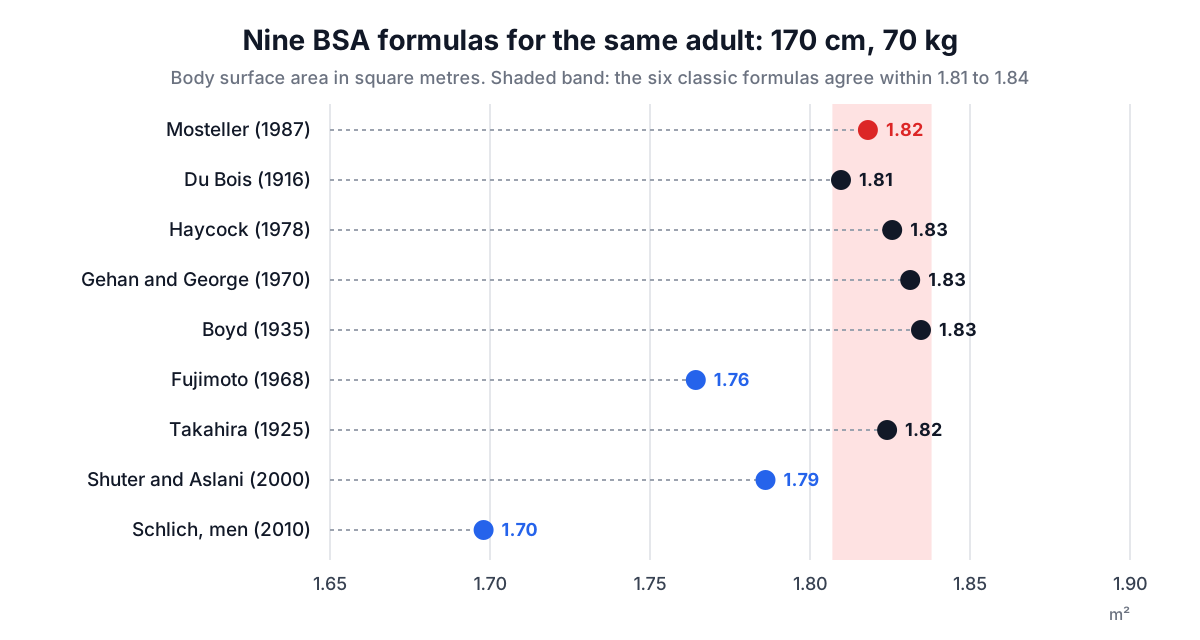
- Take the square root: √3.306 = 1.818 m².
In US units the same formula is √(height in inches × weight in pounds / 3131). For 67 in and 154 lb: 67 × 154 = 10,318; divided by 3131 is 3.295; the square root is 1.815 m². Mosteller's letter gives 3131 for inches and pounds; a strict unit conversion gives about 3125, a difference of under 0.1% in the result.
Du Bois is harder by hand because of the fractional powers. With logarithms: log10(70) × 0.425 = 0.784, log10(170) × 0.725 = 1.617, log10(0.007184) = −2.144. The sum is 0.257, and 10^0.257 = 1.81 m².
How much do the formulas disagree?
For an average adult, very little. At 170 cm and 70 kg, Mosteller, Du Bois, Haycock, Gehan and George, Boyd and Takahira all fall between 1.81 and 1.84 m². Fujimoto and Shuter and Aslani run a little lower, and Schlich's male equation gives 1.70 m², the outlier.
The spread grows at the edges:
- Children. For a child of 110 cm and 18 kg, Mosteller, Du Bois and Haycock all give about 0.74 m². Schlich's adult equation gives 0.59 m², 20% lower. Adult-only formulas should not be used for children.
- High body weight. At 190 cm and 120 kg, Mosteller gives 2.52 m², Du Bois 2.47 m² and Haycock 2.55 m². Du Bois has a lower weight exponent (0.425), so it grows more slowly with weight and reads lowest of those three in obesity.
- Very short or tall adults. Differences in height exponents (from 0.30 in Boyd to 1.24 in Schlich's male equation) mean the formulas cross over at different heights.
A difference of 3% sounds small, but on a drug dosed at 1,000 mg/m² it is 30 mg. That is why a hospital picks one formula and sticks to it rather than switching between them.
From BSA to a dose
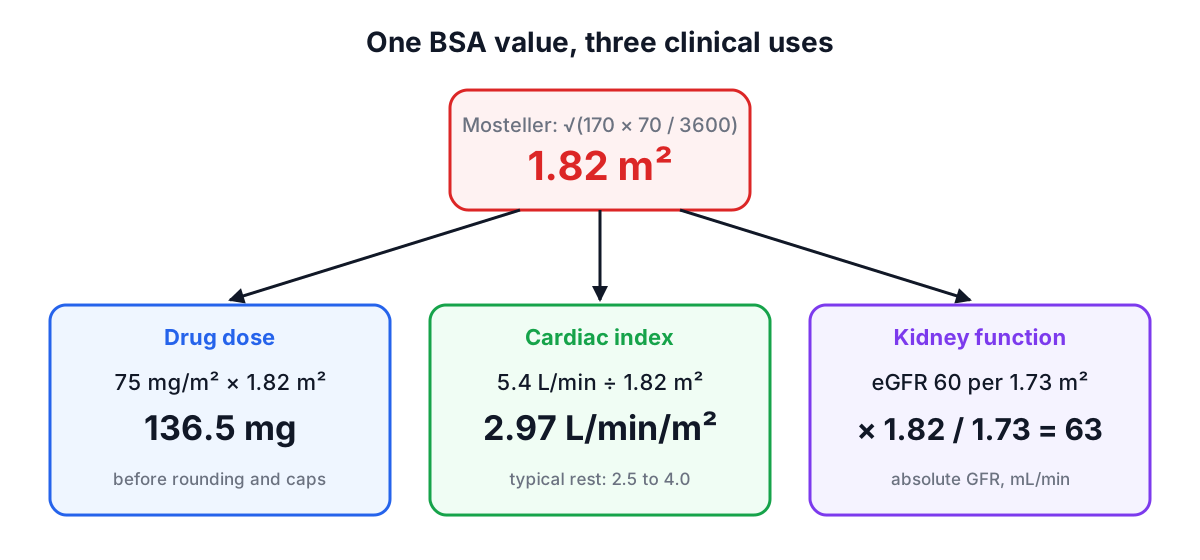
The arithmetic is a multiplication: dose = mg/m² × BSA. A regimen of 75 mg/m² for a person of 1.82 m² is 136.5 mg. Real protocols then add layers the calculator does not:
- Rounding. Many pharmacies round BSA to two decimals and doses to a practical vial size or to within 5%.
- Capping. Some older protocols capped BSA at 2.0 m² to protect larger patients. The American Society of Clinical Oncology guideline (2012, updated 2021) recommends full weight-based doses for adults with obesity in most cases, because capping led to under-treatment without reducing toxicity.
- Organ function. Kidney and liver function, previous toxicity and drug interactions all adjust the final dose.
- Different rules for some drugs. Carboplatin is dosed with the Calvert formula, target AUC × (GFR + 25), not BSA. Many newer targeted drugs and immunotherapies use flat doses or mg/kg.
The Body Surface Area Calculator has an optional dose field so you can check the multiplication on a plan, but the prescribing decision belongs to the treating team.
Cardiac index and other indexed values
Cardiac output, the litres of blood the heart pumps per minute, depends on body size. Dividing by BSA gives cardiac index, which lets clinicians compare a small and a large patient on one scale. A resting adult cardiac index of roughly 2.5 to 4.0 L/min/m² is typical; values below about 2.2 in a sick patient suggest the heart is not keeping up.
Echocardiography reports left ventricular mass, atrial volumes and aortic valve area indexed to BSA as well, and the thresholds in imaging guidelines assume a particular formula, usually Du Bois or Mosteller. If you compare an indexed value with a published cut-off, check which one the lab used.
The 1.73 m² puzzle
Kidney function tests report eGFR in mL/min/1.73 m². The 1.73 comes from a 1928 study by McIntosh, Möller and Van Slyke, whose reference adults averaged that surface area. Modern adults are larger, but the convention stays so that results remain comparable across decades of research. When a drug is dosed by kidney function, pharmacists sometimes "de-index" eGFR back to the patient's actual BSA: absolute GFR = eGFR × BSA / 1.73. For a person of 2.2 m² with an eGFR of 60, that is 76 mL/min, a meaningful difference for some drugs.
Practical tips
- Measure, do not guess. A self-reported height is often 2 to 3 cm too tall and weight a few kilograms too light. Weigh on the day of treatment where it matters.
- Know which formula your numbers came from. Lab reports, echo machines and pharmacy systems may each use a different one.
- For children, use Haycock or Mosteller. Several adult formulas read far too low below about 150 cm.
- Do not confuse BSA with burn percentages. Burn size is a percentage of the total surface estimated with the rule of nines or a Lund and Browder chart.
Summary
BSA is an estimate built on equations from 1916 onward, and for most adults they agree within a few percent. Mosteller's square-root shortcut is the practical standard; Du Bois remains common in physiology and imaging; Haycock suits children. Use one formula consistently, know what it is used for, and leave dose decisions to the people prescribing. To compare the formulas for your own height and weight, open the Body Surface Area Calculator; for weight-for-height checks see the BMI Calculator and our guide to what BMI measures.
Sources: Du Bois D, Du Bois EF, Arch Intern Med 1916; Gehan EA, George SL, Cancer Chemother Rep 1970; Haycock GB et al., J Pediatr 1978; Mosteller RD, N Engl J Med 1987;317:1098; Griggs JJ et al., J Clin Oncol 2012 (ASCO guideline on dosing in obesity); Calvert AH et al., J Clin Oncol 1989.
Related searches
- body surface area formula
- mosteller vs du bois
- bsa for chemotherapy
- how to calculate bsa by hand
- why egfr is per 1.73 m2
- haycock formula children
- cardiac index calculation
- bsa dose capping obesity