
Bolt Tightening Torque and Preload: T = KFd in Practice
How proof load, stress area and nut factor set the torque for metric and inch bolts, why K matters more than the wrench, how much preload a joint needs, and when torque alone is not good enough.
· 10 min read
A torque wrench measures how hard you are twisting, but what a bolted joint needs is tension. A properly tightened bolt is a stiff spring stretched between the head and the nut, and the clamp force it exerts, the preload, is what keeps a flange from leaking, a bracket from sliding and the bolt itself from fatigue. Torque is just the most convenient way to get there. This post explains how the short-form torque equation links the two, where each input comes from in ISO 898-1, SAE J429 and ASME B1.1, and why the least glamorous number, the nut factor, decides more than anything else. Every example can be reproduced in the Bolt Torque Calculator.
Where the torque goes
When you tighten a nut, the torque you apply is spent in three places. A small part, roughly 10%, actually stretches the bolt by driving the nut up the thread ramp. Most of it, typically 80 to 90%, is lost to friction: about half under the nut or head face and the rest in the threads. The long form of the torque equation (in VDI 2230, for example) adds those three terms using the thread pitch, the friction coefficients and the effective bearing diameter of the nut face.
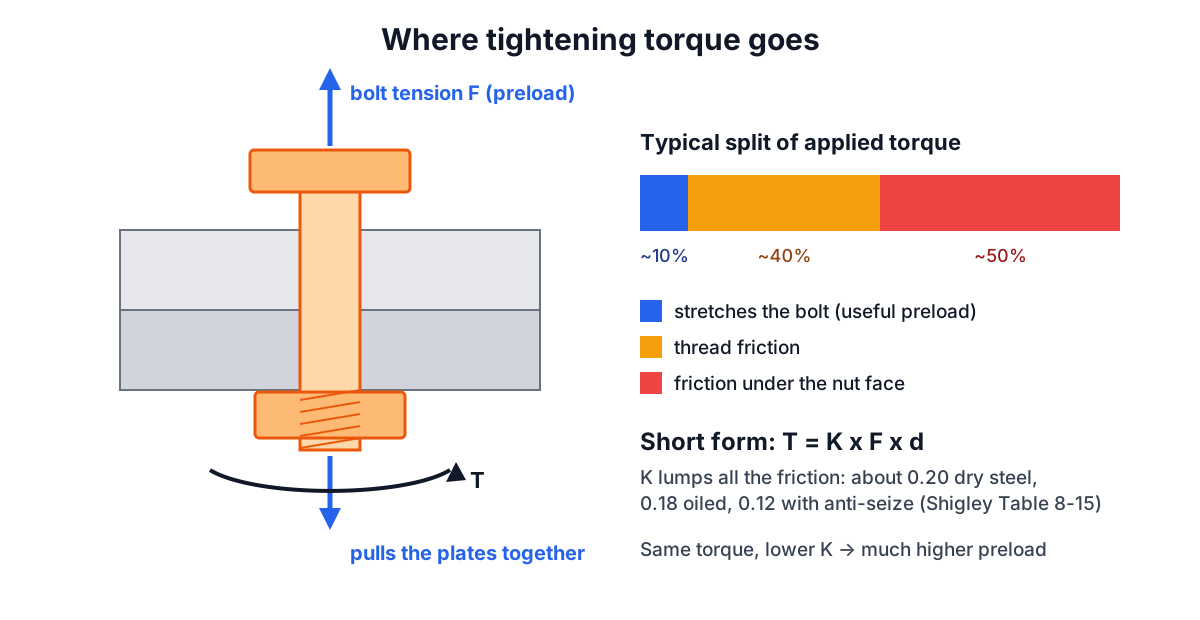
For everyday work those terms are lumped into one empirical number, the nut factor K:
T = K x F x d
T is the tightening torque, F the preload and d the nominal diameter. With F in newtons and d in metres, T comes out in N·m; with F in pounds and d in inches, in lb·in. K is dimensionless and, for steel, usually between about 0.1 and 0.3. It is not a friction coefficient, though it moves with friction almost one for one.
Stress area, proof load and the target preload
How much preload to aim for depends on the bolt's strength, which depends on its grade and its effective cross-section.
Tensile stress area. A threaded rod breaks at an area a little larger than the root area, because the thread helix supports itself. The standards define a tensile stress area from the mean of the pitch and minor diameters:
ISO metric (ISO 898-1):     As = π/4 x (d - 0.9382 P)²      mm², d and pitch P in mm
Unified inch (ASME B1.1):   At = 0.7854 x (D - 0.9743 / n)²  in², n threads per inch
These reproduce the tabulated values: M10 x 1.5 gives 58.0 mm², M20 x 2.5 gives 245 mm², 1/2-13 UNC gives 0.1419 in² and 1/2-20 UNF gives 0.1599 in². Fine threads have more area at the same diameter, which is one reason they are used where strength per size matters.
Proof load is the tensile force the bolt must carry in the standard test without measurable permanent set. It is the stress area times the proof stress:
| Grade | Standard | Proof stress | Min. yield | Min. tensile |
|---|---|---|---|---|
| 8.8, d ≤ 16 mm | ISO 898-1 | 580 MPa | 640 MPa | 800 MPa |
| 8.8, d > 16 mm | ISO 898-1 | 600 MPa | 660 MPa | 830 MPa |
| 10.9 | ISO 898-1 | 830 MPa | 940 MPa | 1,040 MPa |
| 12.9 | ISO 898-1 | 970 MPa | 1,100 MPa | 1,220 MPa |
| Grade 5, 1/4 to 1 in | SAE J429 | 85 ksi | 92 ksi | 120 ksi |
| Grade 5, over 1 to 1-1/2 in | SAE J429 | 74 ksi | 81 ksi | 105 ksi |
| Grade 8, 1/4 to 1-1/2 in | SAE J429 | 120 ksi | 130 ksi | 150 ksi |
The class number on a metric bolt encodes two of these: 8.8 means a nominal tensile strength of 800 MPa and a yield-to-tensile ratio of 0.8.
Target preload. Shigley's Mechanical Engineering Design recommends 75% of proof load for joints that will be taken apart and reused, and 90% for permanent connections. High preload is good: it keeps the joint from separating under external load, it means the bolt sees only a fraction of any fluctuating load (which is what protects it from fatigue), and it resists self-loosening under vibration. The limit is the bolt's own strength plus the torsional stress added by thread friction during tightening.
A worked example: M10 class 8.8
Take an M10 x 1.5 class 8.8 bolt, dry, zinc-plated, tightened to 75% of proof load:
As       = π/4 x (10 - 0.9382 x 1.5)² = 58.0 mm²
proof    = 58.0 x 580 = 33.6 kN
preload  = 0.75 x 33.6 = 25.2 kN
torque   = 0.20 x 25,226 N x 0.010 m = 50.5 N·m  (37.2 lb·ft)
The bolt stress at that preload is 435 MPa, 68% of minimum yield. The inch equivalent most people know is a 1/2-13 Grade 5 bolt: 0.1419 in² x 85 ksi = 12,061 lbf proof, 9,046 lbf preload, and 0.2 x 9,046 x 0.5 = 904.6 lb·in, or 75.4 lb·ft, which is the number printed in most Grade 5 torque charts for dry threads. The calculator's chart produces the whole series at once for whatever grade, K and preload percentage you choose.
The nut factor is the real variable
Here are the typical values that Shigley (Table 8-15, after Bowman's Fastener Facts) gives:
| Condition | K |
|---|---|
| Non-plated, black finish | 0.30 |
| Zinc-plated | 0.20 |
| Lubricated | 0.18 |
| Cadmium-plated | 0.16 |
| With anti-seize compound | 0.12 |
| Condition unknown | 0.20 |
Because preload is T / (K x d), the same wrench setting gives very different clamp forces as K changes. Tighten the M10 above to 50 N·m with dry threads (K = 0.20) and you get 25.0 kN, 74% of proof. Apply the same 50 N·m to a bolt coated in anti-seize (K = 0.12) and the preload is 41.7 kN, 124% of proof: the bolt has yielded. This is the most common way bolts are broken during assembly, and it happens when a dry-thread torque from a manual is used on oiled or anti-seized threads. Thread-locking liquids also lubricate while wet. The rule is simple: the torque value must have been written for the lubrication you actually use.
Even with the condition controlled, K scatters. Surface finish, plating thickness, thread tolerance, washer hardness and tightening speed all move it, and the resulting preload for a given torque commonly varies by 25% or more either way. Precise work uses measured K for the actual parts, or avoids torque control altogether.
When torque is not enough
For joints where preload accuracy matters, such as cylinder heads, connecting rods, structural steel connections, pressure-vessel flanges and wind turbine towers, other methods are used:
- Turn-of-nut. Snug the joint, then rotate a specified angle. Rotation controls stretch directly and ignores most friction. It is standard for structural bolting under the RCSC specification.
- Torque-angle and torque-to-yield. Common for engine bolts, which are deliberately taken into yield and must not be reused.
- Direct tension indicators. Washers with bumps that flatten at the target load.
- Hydraulic tensioners and ultrasonic measurement. Stretch the bolt directly, or measure its elongation, for large or critical bolts.
A full joint analysis to VDI 2230 or a similar method also considers joint stiffness, embedding loss as surface roughness flattens, thermal effects, gasket creep and the share of external load that reaches the bolt. The Stress and Strain Calculator covers the bolt's own stretch, and the Thermal Expansion Calculator is useful where the bolt and clamped parts are different metals that heat up.
Common mistakes
- Using the stress area of the wrong thread. A 1/2-20 UNF bolt has 13% more stress area than 1/2-13 UNC; its torque is correspondingly higher at the same preload percentage.
- Mixing ISO classes with inch grades. Class 8.8 is roughly comparable to Grade 5 and 10.9 to Grade 8, but the proof stresses differ; use the grade actually marked on the head.
- Ignoring soft joints. Gaskets and painted surfaces relax after tightening. Follow the gasket maker's retorque procedure rather than raising the initial torque.
- Over-trusting a chart. A torque chart without a stated K and preload percentage is not a specification. Check the assumptions on top of any chart, including the one in the calculator.
- Reusing stretched bolts. Bolts taken past yield, by design or by accident, are longer and weaker; replace them.
For thread sizes and the drill to tap them, the Tap Drill Calculator covers the same metric and Unified series. Springs under bolts and disc springs for preload retention are covered in the Spring Calculator and its post on compression spring design.
Torque values from the calculator and this post are for preliminary design. For safety-critical joints, follow the manufacturer's or code procedure and have the joint checked by a qualified engineer.