
Box Breathing, 4-7-8 and the Physiological Sigh: How to Do Each One
Exact counts, timings and common mistakes for box breathing, 4-7-8, slow 4-6 breathing and the physiological sigh, plus how to pair them with muscle relaxation.
· 6 min read
Five minutes before a hard conversation, most people do the same unhelpful thing: they take a big gulp of air, hold it without noticing, and breathe out in a short burst. The breathing techniques in this guide all fix the same problem from different angles. They slow the rate down, and they make the exhale at least as long as the inhale. The difference between them is mostly in the counts, and the counts are where people go wrong.
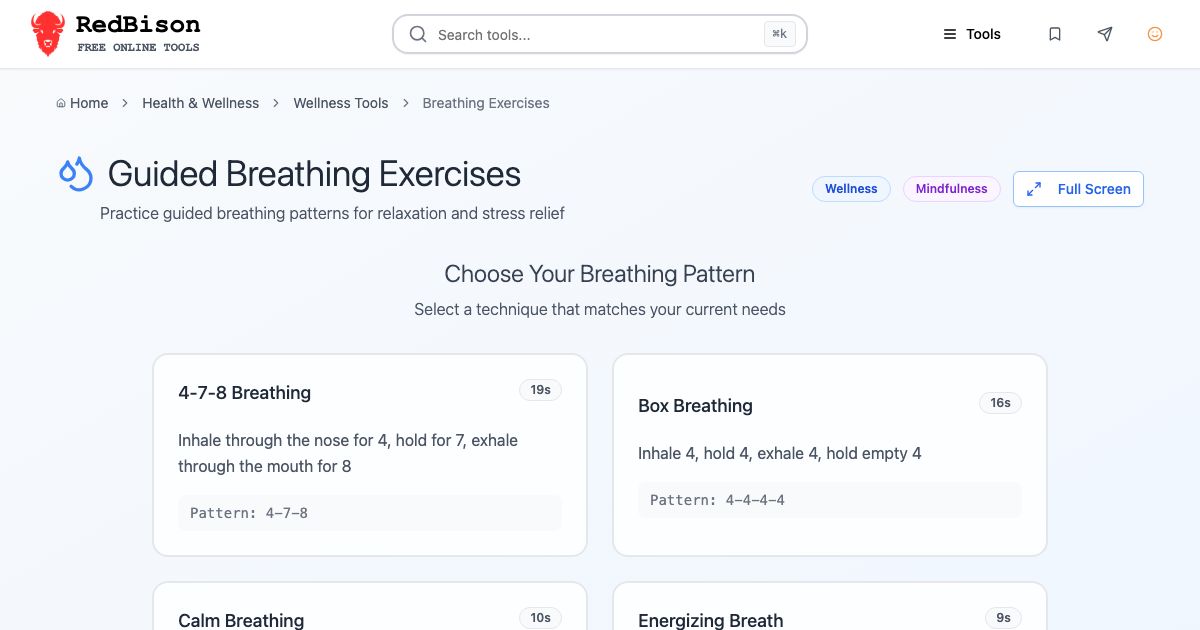
This guide gives the exact pattern for each technique, what one cycle costs in seconds, and the mistakes that make people dizzy or give up. You can follow along with the Breathing Exercise Timer, which paces each phase with a growing and shrinking circle. Nothing here is medical advice; if you have a heart or lung condition or are pregnant, check with a doctor before practising long breath holds.
Why the exhale does most of the work
Your heart rate rises a little as you breathe in and falls a little as you breathe out. That rhythm, called respiratory sinus arrhythmia, is driven by the vagus nerve, which applies a brake to the heart during the out-breath. Lengthen the exhale and you spend more of each minute with the brake on. It is a modest, short-term effect, not a cure for anything, but it is real and you can feel it: put two fingers on your pulse and breathe out slowly for six counts, and the beats near the end of the exhale come further apart.
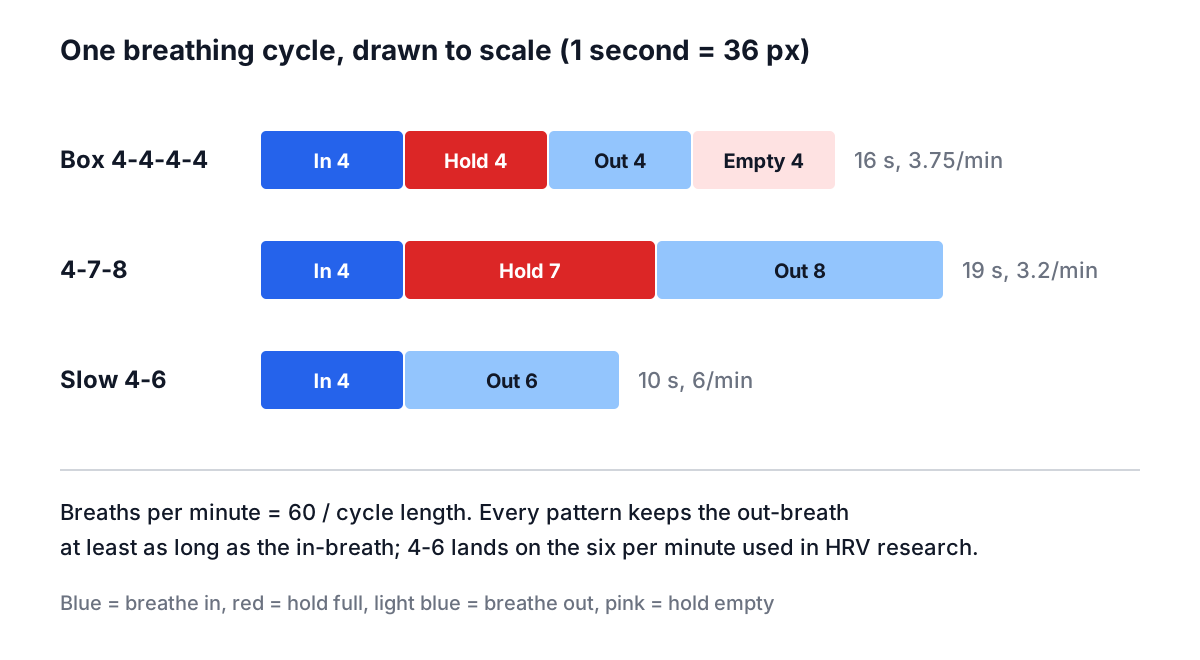
Rate matters too. Resting adults usually breathe 12 to 20 times a minute. Most calming patterns bring that down to between 3 and 6 breaths a minute, and six a minute is the rate most often used in heart rate variability research, where it tends to produce the largest swings in heart rate between in-breath and out-breath.
The four patterns, with exact counts
| Technique | In | Hold | Out | Hold empty | One cycle | Breaths per minute |
|---|---|---|---|---|---|---|
| Box breathing | 4 | 4 | 4 | 4 | 16 s | 3.75 |
| 4-7-8 (Andrew Weil) | 4 | 7 | 8 | 0 | 19 s | about 3.2 |
| Slow 4-6 | 4 | 0 | 6 | 0 | 10 s | 6 |
| Physiological sigh | 2 + 1 (double) | 0 | 6 to 8 | 0 | about 10 s | about 6 |
Box breathing (4-4-4-4)
Breathe in through the nose for four seconds, hold for four, breathe out for four, then hold with empty lungs for four. The four equal sides are why it is also called square breathing, and why it is easy to remember when you are stressed. It is widely taught in military, police and first-responder training for exactly that reason.
The common mistake is the fourth side. People skip the empty hold or turn it into a gasp. Keep it relaxed: the throat stays open and you simply pause before the next inhale. If four seconds is too long, use three for every side; the shape matters more than the number.
4-7-8
This is Dr Andrew Weil's "relaxing breath", adapted from yogic pranayama. Rest the tip of your tongue on the ridge behind your upper front teeth. Breathe out fully through the mouth with a whoosh. Close your mouth and breathe in quietly through the nose for four, hold for seven, then breathe out through the mouth for eight, around the tongue, with the same whoosh.
Two details people miss. First, Weil says the ratio matters, not the speed: if a seven-second hold is a strain, count faster, keeping 4:7:8. Second, he recommends no more than four cycles at a time when you start. Four cycles at one count per second is 76 seconds. People who do ten rounds on day one often end up light-headed and decide the method "doesn't work".
Slow 4-6 breathing
Breathe in for four, out for six, with no holds. A 10-second cycle gives exactly six breaths a minute. This is the gentlest of the four and the best place to start if breath holds make you uncomfortable. It is also the easiest to do with your eyes open in a meeting, because nobody can see you doing it.
The physiological sigh
Breathe in through the nose, then take a second, shorter sip of air on top of the first to fill the lungs completely. Then breathe out slowly through the mouth until empty. You do this spontaneously when you sigh, and when you cry hard. In a 2023 study in Cell Reports Medicine, Balban and colleagues at Stanford had volunteers practise five minutes a day for a month; the "cyclic sighing" group reported a larger improvement in mood than the group doing mindfulness meditation for the same time. The sigh has no preset on the timer because its first phase is two inhales, but the 4-6 pattern with a quick top-up sniff at the end of the in-breath comes close.
A worked session with the timer
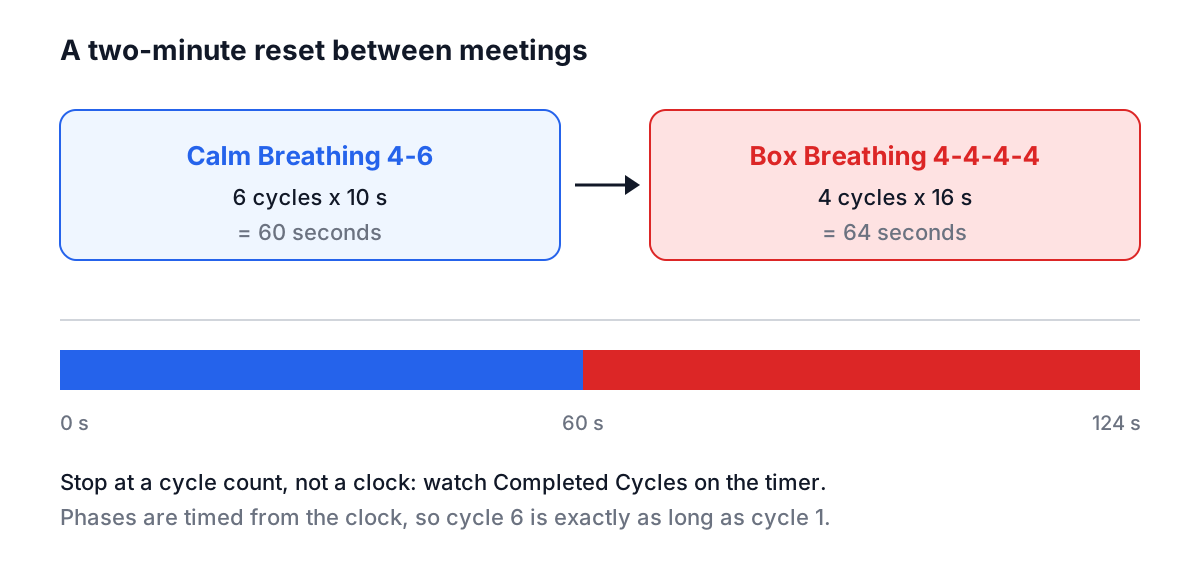
Here is a two-minute routine for the gap between two meetings:
- Open the Breathing Exercise Timer and choose Calm Breathing. The card shows 4-0-6 and a 10s cycle.
- Press Start Session. Breathe in as the circle grows for four seconds, out as it shrinks for six.
- After six completed cycles (one minute), press Choose Different Pattern and pick Box Breathing.
- Start again and stop after four completed cycles, which is 64 seconds.
That is just over two minutes in total. The timer computes each phase from the clock rather than counting ticks, so the 6-second exhale is still six seconds on cycle 50, and pausing keeps your place in the cycle.
Pairing breathing with muscle relaxation
Breathing calms the rate; it does not unclench a jaw you have been clenching all afternoon. For that, progressive muscle relaxation (PMR) works better. The American physician Edmund Jacobson described it in his 1929 book Progressive Relaxation: tense one muscle group for about five seconds, let go, and notice the difference for 10 to 20 seconds. Working up from the feet to the face takes about ten minutes.
The Relaxation Exercise Guide has PMR as a ten-minute, six-step exercise, plus a body scan (the core practice of Jon Kabat-Zinn's Mindfulness-Based Stress Reduction programme, started in 1979), a three-minute 5-4-3-2-1 grounding exercise and a five-minute box breathing session. A good evening combination is PMR first, then four rounds of 4-7-8, because releasing muscle tension makes the long exhale easier.
Common mistakes
- Breathing too deeply. Slow is not the same as big. Over-breathing blows off carbon dioxide and causes tingling fingers and light-headedness. Breathe at a normal volume, just slower.
- Forcing the holds. A hold should feel like a pause, not a strain. Shorten it, or switch to 4-6.
- Lifting the shoulders. Put a hand on your belly; it should move out on the inhale. If only your chest and shoulders rise, you are breathing high and shallow.
- Practising only in a crisis. A technique you have never done calm is hard to remember stressed. One or two minutes a day builds the habit.
- Doing it lying down when you want to stay alert. Slow breathing lying down is a good way to fall asleep. Sit up if you need to go back to work.
Which one to use
Use 4-6 when you want something nobody will notice and that suits beginners. Use box breathing when your attention is scattered, because counting four equal sides gives the mind a job. Use 4-7-8 for a few rounds before sleep. Use a single physiological sigh, or two or three in a row, when you need to calm down in the next ten seconds and have no time for a session.
Pick one pattern, practise it for a week at the same time each day, and use the Mental Wellness Worksheet or the wellness habits guide if you want to work on what is causing the stress in the first place.