
Small Daily Wellness Habits: Stress Journaling, Water Breaks and Laughter
Three small habits for a desk-bound day: writing stress down as causes and actions, drinking water on a schedule, and taking a deliberate laughter break.
· 6 min read
By three in the afternoon, a typical desk day has gone like this: one coffee, half a glass of water, two hours of a problem that will not move, and a background hum of worry about something unrelated. None of that needs an intervention. It needs a few small habits that are easy enough to actually do. This guide covers three of them: writing stress down in a useful shape, drinking water on a schedule, and taking a deliberate laughter break. Each has a small free tool on this site to go with it.
The usual caveat, said once: this is everyday wellness information, not medical advice, and none of these tools diagnose or treat anything. If you are struggling, a doctor or counsellor is the right next step. In the US you can call or text 988 to reach the Suicide and Crisis Lifeline at any hour; elsewhere, your local emergency number or a national crisis line will connect you to help.
Mental Wellness Worksheet: turning worry into a list
Worry is vague by nature. "Work is too much" cannot be acted on. "I answer email after 9pm because I am afraid of missing something urgent" can. The Mental Wellness Worksheet is built around that shift. You add a challenge, then fill in two separate lists for it: "Why is this happening?" and "What can you do about it?".
There is research behind writing things down. In 1986 James Pennebaker and Sandra Beall asked students to write for 15 minutes on four consecutive days, some about difficult experiences and some about neutral topics. In the months that followed, the expressive writing group visited the campus health centre less often. Many studies since have found modest benefits, with plenty of variation between people. Separating causes from actions comes from structured problem solving, a technique used in cognitive behavioural therapy: define the problem, list options, choose one, try it, review.
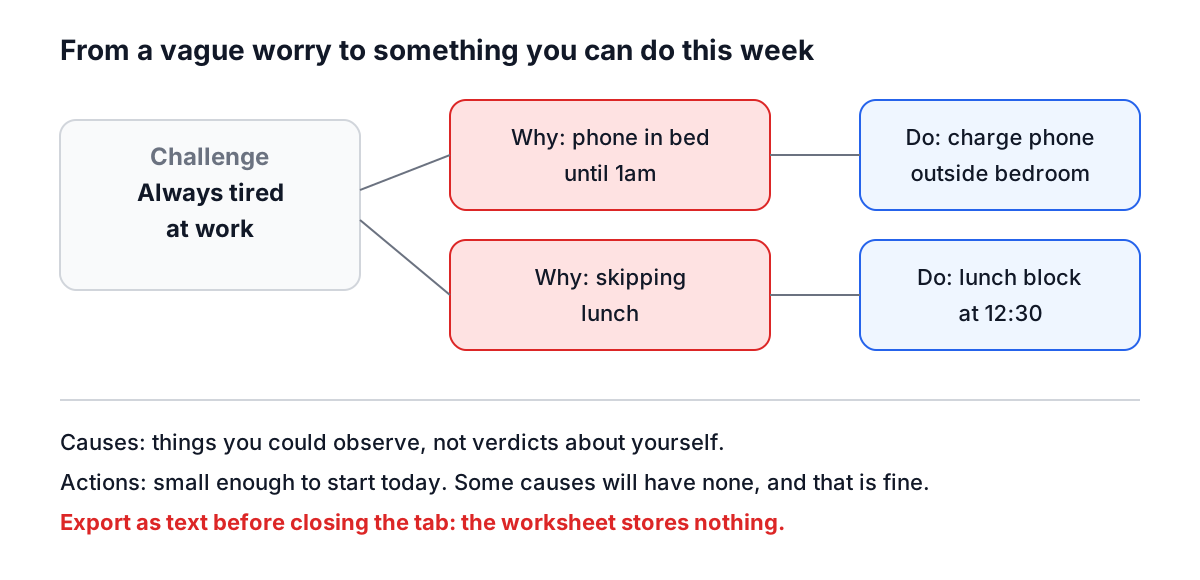
A worked example
- Open the worksheet and type Always tired at work as the challenge. Press Add Challenge, then Expand.
- Under "Why is this happening?", add Phone in bed until 1am and Skipping lunch.
- Under "What can you do about it?", add Charge phone outside the bedroom and Calendar block for lunch at 12:30.
- The summary card now reads 1 Challenges Identified and 2 Solutions Found.
- Press Download as Text before closing the tab.
Step 5 matters. The worksheet stores nothing: no account, no local storage, no server. That is good for privacy and bad if you reload by accident. Export first.
Getting more out of it
- Write causes as things you could observe, not verdicts about yourself. "Meetings fill every morning" beats "I am disorganised".
- Keep actions small enough to start today. "Draft the email to my manager" is an action; "sort out my career" is a wish.
- Leave some causes without a fix. Writing "this is outside my control" is useful information too.
- Revisit the text file a week later. The actions you did not do tell you as much as the ones you did.
Water Reminder: drinking on a schedule
Most people do not need more water in the abstract; they need to remember to drink it during long focus blocks. The Water Reminder does two jobs: it logs each glass in millilitres against a daily goal, and it can show a browser notification every 30, 60, 90 or 120 minutes.
How much is enough
There is no single number, and the references disagree because they measure different things:
| Source | Women | Men | What it counts |
|---|---|---|---|
| US National Academies (2004) | 2.7 L | 3.7 L | All water, including food |
| European Food Safety Authority (2010) | 2.0 L | 2.5 L | All water, including food |
| "8 glasses of 8 oz" rule of thumb | 1.9 L | 1.9 L | Drinks only |
Food usually supplies around a fifth of total water, so the drinks-only figure for most adults lands somewhere near 1.5 to 2.5 litres, more in heat or with exercise. The tool's 2,000 ml default sits in that range. For a figure adjusted to your weight and activity, use the Hydration Calculator, and the hydration guide goes into more detail. If you have a heart or kidney condition with a fluid limit, your doctor's number wins.
The honest limits of a browser reminder
The reminders run on a timer inside the page, so they only fire while the tab is open and the computer is awake. Close the tab or let the laptop sleep and they stop. There is no server pushing notifications to you, which also means nothing about your intake leaves your browser.
Two browser details are worth knowing. First, notifications need your permission, and browsers usually only show the permission prompt in response to a click, so the page asks when you press Start Reminders. If you refuse, it falls back to a pop-up alert. Second, browsers throttle timers in background tabs, so a reminder can arrive up to about a minute late. Neither matters much for a drink of water.
The intake log is kept in local storage and entries from earlier days are dropped when you open the page, so the total starts at zero each morning. One practical trick: measure your favourite glass or bottle once. A "glass" can be anything from 200 to 350 ml, and a US 16.9 fl oz bottle is exactly 500 ml.
Online Laughter Yoga: a deliberate laugh break
Laughter yoga was started in Mumbai in 1995 by Dr Madan Kataria, a physician, with a small group in a public park. The story goes that the group ran out of decent jokes within a couple of weeks, so Kataria switched to laughter exercises: people laugh on purpose, with eye contact and silly movements, and the forced laughter tends to turn into real laughter. Yogic breathing between rounds gives the practice its name, and laughter clubs using the method now meet in many countries.
The Online Laughter Yoga page borrows the spirit rather than the method. It is a joke machine: 218 programmer jokes and 274 general ones, one at a time, with an Another One? button that never repeats the joke on screen. You can copy a joke or download it as an 800 x 600 PNG card for a team channel. There is no group, no leader and no breathing routine, so if you want laughter yoga proper, look for a local club or a session led by a trained leader.
What a joke break does well is interrupt a loop. A groan at "Why do programmers prefer dark mode? Because light attracts bugs!" is enough to break a train of thought that has been going in circles for an hour. Pair it with something physical, such as standing up or refilling your water, and it becomes a proper reset.
Putting the three together
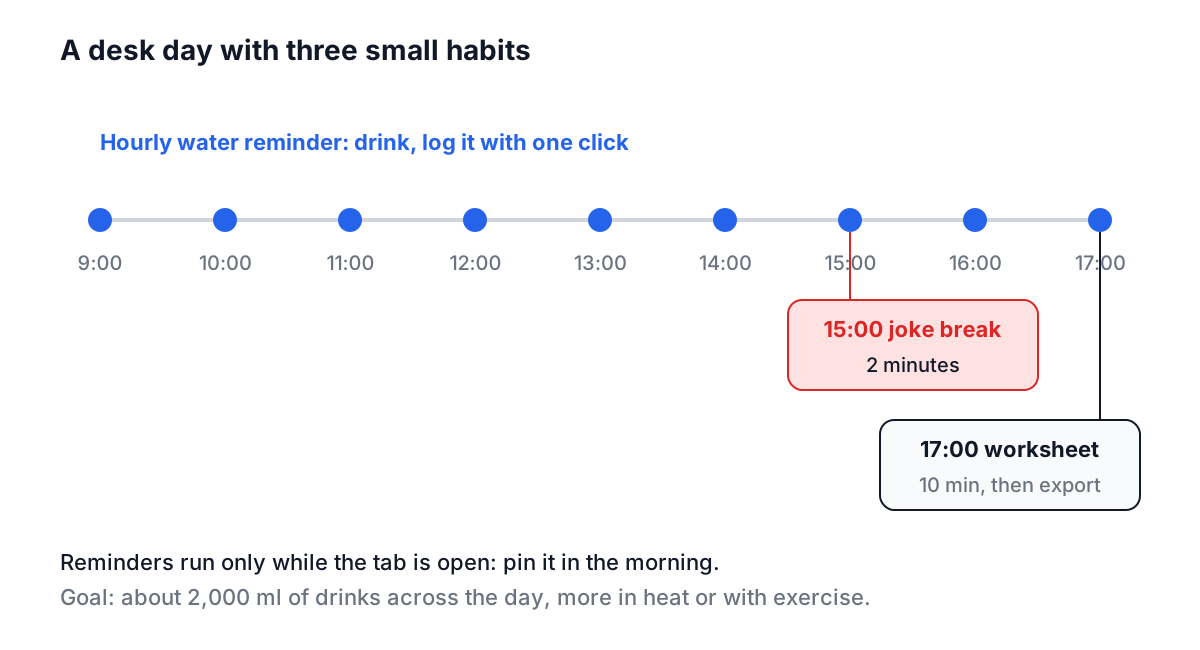
A routine that fits into an ordinary working day:
- Morning: open the Water Reminder in a pinned tab, set the goal and an hourly interval, and press Start Reminders.
- Each reminder: drink, log it with one click, and if you have been stuck on something, read one joke before going back.
- End of day: ten minutes with the worksheet on whatever is still bothering you, then export it.
For calming down in the moment rather than over a day, the breathing techniques guide explains box breathing, 4-7-8 and the physiological sigh with exact counts.
Common mistakes
- Treating a tool as a fix. A reminder does not make you drink, and a list does not solve a problem. They make the next small step easier to take.
- Starting with everything at once. Pick one habit for a week. Add the next when the first one is automatic.
- Forgetting the browser limits. Reminders stop with the tab, and the worksheet is gone on reload. Pin the tab and export the worksheet.
- Ignoring signs that you need more than a habit. Persistent low mood, panic or thoughts of self-harm are reasons to talk to a professional now, not after another week of journaling.
Start with whichever of the three you are most likely to keep doing tomorrow. For most people that is the water log, because it takes a single click, and the habit of glancing at the tab tends to make room for the other two.