
Car Loans, Leases and Paying Off Debt: The Numbers That Matter
How car loans and leases are priced, what a money factor really is, avalanche versus snowball, debt-to-income limits, and how student loan interest builds up.
· 10 min read
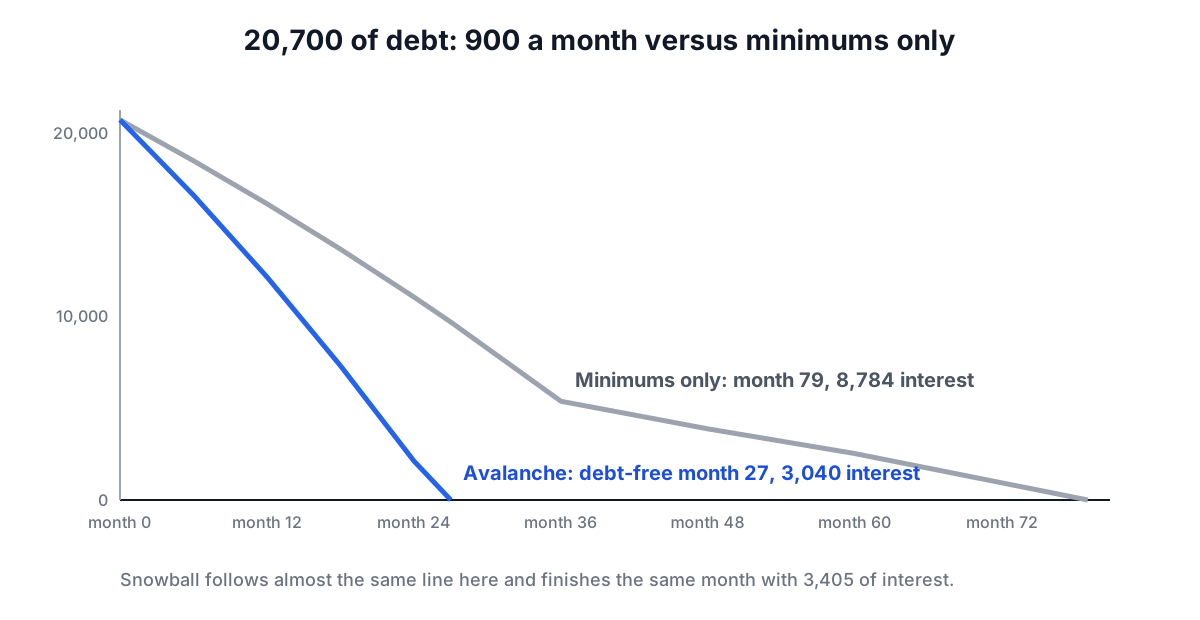
A 35,000 car with 5,000 down, a trade-in and 7% sales tax becomes a 27,490 loan and a 537.87 monthly payment over five years. Stretch it to seven years and the payment drops to 408.21, while the interest climbs by more than 2,000. Meanwhile 20,700 of mixed card and loan debt paid at the minimums takes 79 months and 8,784 of interest to clear; paying 900 a month instead takes 27 months and about 3,040.
These are the decisions where a little arithmetic saves real money. This guide covers how car loans and leases are priced, how to plan a debt payoff, what lenders mean by debt-to-income ratio, and how student loan interest builds up before you make a single payment. Every figure can be reproduced with the Auto Loan Calculator, Car Lease Calculator, Debt Payoff Calculator, Debt-to-Income Ratio Calculator and Student Loan Calculator. It explains the maths; it is not advice about any particular loan.
Car loans: it is all in the amount financed
The payment on a car loan uses the same annuity formula as a mortgage:
payment = P × r × (1 + r)^n / ((1 + r)^n − 1)
r = APR / 12,  n = months
What varies from deal to deal is P, the amount financed, and that is where the paperwork deserves attention:
amount financed = price − cash down − (trade-in value − amount owed on it)
                  + sales tax + fees        (if they are financed)
With a 35,000 price, 5,000 down, a trade-in worth 8,000 with 3,000 still owed, 7% tax and 600 of fees, the trade-in equity is 5,000 and works exactly like extra cash. In most US states tax is charged on the price after the trade-in value, here 27,000, so tax is 1,890. Some states, California among them, tax the full price, which would make it 2,450. Financing tax and fees gives 27,490, and at 6.5% for 60 months the payment is 537.87.
Three things move the total more than people expect:
- Term. At 84 months the payment is 408.21 but interest is 6,799.72 instead of 4,782.40. Cars lose value fastest early on, so a long loan also keeps you owing more than the car is worth for longer.
- Negative equity. Owe 12,000 on that 8,000 trade-in and the 4,000 shortfall is added to the new loan: 36,490 financed and 713.97 a month. You are still paying for the old car, with interest.
- Add-ons. Extended warranties, paint protection and GAP cover are often added to the amount financed. Put them in the fees field to see what they cost monthly and in total.
Negotiate the price first, arrive with a pre-approved rate from a bank or credit union, and only then talk about monthly payments.
Leases: depreciation plus a rent charge
A lease does not amortize a loan. You pay for the value the car loses while you have it, plus a finance charge, plus tax:
adjusted cap cost  = negotiated price + capitalized fees − down payment − trade-in − rebates
residual value     = MSRP × residual %
depreciation fee   = (adjusted cap cost − residual) / months
rent charge        = (adjusted cap cost + residual) × money factor
payment            = (depreciation + rent) × (1 + sales tax rate)
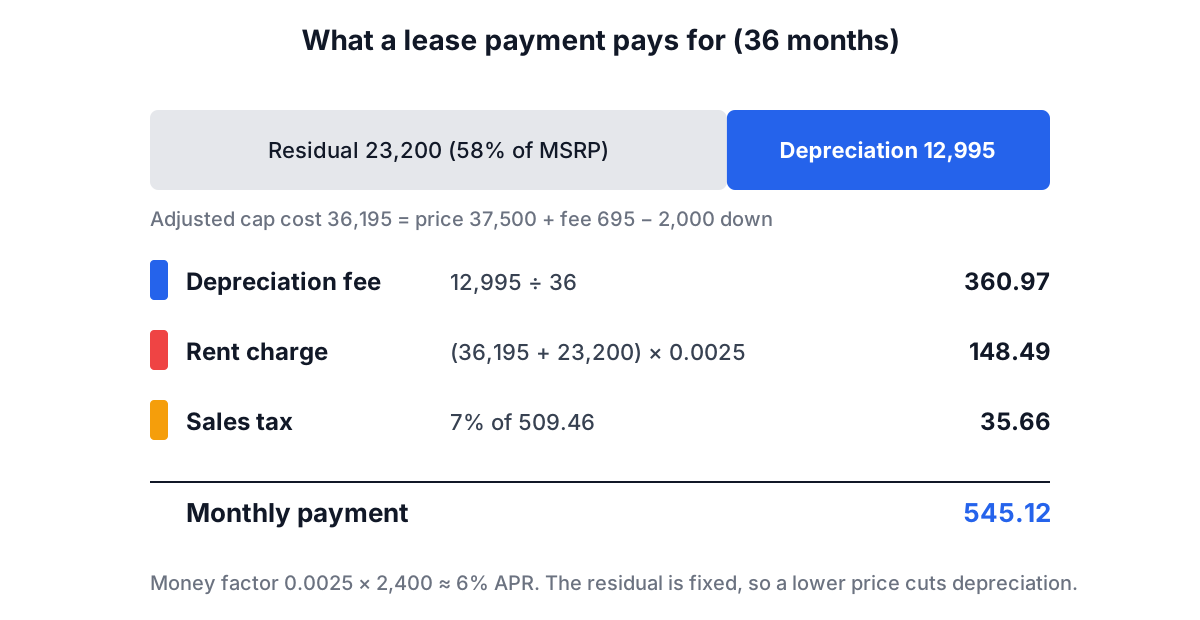
The money factor is the interest rate written differently. Multiply by 2,400 to get an approximate APR: 0.0025 is about 6%. The 2,400 is 24 × 100. The rent charge is applied to cap cost plus residual, roughly twice the average amount you are financing, so dividing by 24 instead of 12 turns it into a monthly rate on the average balance. Ask for the money factor in writing, convert it, and compare it with loan rates. A factor well above current auto loan APRs may include a dealer markup.
The residual is set by the leasing company as a percentage of MSRP and is not usually negotiable. It does two things: a higher residual means less depreciation to pay, and because it is fixed, every 1,000 you negotiate off the price comes straight off the depreciation. In the example above that is about 32 a month, tax included, for each 1,000 of discount. Dropping the residual from 58% to 52% raises the payment from 545.12 to 610.04.
Large down payments on a lease buy little: they reduce the payment almost one for one but save only a small rent charge, and the cash is usually lost if the car is written off early. Mileage limits and wear charges at turn-in are not in the payment at all.
Paying off debt: avalanche or snowball
If you have several debts, the method matters less than the commitment to a fixed monthly total that is more than the minimums. Both popular methods work the same way: pay every minimum, put all the extra toward one target debt, and when a debt is gone keep paying the same total so its old minimum rolls onto the next target.
- Avalanche targets the highest APR first. It always costs the least interest.
- Snowball targets the smallest balance first. It clears accounts sooner, which many people find keeps them going. A 2012 study in the Journal of Marketing Research by Gal and McShane found that closing out individual accounts was associated with eliminating debt overall.
Take four debts: a store card (1,200 at 27.99%), a Visa (6,500 at 22.9%), a personal loan (4,000 at 11.5%) and a car loan (9,000 at 6.9%), with minimums totalling 605 and a budget of 900.
| Plan | Debt-free | Interest |
|---|---|---|
| Avalanche | month 27 | 3,039.67 |
| Snowball | month 27 | 3,404.51 |
| Minimums only | month 79 | 8,784.28 |
The choice between avalanche and snowball cost 365 here. The choice between a plan and minimums cost over 5,700 and four years. Raising the budget to 1,100 brings the avalanche plan down to 21 months and 2,280 of interest.
Minimum payments are slow because so much of each one is interest. A 22.9% card charges about 124 a month on 6,500, so a 160 minimum reduces the balance by only around 36 at first. If a minimum does not even cover the monthly interest, the balance will never fall; the Debt Payoff Calculator flags that case.
Debt-to-income ratio: what lenders see
Before a mortgage or auto lender approves you, it divides your monthly debt payments by your gross monthly income:
front-end DTI = housing payment ÷ gross monthly income
back-end DTI  = (housing + all other debt payments) ÷ gross monthly income
Debts are what appears on a credit report or a court order: car loans and leases, student loans, card minimums, personal loans, child support and alimony. Utilities, phone bills, groceries and insurance premiums (other than homeowners insurance in the housing payment) are not included.
A household earning 90,000 (7,500 a month) with a 1,900 housing payment, a 420 car loan, 250 of student loans and 120 of card minimums has a front-end ratio of 25.3% and a back-end ratio of 35.9%. Typical limits: 28/36 as a budgeting rule; 36% for manually underwritten conventional loans (45% with compensating factors, up to 50% through Fannie Mae's automated system); 31/43 for manually underwritten FHA loans; 41% for VA with a residual income check; 29/41 for USDA. These are typical published figures, not promises, and lenders can be stricter.
The practical use is timing. Add a 400 car payment to that household and its back-end ratio jumps to 41.2%, enough to complicate a mortgage application next year. If a home purchase is coming, buy the house before the car, or clear a small loan first to bring the ratio down. The Debt-to-Income Ratio Calculator shows how much room you have under 36%, and the House Affordability Calculator turns that room into a home price.
Student loans: the interest that comes before the first payment
Student loans differ from other debt because interest can build up for years before repayment starts. Federal Direct loans use simple interest, so the amount is easy to estimate:
interest while in school = balance × rate × months / 12
On 35,000 of unsubsidized loans at 6.5%, a six-month grace period adds 1,137.50 and four years in school adds 9,100. On a Direct Subsidized loan, the government pays this interest during school, grace and deferment.
What happens to that interest next is capitalization. If it is added to the principal, you pay interest on it from then on. With 9,100 capitalized, a 10-year payment on 35,000 rises from 397 to 500.75. The US Department of Education removed most capitalization events for federal Direct loans from July 2023, including entering repayment for the first time, though unsubsidized interest can still capitalize after some deferments. Private lenders usually capitalize when repayment starts. Paying the interest while in school, about 190 a month in this example, avoids the problem entirely.
Extra payments help as they do on any amortizing loan. With the six-month grace period and a 410.12 payment, adding 100 a month finishes in 90 months instead of 120 and saves about 3,500 of interest. Federal loans have no prepayment penalty.
Income-driven repayment plans are a different calculation: payments are set from income and family size, some balances are forgiven, and the plans themselves are being reshaped by legislation passed in 2025. For those, use the Loan Simulator on StudentAid.gov with your actual loan data.
Putting it together
- For a car, settle the price, then the trade-in, then the financing, and check the payment from the amount financed.
- For a lease, get the cap cost, residual, money factor and fees in writing and rebuild the payment.
- For debts, pick a fixed monthly total above the minimums and a method you will stick with.
- Before applying for any large loan, check your debt-to-income ratio and avoid new debt in the months before.
- For student loans, find out whether interest is accruing now and whether it will capitalize.
For the bigger loan most households carry, the mortgage guide covers payments, PMI, affordability and refinancing.