
Mortgage Maths: Payments, PMI, Affordability, Refinancing and APR
Where a mortgage payment comes from, when PMI ends, how lenders decide what you can afford, how to find a refinance break-even, and why APR is higher than the rate.
· 10 min read
Buy a 400,000 home with 10% down at 6.5% over 30 years and the bank's payment is 2,275.44 a month. The payment you actually make is closer to 2,942, once property tax, insurance and private mortgage insurance are added. Over the life of the loan you will pay about 459,000 in interest, more than the house cost, unless you pay extra.
None of those numbers is hidden. They all fall out of a handful of formulas and rules, and knowing them lets you check a lender's figures, decide how much house to buy, judge a refinance offer and compare loans with different fees. Every example below can be reproduced in the Mortgage Calculator, the House Affordability Calculator, the Refinance Calculator and the APR Calculator. This explains how the maths works; it is not advice about any particular loan.
The payment formula and PITI
A fixed-rate mortgage is an annuity: the same payment every month that repays the loan and all its interest exactly at the end of the term.
M = P × r × (1 + r)^n / ((1 + r)^n − 1)

P = amount borrowed            360,000
r = annual rate / 12           0.065 / 12 = 0.0054167
n = number of payments         360
M = 2,275.44
That is principal and interest only. Lenders usually collect property tax and homeowners insurance in the same payment through an escrow account, and the four together are called PITI. With 1.1% property tax (4,400 a year), 1,800 a year of insurance and PMI at 0.5% of the loan, the default example becomes:
| Part | Monthly |
|---|---|
| Principal and interest | 2,275.44 |
| Property tax | 366.67 |
| Insurance | 150.00 |
| PMI | 150.00 |
| Total | 2,942.11 |
HOA dues, if any, come on top. Tax and insurance are re-estimated every year by the servicer, so the escrow part of the payment drifts upward over time even on a fixed-rate loan.
Why early payments are mostly interest
Each month the lender charges interest on what you still owe: balance × r. The first month that is 360,000 × 0.0054167 = 1,950.00, leaving only 325.44 of the 2,275.44 to reduce the balance. As the balance falls, the interest share shrinks and the principal share grows, but slowly.
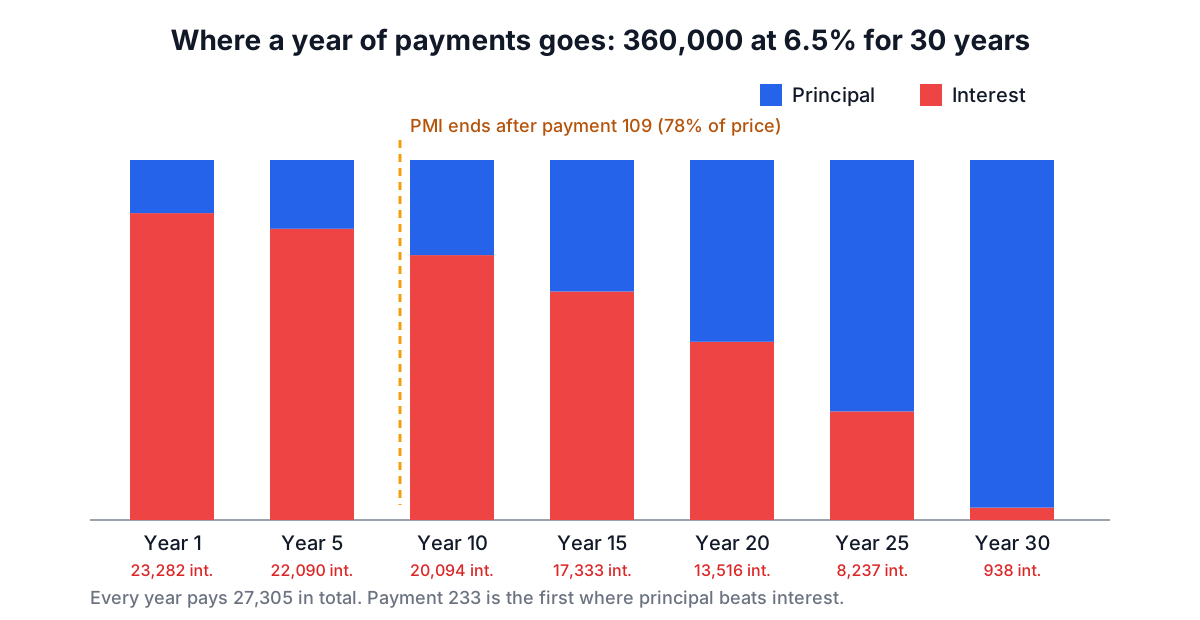
Payment 233, more than 19 years in, is the first where principal outweighs interest. After ten years you still owe 305,194 of the original 360,000. That is why people who sell after a few years are often surprised by how little equity the payments built, and why extra payments early on are so effective.
Extra payments
Every extra dollar of principal stops accruing interest for the rest of the loan. On the example loan:
- 200 extra a month saves about 108,900 of interest and ends the loan 73 months early.
- One extra payment a year (2,275.44 with every 12th payment) saves about 100,800 and 68 months.
Before prepaying, check there is no prepayment penalty and tell the servicer to apply the money to principal. If you also have high-rate debt, paying that off first usually beats a 6.5% mortgage.
PMI: when it starts and when it ends
Private mortgage insurance protects the lender, not you, on conventional loans where you borrow more than 80% of the home's value. It is usually priced as an annual percentage of the loan, often somewhere between about 0.3% and 1.5% depending on credit score and down payment.
The US Homeowners Protection Act sets three exits:
- Request at 80%. Once the balance reaches 80% of the original value (by the schedule or through extra payments), you can ask in writing to cancel. The lender can require a good payment history and evidence that the value has not fallen.
- Automatic at 78%. The servicer must cancel PMI on the date the balance is first scheduled to reach 78% of the original value, as long as you are current.
- Midpoint. PMI ends at the halfway point of the loan term regardless.
On the example, the 80% point arrives after payment 95 and the 78% point after payment 109, so PMI costs 16,350 in total. With 200 a month extra, the balance reaches 78% after payment 75. Note the wording: automatic cancellation follows the original schedule, so if you prepay, you will usually need to ask. FHA loans use a different mortgage insurance premium with its own rules and often keep it for the life of the loan.
How much house you can afford
Lenders do not start from the house; they start from your income. Two ratios do the work:
front-end ratio = housing payment (PITI + PMI + HOA) ÷ gross monthly income
back-end ratio  = (housing payment + other debt payments) ÷ gross monthly income
The classic 28/36 rule keeps them at or below 28% and 36%. Real programs vary: Fannie Mae caps manually underwritten loans at a 36% back-end ratio (45% with strong credit and reserves, up to 50% through its automated system), FHA's manual underwriting guideline is 31/43, and VA uses 41% plus a residual income test.
Your budget is the smaller of the two limits. A household earning 120,000 (10,000 a month) with 500 of other debts gets 2,800 from the front-end rule and 3,100 from the back-end rule, so 2,800 it is. Converting that to a price means working backwards through the payment formula while tax and PMI change with the price. The House Affordability Calculator does that search: with 60,000 down at 6.5% the answer is about 399,000.
The interesting part is which ratio binds. Add 1,000 a month of car and student loans and the back-end ratio takes over, the housing budget falls to 2,100 and the price to about 307,600. For that household, paying off a car loan raises buying power more than saving a bigger down payment. Rates matter too: each half point moved the example's maximum price by roughly 13,000 to 16,000.
A ratio a lender accepts is not the same as a comfortable budget. The ratios ignore utilities, maintenance, childcare and saving. Check the payment against take-home pay before deciding.
Refinancing and the break-even month
A refinance replaces your loan with a new one, at a cost: lender fees, appraisal, title, recording and any discount points. The usual test is the simple break-even:
break-even months = closing costs ÷ monthly saving
Take 300,000 owed at 7.25% with 27 years left, refinanced to 6.25% over 30 years with 5,000 of costs. The payment falls from 2,112.58 to 1,847.15, a saving of 265.43, so the simple break-even is 19 months.
That rule ignores something. The new 30-year loan pays principal down more slowly than the old loan you are three years into, so part of the "saving" is just borrowing for longer. A fairer test tracks net position each month: payment savings, minus costs paid, plus the difference between what you would owe on each loan.
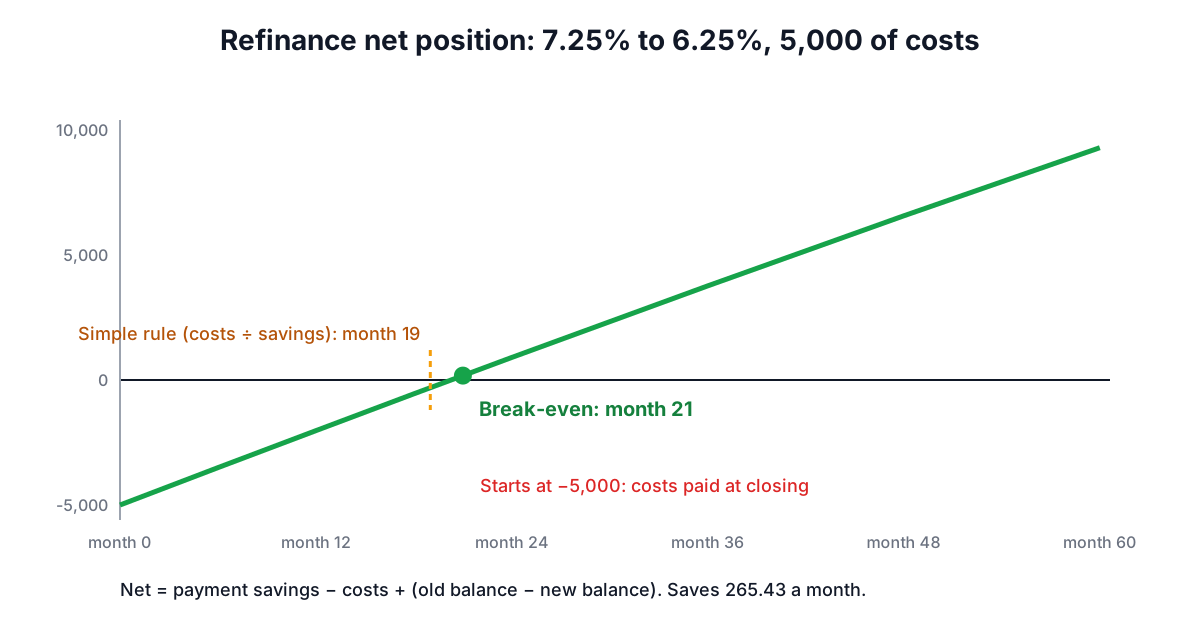
On that basis the break-even is month 21. The gap can be much larger when the rate drop is small or the term is extended a lot. In the other direction, refinancing the same balance to a 20-year loan raises the payment by 80 a month but puts you ahead after 19 months and saves about 158,000 of interest, which the simple rule cannot show at all because there is no monthly saving to divide by. The Refinance Calculator reports both figures and the lifetime interest of each loan.
Judgment calls: compare the break-even month with how long you will really keep the loan, remember that rolling costs into the loan delays break-even (month 23 in the example), and treat cash-out as new borrowing rather than savings.
APR versus the interest rate
The note rate sets your payment. The APR tells you what the loan costs once up-front finance charges are counted. Under US Regulation Z, APR is the rate at which the payments, discounted month by month, equal the amount financed: the loan minus prepaid finance charges such as origination fees and points.
A 250,000 loan at 6.5% with 3,500 of fees and one point (2,500) has a payment of 1,580.17, but you effectively receive 244,000. The rate that makes 360 payments of 1,580.17 worth 244,000 today is 0.56126% a month, an APR of 6.735%. There is no closed-form solution; the APR Calculator solves it numerically.
Two cautions. First, APR assumes you keep the loan for the full term. Repay that loan after five years and the fees, spread over fewer payments, put the effective cost at 7.088%; after three years, 7.409%. If you expect to move or refinance, compare loans over your real horizon. Second, APR is still a nominal rate. Compounded monthly, 6.735% is an effective annual rate of 6.947%, the figure comparable to a savings APY.
A checklist before you sign
- Reproduce the lender's principal and interest payment to the cent from the rate, amount and term.
- Add realistic tax, insurance, PMI and HOA to get the real monthly cost.
- Check both debt-to-income ratios against take-home reality, not just the lender's limit.
- Find the PMI request and automatic cancellation dates.
- For a refinance, compare the break-even month with how long you will keep the loan.
- Compare offers by APR over the years you expect to hold the loan.
If you are still weighing whether to buy at all, the Rent vs Buy Calculator takes these costs further, and the EMI and amortization guide works through the payment formula in more depth.