
How to Split Co-founder Equity (and Agree Before You Argue)
Equal splits, contribution scoring and role weights compared, how 4-year vesting with a 1-year cliff actually works, and the alignment questions to settle first.
· 7 min read
Two founders split a company 50/50 over coffee in month one. In month nine one of them takes a job offer, keeps half the company, and the one who stayed now has to raise money with a dead co-founder on the cap table. Nothing about that story needed bad faith. It needed only an equity split with no vesting and a conversation that never happened.
This guide covers the two halves of getting it right: the numbers (how to split, and how vesting protects the split) and the conversation that should come first (whether the founders want the same company). The Co-founder Equity Split Calculator handles the first and Founding Team Alignment the second. Both run in your browser. This is not legal or tax advice; the numbers here are a starting point for a discussion that ends with a lawyer drafting the documents.
Three ways founders split equity
There is no correct formula, only defensible ones. Most real splits come from one of three approaches.
Equal splits. Two founders, 50/50; three, a third each. The argument for it is that the work that matters is all ahead of you, so past contributions (the idea, a few months of nights) are small next to the next five years. The argument against is that equal splits paper over real differences in commitment and can deadlock decisions. Equal is fine when it is a deliberate choice, and risky when it is a way to avoid talking.
Contribution scoring. Score each founder on what they bring (time, cash, experience, the original idea, risk taken) and split in proportion. It feels objective, but every weight in the scoring is a judgement call. Its value is that it forces the team to say out loud what they think each person brings.
Dynamic equity. Mike Moyer's Slicing Pie model tracks contributions over time and adjusts shares until the company reaches a defined milestone, such as a priced funding round. It suits teams that genuinely cannot predict who will contribute what, at the cost of more bookkeeping.
The calculator offers static versions of the first two ideas, plus a mix.
How the Co-founder Equity Split Calculator scores
Add each co-founder on the Setup tab with a role, primary contribution, time commitment (percent of full time), cash invested, years of experience, risk tolerance, cliff and vesting period. Choose a method and a Total Equity Pool (clamped to 0 to 100%; use less than 100 if you are setting aside an option pool first). Then click Calculate Equity Allocation and open the Results tab.
Contribution-Based (points) gives each founder points in five buckets:
| Bucket | Points |
|---|---|
| Idea | 5 if primary contribution is Idea/Vision, else 1 |
| Execution | time commitment % / 20 (full time = 5) |
| Cash | cash / $10,000, capped at 5 ($50k or more) |
| Experience | years / 2, capped at 5 (10 years or more) |
| Risk | high 5, medium 3, low 1 |
Role-Based uses fixed weights: CEO 30, CTO 25, CMO 15, COO 15, CFO 10, Other 5, then adds up to 20% of that weight for time commitment (a full-time CEO scores 30 + 6 = 36).
Hybrid takes half the role weight plus half of each contribution bucket. Because role weights are much larger numbers than contribution points, roles dominate the hybrid result.
Each founder's share is their points divided by the team's total, times the pool. Shares are rounded to one decimal with the largest-remainder method, so they always add up to the pool exactly: three identical founders get 33.4, 33.3 and 33.3 rather than three 33.3s that leave 0.1% unaccounted for.
A worked example with two founders
Maya is CEO, brought the idea, works full time, put in $20,000, has 8 years of experience and high risk tolerance. Ravi is CTO, primary contribution technical expertise, full time, no cash, 6 years of experience, medium risk tolerance.
Contribution points: Maya scores 5 (idea) + 5 (execution) + 2 (cash) + 4 (experience) + 5 (risk) = 21. Ravi scores 1 + 5 + 0 + 3 + 3 = 12. Hybrid: Maya gets 15 (half of 30) plus half of her 21 contribution points, 25.5 in total; Ravi gets 12.5 plus 6, 18.5 in total.
| Method | Maya points | Ravi points | Maya share | Ravi share |
|---|---|---|---|---|
| Contribution-Based | 21 | 12 | 63.6% | 36.4% |
| Role-Based | 36 | 30 | 54.5% | 45.5% |
| Hybrid | 25.5 | 18.5 | 58.0% | 42.0% |
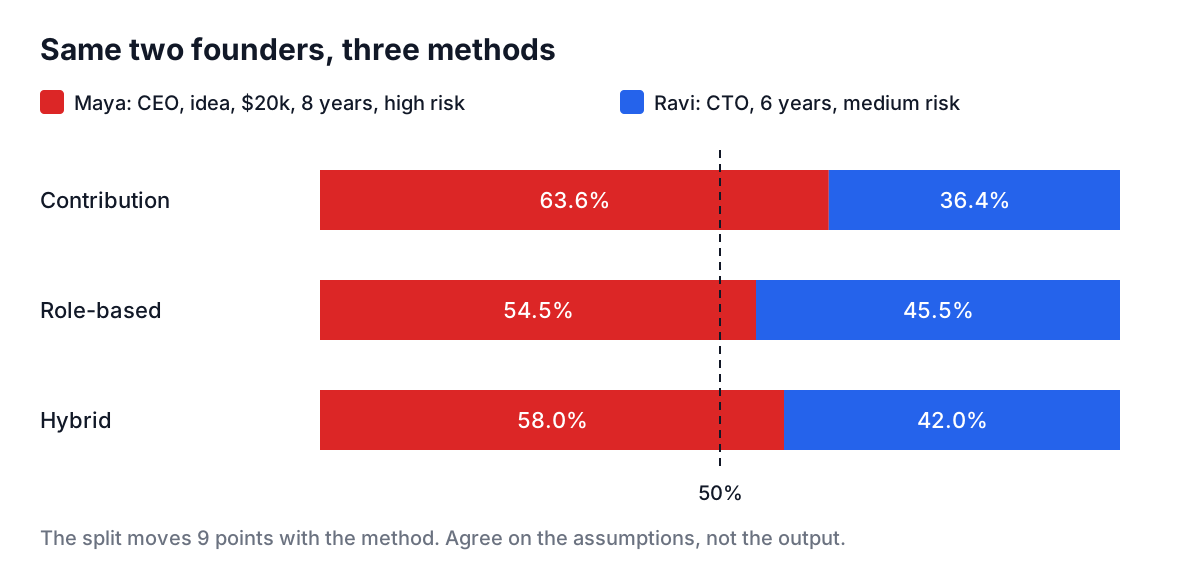
The spread is the lesson. The same two people land anywhere between 54.5/45.5 and 63.6/36.4 depending on the method. That is not a flaw in the calculator; it is the honest range, and the team's job is to agree which assumptions they believe. Because Maya is above 50% under every method, the Recommendations card flags concentration risk, which is worth discussing even if you keep the split.
Vesting: what protects the split
Vesting means founders earn their shares over time instead of owning them outright on day one. The common founder setup is four years (48 months) with a one-year cliff:
- Before month 12, nothing has vested. A founder who leaves gets nothing.
- At month 12, 12/48 = 25% vests at once.
- After that, 1/48 vests each month until month 48.
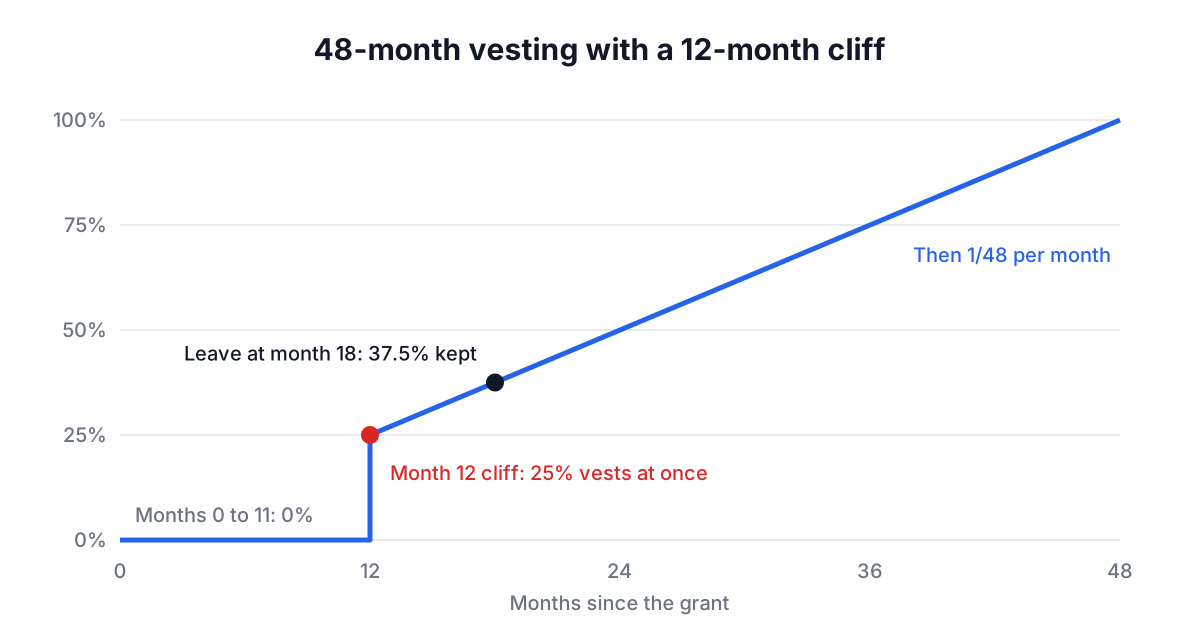
So if Ravi leaves at month 18, he keeps 18/48 = 37.5% of his 42.0%, about 15.75% of the company, and the rest returns to the company. That is the scenario from the opening, defused.
The calculator shows each founder's cliff with the percentage that vests at it, and its recommendations warn when a cliff is shorter than 12 months or when the cliff is as long as the whole vesting period (which means nothing vests until the very end). In the US, founders who receive restricted stock commonly file an 83(b) election within 30 days of the grant; ask an adviser whether it applies to you.
Founding Team Alignment: have the conversation first
Most co-founder breakups are not about percentages. They are about one founder wanting a lifestyle business and the other wanting to raise a Series A, or one working 60 hours and the other 20. The split is downstream of those answers.
In Founding Team Alignment, each founder fills in their own answers separately: name, role, company vision, mission, core values, key goals for the next 12 months, biggest concerns, time commitment and expected equity. Click Add Founder Response after each one. Once two or more founders are in, Analyze Alignment shows:
- Visions and missions side by side, so differences in ambition are visible in one glance.
- Common values: values that two or more founders typed, matched case-insensitively. "Innovation" and "innovation" match; "innovative products" does not, so agree on short words.
- Each founder's goals, concerns, time commitment and expected equity.
- Whether expected equity adds up to 100%. If three founders each expect 40%, the tool says the total is 120% and that the team has not agreed a split yet.
Answers are saved in your browser under the key founding-team-alignment, and the analysis can be downloaded as text, image or PDF.
The useful order is alignment first, then the calculator. If expected equity does not add up, run the calculator with each method and use the range to anchor the discussion.
Common mistakes
No vesting because "we trust each other". Vesting protects the founders who stay, including you. Investors will usually insist on it anyway.
Splitting on the idea. An idea is worth little without years of execution. Scoring it at 5 points out of a possible 25 is already generous.
Ignoring part-time commitment. A founder at 50% time scores half the execution points. If they plan to go full time later, agree when, and revisit the split if it does not happen.
Forgetting the option pool. If you plan to hire, set the pool below 100% or agree how founders will be diluted when the pool is created.
Treating the output as final. The calculator turns assumptions into numbers. The assumptions are the thing to argue about.
Once you have a split, the next documents founders usually need are a pitch: the Pitch Deck Builder has a team slide that should match what you agreed. If you are still choosing what to work on, the Idea Prioritizer and the guide to choosing a startup idea come first.
Book an afternoon, have each founder fill in the alignment answers on their own, compare, then run the calculator with all three methods. Write down the split, the vesting schedule and the cliff, and take that page to a lawyer.