
Dog and Cat Age in Human Years: Why Times Seven Is Wrong
Where the 15, 24, then per-year curve comes from, how size changes a dog's ageing, the 16 ln(age) + 31 epigenetic formula, and when pets become seniors.
· 6 min read
A one-year-old Labrador can have puppies of her own, has nearly all of her adult teeth and is close to full size. Under the "multiply by seven" rule she is the equivalent of a seven-year-old child. That mismatch is the quickest way to see why the rule is wrong, and why vets use a different curve.
This guide explains the curve the Pet Age Calculator uses, where it is approximate, how size changes the picture for dogs, and what the newer epigenetic formula says. A quick note before the numbers: all of this is a way to think about maturity and ageing. It is not veterinary advice, and your vet's examination tells you far more than any conversion.
Where "times seven" came from, and why it fails
Nobody has found a study behind the seven-to-one rule. The most likely origin is a back-of-envelope comparison of lifespans: people lived to about 70, dogs to about 10, so one dog year must be seven human years.
The rule fails because dogs and cats do not age at a constant rate. They race through childhood and adolescence in about two years and then age more steadily. A straight line through the origin cannot describe that. Times seven makes young pets far too young and, for many dogs, old pets too young as well.
The curve vets actually quote
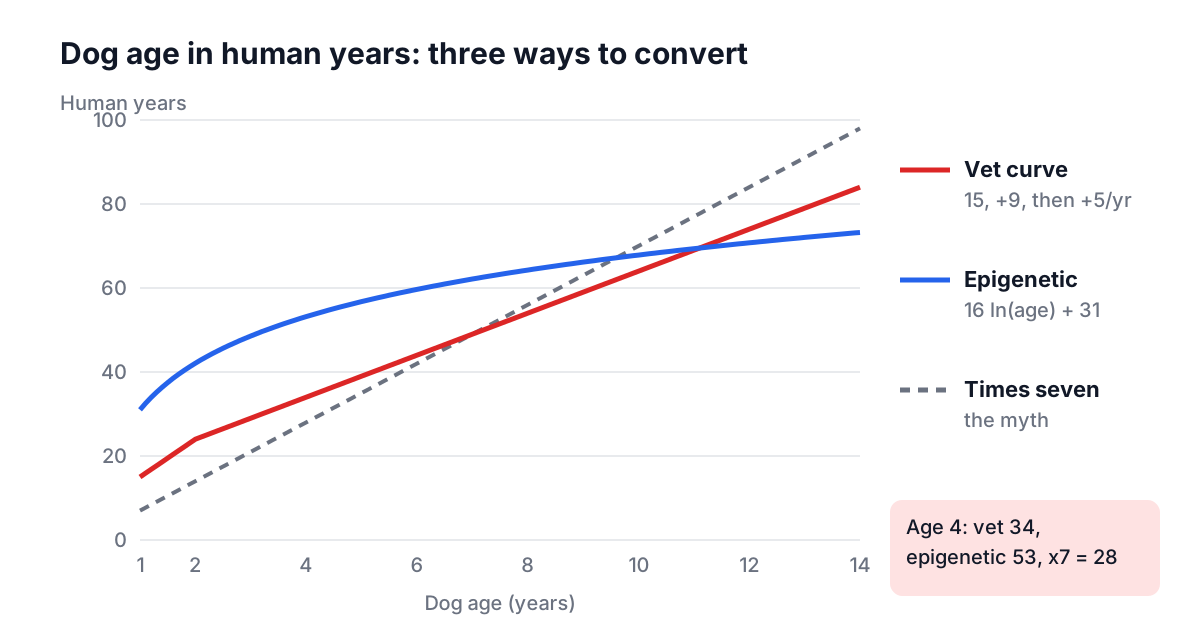
The conversion most often printed by veterinary bodies, and used by the calculator for dogs and cats, has three parts:
- The first year counts as about 15 human years.
- The second year adds about 9, so a two-year-old is about 24.
- Each year after that adds a steady amount: about 4 for cats, and between 4 and 7 for dogs depending on size. The calculator uses 5 for dogs.
Here is the cat version written out. It matches the chart published with the AAFP and AAHA feline life stage guidelines.
| Cat age | Human equivalent | Life stage (AAFP/AAHA) |
|---|---|---|
| 6 months | about 8 to 10 | Kitten |
| 1 year | 15 | Young adult |
| 2 years | 24 | Young adult |
| 5 years | 36 | Young adult |
| 7 years | 44 | Mature adult |
| 10 years | 56 | Mature adult |
| 12 years | 64 | Senior |
| 15 years | 76 | Senior |
| 20 years | 96 | Senior |
The formula behind the table is short enough to do in your head:
age < 1:      human = age x 15
1 <= age < 2: human = 15 + (age - 1) x 9
age >= 2:     human = 24 + (age - 2) x rate   (cats 4, dogs about 5)
Worked example: a four-year-old dog
Open the Pet Age Calculator, choose Dog, type 4 and leave the unit on Years. Click Calculate Age.
- First year: 15
- Second year: +9, total 24
- Years three and four: 2 x 5 = 10, total 34
The calculator shows 34 human years and the life stage Adult. Times seven would have said 28.
Try 6 in the age field with Months selected. Months are divided by 12 first, so 6 months becomes 0.5 years, and 0.5 x 15 = 7.5, which rounds to 8. That is the weakest part of any simple curve: a six-month-old puppy is physically more like a young teenager in some ways and a child in others. Use the first-year figures loosely.
Size changes everything for dogs
Cats are similar in size across breeds, so one curve fits most of them. Dogs range from a 2 kg Chihuahua to an 80 kg Mastiff, and large dogs live shorter lives. After the first two years the yearly rate spreads out:
| Dog size | Typical adult weight | Human years per year after age 2 | Ten-year-old is roughly |
|---|---|---|---|
| Small | under 10 kg | about 4 | 56 |
| Medium | 10 to 25 kg | about 4.5 to 5 | 60 to 64 |
| Large | 25 to 45 kg | about 5 to 5.5 | 64 to 68 |
| Giant | over 45 kg | about 6.5 to 7 | 76 to 80 |
The calculator uses 5, which lands between the medium and large rows. If you have a toy breed, knock a few years off results past age five. If you have a Great Dane or an Irish Wolfhound, add several. The direction matters more than the exact number: a ten-year-old giant dog is old, while a ten-year-old terrier may have years of active life left.
The epigenetic formula: 16 ln(age) + 31
In 2020 a team led by Tina Wang published a study in Cell Systems that compared DNA methylation, chemical tags on DNA that change predictably with age, in Labrador Retrievers and in people. Matching the two "epigenetic clocks" gave this formula:
human age = 16 x ln(dog age) + 31
ln is the natural logarithm. Working it through for a few ages:
| Dog age | ln(age) | 16 x ln(age) + 31 | Vet curve (5 per year) |
|---|---|---|---|
| 1 | 0 | 31 | 15 |
| 2 | 0.69 | 42 | 24 |
| 4 | 1.39 | 53 | 34 |
| 7 | 1.95 | 62 | 49 |
| 10 | 2.30 | 68 | 64 |
| 14 | 2.64 | 73 | 84 |
Two things stand out. The epigenetic formula makes young dogs much "older" than the vet curve, which fits the fact that dogs reach sexual maturity within a year. And it flattens out later, so a 14-year-old Labrador maps to about 73. It was fitted on about a hundred dogs of a single breed, so it is a fascinating result rather than a replacement. The calculator sticks with the vet curve because that is what life-stage care advice is built around.
When does a pet become a senior?
Age labels matter because they change care: senior pets usually move to exams every six months, routine blood and urine tests, and diets with different calorie and protein levels.
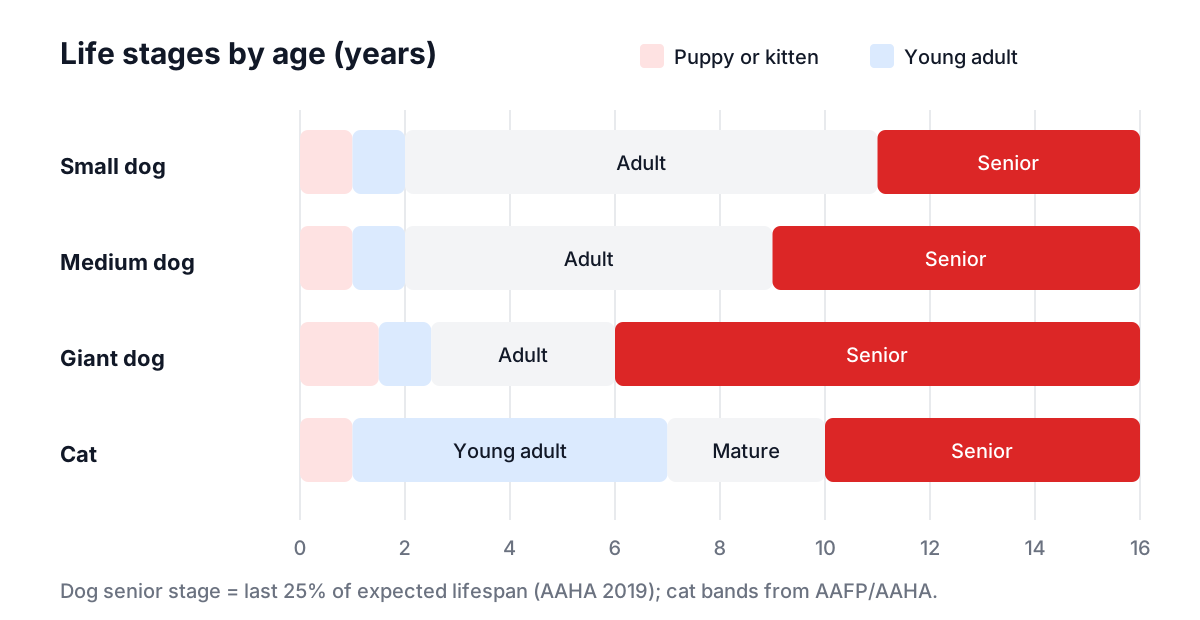
- Dogs. The 2019 AAHA canine life stage guidelines define the senior stage as the last 25% of a dog's estimated lifespan, rather than a fixed birthday. For a giant breed expected to live 8 years that is 6. For a small breed expected to live 15 it is past 11. The calculator labels dogs senior from 7 as a middle value.
- Cats. The AAFP and AAHA feline guidelines call cats from 7 to 10 "mature adults" and cats over 10 "seniors". The calculator uses 8 as its senior threshold, so treat the 8 to 10 band as a heads-up rather than a hard line.
Common mistakes
- Using times seven for a young pet. A two-year-old dog is roughly 24, not 14. Training and exercise expectations should be those of a young adult.
- Ignoring size for an older dog. A nine-year-old Bernese Mountain Dog and a nine-year-old Jack Russell are at very different points in life.
- Trusting small-pet multipliers. The calculator uses flat rates for rabbits (8), hamsters (14) and small birds (5). Species within those groups vary widely; a budgie and a cockatoo are both "birds".
- Treating the number as a health score. Two dogs of the same age can differ enormously in health. Weight trends and body condition say more, which is why a log in the Pet Weight Tracker is worth keeping.
Putting the number to use
Age conversion is most useful at the transitions. When your dog or cat moves from young adult to adult, review its food: the Pet Feeding Calculator uses a different energy factor for puppies, adults and seniors. When it nears the senior band, book the conversation with your vet about twice-yearly checks, and put the dates in the Pet Care Reminder so they do not slip. For everything else about weight logs and care schedules, see the pet care records guide.