
Pet Care Records: Weight Logs, Care Schedules, Budgets and Names
A practical system for tracking a pet's weight, preventive care dates and real costs, plus how to pick a name your dog will actually respond to.
· 7 min read
The vet asks when your dog last had its heartworm preventive, whether it has lost weight since spring, and you realise the answers are spread across a phone camera roll, a receipt drawer and a vague memory of "around Easter". Most pet health questions come down to dates and numbers, and very few owners keep either in one place.
This guide sets out a simple record system covering four things: weight, care dates, costs and, for new owners, the name you will be calling for the next fifteen years. Each section uses one of the RedBison pet tools, all of which run in your browser. None of it replaces your vet's advice; the point is to arrive at the appointment with better information.
Track weight with the Pet Weight Tracker
Weight is the cheapest early-warning signal you have. Slow weight gain creeps up unnoticed because you see your pet every day. Slow weight loss in an older cat can be one of the first signs of kidney disease, an overactive thyroid or diabetes, often months before other symptoms.
The Pet Weight Tracker keeps a dated log for one pet. Set an ideal weight (ask your vet; it should come from a body condition assessment, not a breed chart), then add entries with a note such as "started new food" or "after dental".
What the tracker computes:
- Trend. The change and percentage between the two most recent entries by date. 20 kg to 22 kg reads "+2.0 kg (10.0%)".
- Status. The latest weight against your ideal: within 5% is ideal, 5 to 15% off is "slightly" over or under, beyond 15% is "significantly".
- Chart. All entries on a line chart with the ideal as a dashed reference line.
Percentages matter more than kilograms. The same 200 g is noise for a Labrador and a 5% loss for a 4 kg cat, which is enough to mention to your vet.
How to weigh reliably at home:
- Use the same scale every time. For small pets, a kitchen or baby scale with a box on it beats the "hold the cat and subtract" method, which doubles the scale's error.
- Weigh at the same time of day, before a meal.
- Weigh monthly for a healthy adult, weekly during a diet or for a growing puppy or kitten.
- Look at the trend over a month or two, not at single readings.
Entries are saved in your browser's local storage, so they survive a reload on the same device. They are not synced, so export a CSV now and then as a backup and to share with your vet. Switching the unit between kg and lbs converts the existing entries rather than relabelling them.
If the trend is moving the wrong way, the next step is the daily calorie target in the Pet Feeding Calculator, explained in the feeding guide.
Keep a care schedule with the Pet Care Reminder
Preventive care runs on a few repeating intervals. Getting them onto one dated list is most of the work.
| Task | Typical interval | Notes |
|---|---|---|
| Flea and tick preventive | Monthly, or every 12 weeks to 8 months depending on product | Follow the label; products are not interchangeable |
| Heartworm preventive (dogs) | Monthly in most products | Year-round in many regions |
| Deworming | Every 1 to 3 months for many adults | Depends on lifestyle and region |
| Nail trim | Every 3 to 6 weeks | More often for indoor dogs |
| Vet wellness exam | Yearly; every 6 months for seniors | Bring your weight log |
| Core vaccines (dogs) | Often every 3 years after the first year | Your vet sets the schedule |
| Rabies | 1 or 3 years | Set by local law and product |
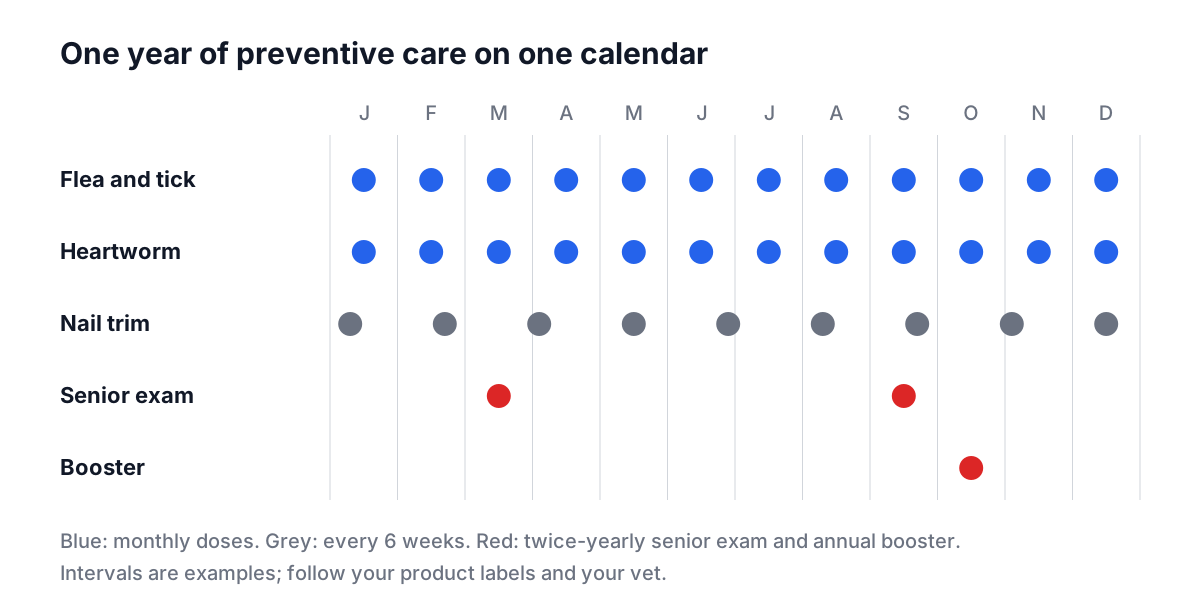
The Pet Care Reminder sorts tasks into four groups:
- Overdue: due before today.
- Upcoming: due today or within the next seven days.
- Later: further out, such as next spring's booster.
- Completed: ticked off, and reopenable if you ticked the wrong one.
Due dates are compared as whole calendar days in your time zone, so a task due today says "Due today" until midnight rather than turning overdue in the afternoon.
Worked example. Today is 24 October. You add four tasks: a flea dose due 20 October, a heartworm chew due today, a nail trim due 31 October and a booster due 23 November. The page shows the flea dose as "4 days overdue", the heartworm chew as "Due today" and the nail trim as "Due in 7 days" under Upcoming, and the booster under Later.
Two honest limitations. First, it does not send notifications; it shows you what is due when you open it. Pair it with a phone calendar alert for anything critical, or use the general Reminder Tool. Second, the frequency is a label: completing "Monthly flea treatment" does not create next month's task, so add the next date when you tick off the current one. Writing the product name and dose in the description saves arguments when someone else is looking after the pet.
Budget realistically with the Pet Expense Calculator
People underestimate pet costs in two ways: they mix frequencies, and they leave out the irregular bills.
The Pet Expense Calculator takes each cost at the frequency you actually pay it and converts everything through a yearly figure:
daily x 365, weekly x 52, monthly x 12, quarterly x 4, annually x 1
monthly total = yearly total / 12
That avoids the "4.33 weeks a month" and "30 days a month" shortcuts, which drift by a percent or two a year. One-time costs such as a crate, microchip or spay are kept out of the monthly and yearly totals and added once to the first-year and lifetime figures.
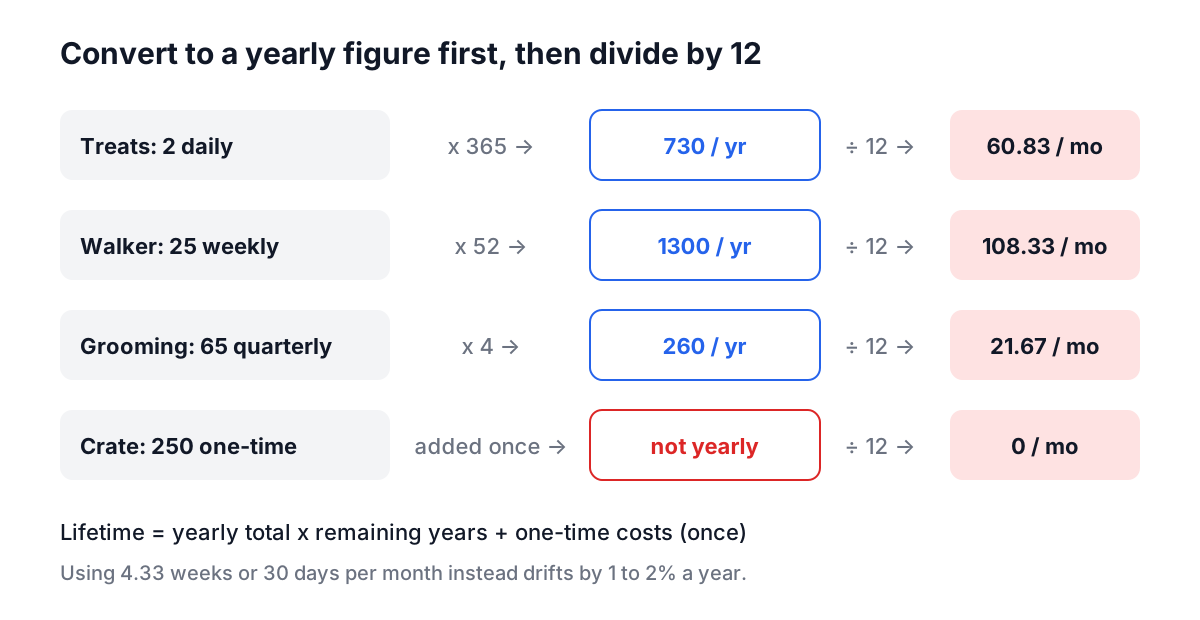
Worked example. A two-year-old dog with these costs:
| Item | Amount | Frequency | Per year | Per month |
|---|---|---|---|---|
| Food | 55 | Monthly | 660 | 55.00 |
| Treats | 2 | Daily | 730 | 60.83 |
| Insurance | 40 | Monthly | 480 | 40.00 |
| Vet wellness | 300 | Annually | 300 | 25.00 |
| Grooming | 65 | Quarterly | 260 | 21.67 |
| Crate and bed | 250 | One-time | (once) | (none) |
The calculator shows 202.50 a month and 2,430 a year, plus 250 in one-time costs. With a default dog lifespan of 13 years, the lifetime estimate covers 11 more years: 2,430 x 11 + 250 = 26,980.
Two things the example teaches. The daily treat habit costs more than the food, which surprises most people. And there is no line for emergencies. A single emergency surgery can cost more than a year of everything else, so either insurance or a monthly contribution to an emergency fund belongs in the list. The lifetime figure uses today's prices, so treat it as a floor. To fold the monthly number into the rest of your finances, the Budget Planner takes it from there.
Choose a name with the Pet Name Generator
Names are the fun part, but there is one practical rule: your pet will hear its name thousands of times, often alongside commands, so it should be easy to say and hard to confuse.
The Pet Name Generator offers ten names at a time from ten styles: Popular, Unique, Classic, Modern, Food, Nature, Mythology, Celebrity, Cute and Strong. Popular, Unique and Classic have separate lists for dogs, cats and small pets. Pick a gender (or Any), click names to collect a shortlist, then copy it for the family vote.
Checks before you commit:
- One or two syllables. Max, Luna, Biscuit. Longer names get shortened anyway, so choose the short form you will actually use.
- No rhyme with a cue. Kit sounds like "sit", Bo like "no", Ray like "stay", Dawn like "down". Say the name and your main cues aloud one after another.
- A clear first sound. Hard consonants (K, T, B, D) carry across a park better than soft ones.
- Distinct from people and other pets. A dog called Benny in a house with a Kenny will be confused, and so will Kenny.
Cats do learn their names. A 2019 study in Scientific Reports found pet cats reacted differently to their own name than to similar-sounding words, especially when the name had been linked with food or attention. Using the name before good things happen helps either species.
Putting the system together
Each record answers a question you will be asked. The weight log answers "has anything changed?". The care list answers "when was it last done?". The expense list answers "can we afford this, and for how long?". Set up all three in the first week with a new pet, or this weekend with the one you have: an ideal weight and first weigh-in, every preventive and booster date you can find on old invoices, and the five or six costs you pay regularly. Fifteen minutes now saves a lot of guessing in the exam room. If you want to put your pet's age in context as well, the dog and cat age guide explains when the senior checks start.