
How Big Should Your Emergency Fund Be?
Months of essential expenses, not income: what counts, how to choose between 3 and 12 months, where to keep the money and how long it takes to build.
· 9 min read
An emergency fund is cash you keep for the expenses you cannot plan: a job loss, a medical bill, a car that will not start, a roof that leaks. The usual advice is "three to six months of expenses", which leaves two questions open: months of which expenses, and why three for one person and six or more for another. This guide answers both, then works out how long it takes to build the fund, using the Emergency Fund Calculator so every figure can be checked. It explains the arithmetic and common practice; it is not personalised financial advice.
Why a cash buffer matters
The Federal Reserve's annual Survey of Household Economics and Decisionmaking (SHED) asks adults how they would pay an unexpected $400 expense. In the report on 2025, 63% said they would cover it with cash or its equivalent, unchanged from the year before. The rest would borrow, put it on a card and carry the balance, sell something, or could not pay it at all.
A $400 surprise is small next to a few months without a paycheck. Without savings, a short shock turns into high-interest debt, missed bills or early withdrawals from a retirement account with tax and penalties attached. The point of an emergency fund is to break that chain: the shock is paid from cash, and the rest of your plan carries on.
Months of essential expenses, not income
The fund is measured in months of essential spending: what you would still have to pay if your income stopped tomorrow. That is usually well below your take-home pay, because it leaves out saving, investing and spending you would cut in a crisis.
Count:
- Rent or mortgage, including property tax, home insurance and HOA dues
- Utilities, phone and internet
- Groceries (not restaurants)
- Insurance premiums: health, car, life, renters
- Transport to work and essential trips
- Minimum payments on every debt
- Childcare, medicine and other true must-pays
Leave out retirement contributions, extra debt payments, travel, subscriptions you would cancel and eating out. If you lose a job with employer health cover, add the cost of replacing it, because that line often grows in exactly the situation the fund is for.
The calculator has a field for each category and adds them up. Its defaults come to $3,500 a month:
| Category | Monthly |
|---|---|
| Rent or mortgage | $1,600 |
| Utilities and phone | $250 |
| Groceries | $600 |
| Insurance premiums | $350 |
| Transport | $300 |
| Minimum debt payments | $250 |
| Other must-pays | $150 |
| Essential total | $3,500 |
At six months the target is $3,500 x 6 = $21,000.
Choosing the number of months
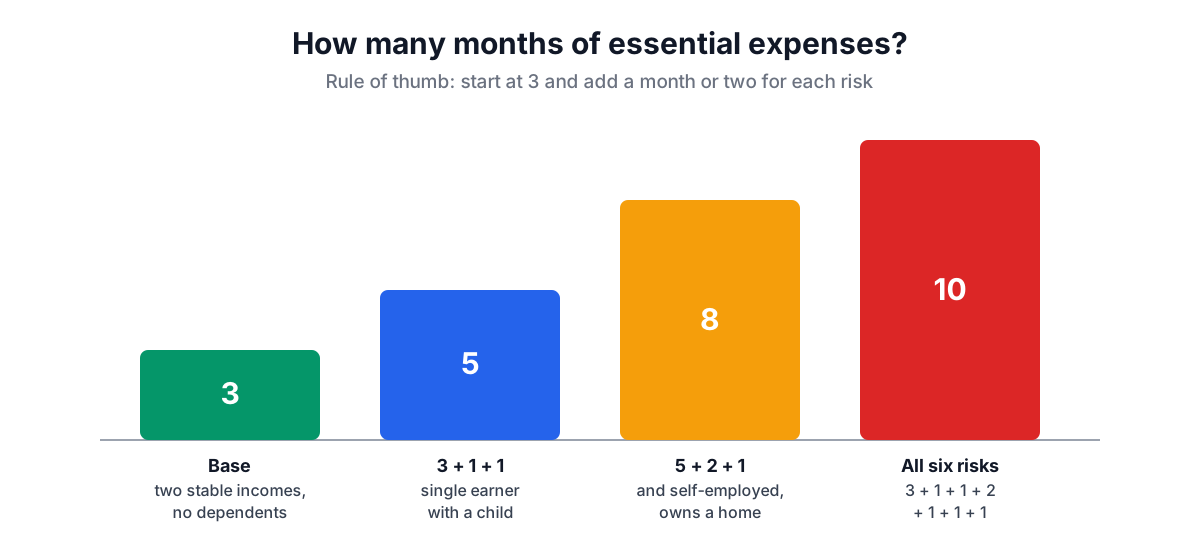
Three months is the common floor and six the common recommendation, but the right number depends on how likely a gap in income is, how long it could last, and how many people depend on the money. The calculator offers a rule of thumb rather than a formula from any official body: start at 3 months for a stable two-income household, and add months for each risk.
| Risk factor | Adds |
|---|---|
| One income in the household | +1 month |
| Children or other dependents | +1 month |
| Self-employed, commission or irregular income | +2 months |
| Homeowner (repairs fall on you) | +1 month |
| Job that takes a long time to replace | +1 month |
| High-deductible health plan | +1 month |
With all six factors the suggestion reaches 10 months, and the calculator never suggests more than 12. A single parent with one income starts at 3, adds 1 for the single income and 1 for the dependent: 5 months. Make that parent a self-employed homeowner and it becomes 8 months.
The reasoning behind each step:
- One income means one job loss stops all income, not half of it.
- Dependents raise essential costs and make cutting back harder.
- Variable income is the biggest factor. A freelancer can have a slow quarter with no layoff at all, and has no unemployment benefit or severance to soften it.
- Owning a home means a furnace, roof or water heater is your bill, not the landlord's.
- A specialised job may take many months to replace at the same pay.
- A high-deductible health plan can mean several thousand dollars due before insurance pays.
Treat the suggestion as a starting point. Unemployment insurance, a partner's stable job or a large taxable investment account can justify fewer months; a chronic health condition or an unstable industry can justify more. Type your own figure into Target months and the calculator uses that.
How long it takes to build
Once the target is set, the question is time. The calculator adds your monthly saving to the balance each month and pays interest at the account's APY, converted to a monthly rate:
monthly rate = (1 + APY)^(1/12) - 1
balance next month = balance x (1 + monthly rate) + monthly saving
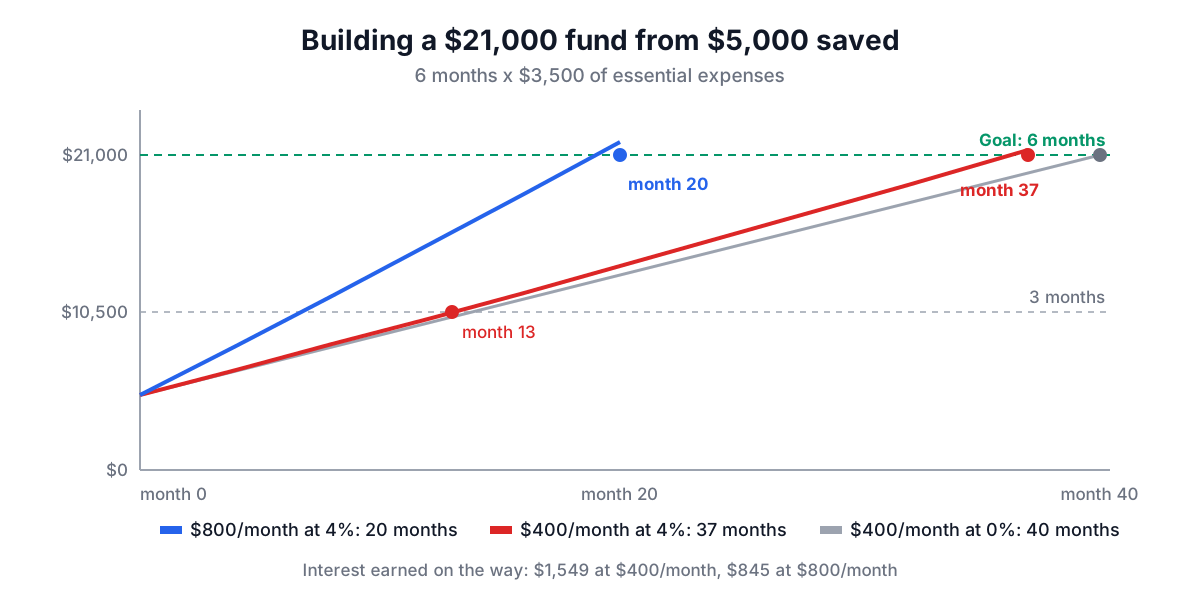
With the $21,000 target, $5,000 already saved and $400 a month going in at a 4% APY:
- $5,000 covers 1.4 months of essentials today, and $16,000 is still to save.
- The 3-month mark ($10,500) is reached in month 13.
- The full $21,000 is reached in month 37, a little over three years.
- Along the way you deposit $14,800 and earn $1,549.11 in interest.
The interest helps, but the saving rate matters far more:
| Monthly saving | APY | Months to $21,000 | Interest earned |
|---|---|---|---|
| $400 | 0% | 40 | $0 |
| $400 | 4% | 37 | $1,549.11 |
| $800 | 4% | 20 | $845.28 |
Doubling the monthly amount nearly halves the time. Interest earned falls because the money sits in the account for fewer months, which is a good trade. A practical approach is to set an automatic transfer on payday and put windfalls such as a tax refund or bonus straight into the fund.
A second example, for someone with irregular income: essentials of $4,200 a month and a 9-month target give $37,800. With $12,000 saved (2.9 months) and $900 a month at 4%, the 3-month mark arrives in month 1 and the goal in month 27, with $2,170.04 of interest.
Where to keep the money
An emergency fund has three requirements: it must not lose value, you must be able to reach it within a day or two, and it should earn something. In practice that points to:
- A high-yield savings account or money market deposit account at an FDIC-insured bank or NCUA-insured credit union. FDIC deposit insurance covers $250,000 per depositor, per insured bank, per ownership category, which is more than most emergency funds.
- Money market funds or short Treasury bills for part of a larger fund. These are not deposit insurance products, but their value moves very little.
Stocks are not a good home for the core fund. Markets tend to fall in the same recessions that cause layoffs, so you could be forced to sell at a loss just when you need the cash. CDs can work for a slice of a large fund if the early-withdrawal penalty is small. A HELOC or credit card is not an emergency fund: lenders can reduce or freeze lines in a downturn. The HELOC guide explains when that can happen.
To compare savings accounts by APY, the APY Calculator converts quoted rates and shows what a balance earns.
Emergency fund or paying off debt first?
Many people have both a thin cushion and debt at 20% or more on credit cards. Paying the debt looks better on paper, but with no cash at all, the next car repair goes straight back on the card. A common order of priorities:
- Save a small starter buffer, often one month of essentials or $1,000 to $2,000.
- Take any employer retirement match, which is an immediate return.
- Pay down high-interest debt aggressively, using the Debt Payoff Calculator to plan it.
- Finish the full emergency fund, then move on to other goals.
Each step reduces the chance that a surprise undoes the previous one.
Using the calculator
- Enter each essential monthly cost. The total updates as you type.
- Tick the risk factors that apply and press "Use N months" to take the suggestion, or type your own number of months.
- Enter what you have saved, how much you can add each month and the account's APY.
- Read the target, the months covered now, the amount still to save and the time to the goal, and check the milestone table for the 1-month and 3-month marks.
- Copy the result or share a link that reopens the same figures.
Limits to keep in mind: the suggested months are a rule of thumb, not a standard; the APY is held constant although savings rates change; taxes on interest are ignored; and the plan assumes the same deposit every month. If your essentials change, after a move or a new child, run it again.
The fund is one line in a wider plan. The Budget Planner helps find the monthly saving, the Savings Goal Calculator works for other targets such as a down payment, and the Net Worth Calculator shows the fund as part of your liquid assets.
Sources
- Board of Governors of the Federal Reserve System, Economic Well-Being of U.S. Households in 2025 (Survey of Household Economics and Decisionmaking), section on dealing with unexpected expenses.
- Consumer Financial Protection Bureau, "An essential guide to building an emergency fund" and related emergency savings resources.
- Federal Deposit Insurance Corporation, "Deposit Insurance FAQs" and "Understanding Deposit Insurance" ($250,000 standard maximum deposit insurance amount).
- National Credit Union Administration, share insurance coverage for credit union accounts.
Related searches
- how much emergency fund do i need
- 3 or 6 months emergency fund
- emergency fund calculator
- essential expenses list
- where to keep emergency fund
- emergency fund for self employed
- high yield savings emergency fund
- how long to build an emergency fund
- emergency fund vs paying off debt
- months of expenses saved