
Fuel Injector Sizing: BSFC, Duty Cycle and Fuel Pressure
The injector sizing formula step by step, sensible BSFC values for naturally aspirated, blower and turbo engines, E85 and methanol, lb/hr to cc/min, and the square-root pressure law.
· 10 min read
Injectors that are too small are one of the classic ways to hurt a modified engine: at full load the duty cycle hits 100%, the injectors go static, and the mixture leans out exactly where cylinder pressure and temperature are highest. Injectors that are far too large cause the opposite problem, poor idle and part-throttle control. Sizing them is simple arithmetic once you understand the four inputs: power, BSFC, injector count and duty cycle. This guide works through each, then covers alternative fuels, unit conversions and fuel pressure. The Fuel Injector Size Calculator runs the same numbers.
The sizing formula
Injector flow (lb/hr) = horsepower × BSFC ÷ (number of injectors × maximum duty cycle)
Each term has a physical meaning:
- Horsepower × BSFC is the total fuel the engine burns per hour at peak power, in pounds.
- Number of injectors shares that fuel out. Port injection normally has one per cylinder.
- Maximum duty cycle is the fraction of each engine cycle the injector is open at peak power. At 80%, each injector only delivers 80% of its rated flow.
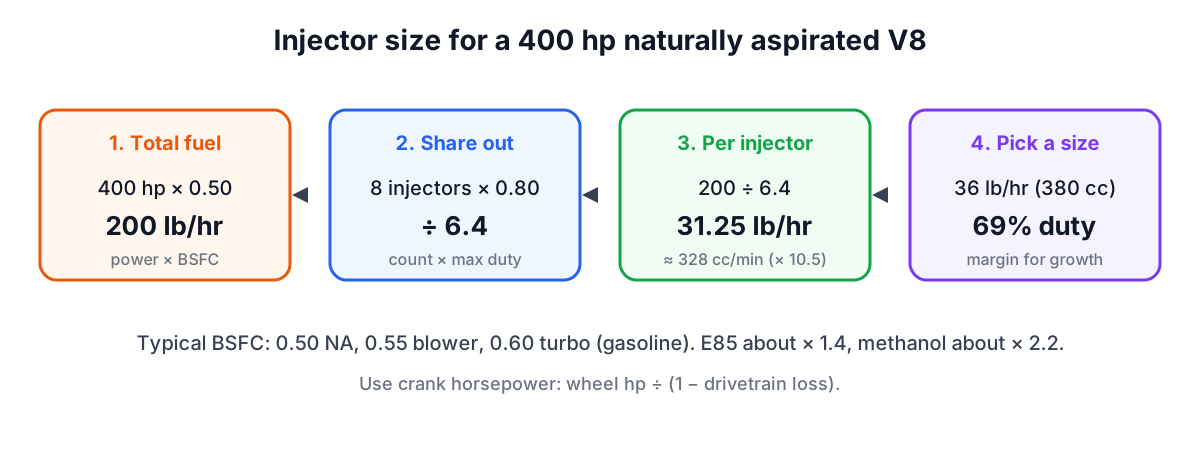
Example: a 400 hp naturally aspirated V8 with BSFC 0.50 and a target of 80% duty.
- Total fuel: 400 × 0.50 = 200 lb/hr.
- Per injector: 200 ÷ (8 × 0.80) = 31.25 lb/hr, about 328 cc/min.
A 36 lb/hr (roughly 380 cc/min) injector would run at about 69% duty, which leaves room for a hotter cam or added boost later.
BSFC: the number that does the most work
Brake specific fuel consumption is the mass of fuel burned per horsepower per hour, in lb/hp·hr (or g/kWh in metric; multiply lb/hp·hr by 608 to convert). It describes how efficiently an engine turns fuel into crankshaft power at a given operating point. For injector sizing you want the value at peak power, where the engine runs rich for cooling and is less efficient than at cruise.
Typical full-load sizing values used across the tuning industry:
| Engine | Gasoline BSFC (lb/hp·hr) |
|---|---|
| Naturally aspirated, efficient modern head | 0.45 to 0.50 |
| Belt-driven blower (positive displacement or centrifugal) | 0.55 to 0.60 |
| Turbocharged | 0.60 to 0.65 |
Boosted engines run higher BSFC because they are fuelled richer to control combustion temperature and knock, and a belt-driven blower takes crank power to drive. The calculator's presets are 0.50, 0.55 and 0.60. If you have dyno data with measured fuel flow, calculate your own: BSFC = fuel flow (lb/hr) ÷ horsepower. A difference of 0.05 in BSFC changes the injector size by 8 to 10%, more than most other choices you make.
Crank horsepower, not wheel horsepower
BSFC is defined at the crankshaft. A chassis dyno measures at the wheels, after gearbox, differential and tyre losses. Convert first:
Crank hp = wheel hp ÷ (1 − loss)
With 15% loss, 300 whp is 300 ÷ 0.85 = 353 crank hp. Losses are often quoted as 10 to 15% for manual rear-wheel drive and 15 to 20% or more for automatics and all-wheel drive, but these are rough; using the wrong figure is better than mixing wheel and crank numbers.
Duty cycle and headroom
Duty cycle is the fraction of time the injector is open: pulse width ÷ time per engine cycle. A four-stroke engine fires each cylinder once every two revolutions, so at 7,000 rpm one cycle takes 60 ÷ 7,000 × 2 = 17.1 ms. An injector at 80% duty is open for 13.7 ms of that.
Most tuners size for 80 to 85% at peak power. Above that the injector has too little time to close and reopen cleanly, flow becomes less linear, and there is no margin for a hot day, a tired pump or a richer target. Running a turbo four at 66 lb/hr per injector:
| Injector rating | Duty at peak |
|---|---|
| 550 cc/min (52.4 lb/hr) | 126%, impossible |
| 750 cc/min (71.4 lb/hr) | 93%, too close |
| 850 cc/min (81.0 lb/hr) | 82%, acceptable |
| 1000 cc/min (95.2 lb/hr) | 70%, comfortable |
Alcohol fuels
Ethanol and methanol carry less energy per pound than gasoline, so more of them is needed for the same power. A practical indicator is the stoichiometric air-fuel ratio: about 14.7 for gasoline, about 9.8 for E85 and about 6.4 for methanol. The ratio 14.7 ÷ 9.8 suggests 50% more E85, but in practice engines on E85 make a little more power per unit of energy and tuners typically see 30 to 40% more fuel flow. The calculator scales gasoline BSFC by 1.4 for E85 and 2.2 for methanol.
The same turbo four from above on E85: BSFC 0.60 × 1.4 = 0.84, so 352.9 × 0.84 ÷ (4 × 0.8) = 92.6 lb/hr per injector, which is why E85 conversions so often go to 1000 cc injectors and a larger pump.
lb/hr and cc/min
US suppliers rate injectors in lb/hr, most others in cc/min. The conversion depends on fuel density:
cc/min = lb/hr × 453.6 ÷ 60 ÷ density (g/cc)
With a specific gravity of 0.72, that is lb/hr × 10.5, the familiar trade rule. The calculator uses 0.72 for gasoline, 0.78 for E85 and 0.79 for methanol. Injector makers measure flow on a calibration fluid at a stated pressure, so compare ratings at the same test pressure, and treat the conversion as approximate to a few percent.
Fuel pressure: the square-root law
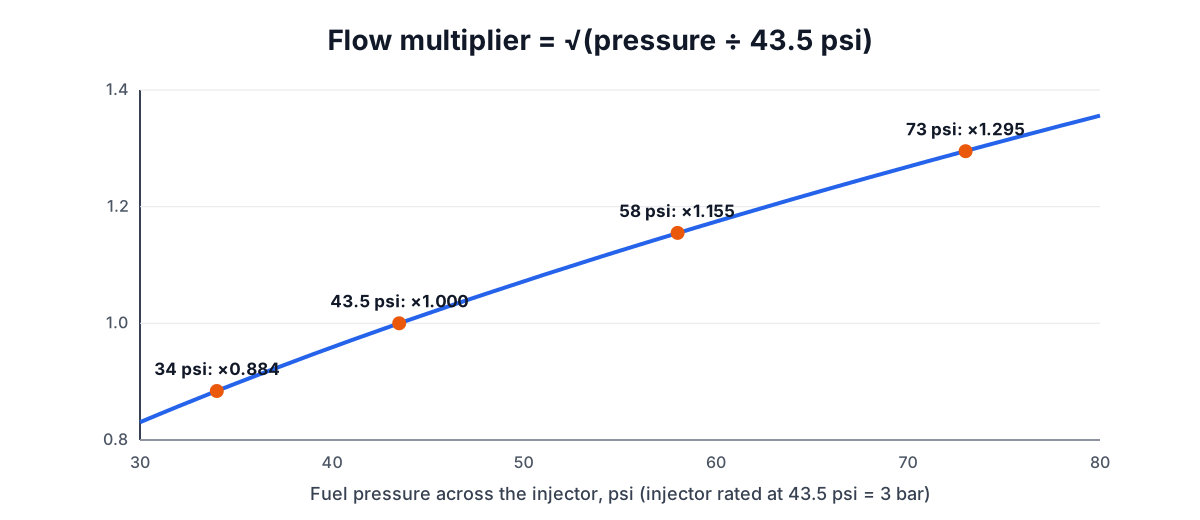
Flow through an injector behaves like flow through an orifice: it is proportional to the square root of the pressure difference across it.
Flow at new pressure = rated flow × √(new pressure ÷ rated pressure)
An injector rated at 43.5 psi (3 bar) delivers √(58 ÷ 43.5) = 1.155 times its rating at 58 psi (4 bar). So if you need 66.2 lb/hr at 58 psi, an injector rated at 66.2 ÷ 1.155 = 57.3 lb/hr at 43.5 psi will do.
What matters is the pressure difference between the fuel rail and the intake manifold. Most boosted engines use a 1:1 rising-rate regulator that raises rail pressure one psi for every psi of boost, so the difference stays at the base pressure. Returnless systems with fixed rail pressure lose effective pressure under boost, and the ECU must compensate. The square-root law is an approximation: at very high or very low pressures, injector opening and closing times (dead time) change, and that is why modern tunes use the injector maker's characterisation data.
Reversing the formula: what do my injectors support?
Horsepower = injector flow × number of injectors × duty cycle ÷ BSFC
Four 550 cc/min injectors (52.4 lb/hr) at 80% duty on a turbo engine with BSFC 0.60: 52.4 × 4 × 0.8 ÷ 0.6 = 279 crank hp, about 237 whp at 15% loss. Six 1000 cc injectors on the same terms support about 762 crank hp on gasoline.
Beyond the injectors
The injectors are only one link. The fuel pump must deliver the engine's total flow at the rail pressure you run (plus boost on a rising-rate system), at the voltage the car actually provides under load. Pump flow charts drop steeply with pressure, so a pump rated for 255 litres per hour at 40 psi may deliver far less at 70 psi. Lines, filter and regulator must flow it too, and with E85 every component must be ethanol compatible.
Sources
- Bosch Automotive Handbook, sections on gasoline injection and specific fuel consumption.
- SAE J1349, engine power test code, for the definition of brake power at the crankshaft.
- Injector and pump makers' flow data at stated test pressures.
Related tools: the Horsepower Calculator for power estimates, the Compression Ratio Calculator for boosted builds, and our torque, horsepower and rpm guide.
Related searches
- fuel injector size formula
- bsfc values turbo
- injector duty cycle
- lb/hr to cc/min
- e85 injector size
- injector flow vs fuel pressure
- what injectors for 500 hp
- wheel hp to crank hp
- injector dead time