
Grass Seed Rates and Sod Ordering for a New Lawn
Seeding rates by species for new lawns and overseeding, why bluegrass and tall fescue differ tenfold, unit conversions, and how many pieces and pallets of sod to order.
· 9 min read

How much grass seed a lawn needs depends far more on the species than on the lawn. A pound of Kentucky bluegrass holds well over a million seeds; a pound of tall fescue holds only a few hundred thousand. Sow both at the same weight and one lawn is crowded while the other is patchy. This guide covers seeding rates by species, new lawns versus overseeding, the unit conversions, and how to order sod by the piece and pallet. The Grass Seed and Sod Calculator applies the same rules to your lawn.
Measure the lawn first
Rates are given per area, so start with the area you will actually seed. Measure the lawn as rectangles, add them, and leave out flower beds, patios, paths and the footprint of sheds. A lawn that wraps round a house is usually two or three rectangles. Curved edges can be approximated with a rectangle and a triangle, or measured with the Square Footage Calculator.
In the US, seed labels quote pounds per 1,000 square feet. In most other countries rates are grams per square metre. The conversion is:
1 lb per 1,000 ft² = 453.6 g / 92.9 m² = 4.88 g/m²
So 8 lb per 1,000 square feet is about 39 g/m², and 2 lb is about 10 g/m².
Seeding rates by species
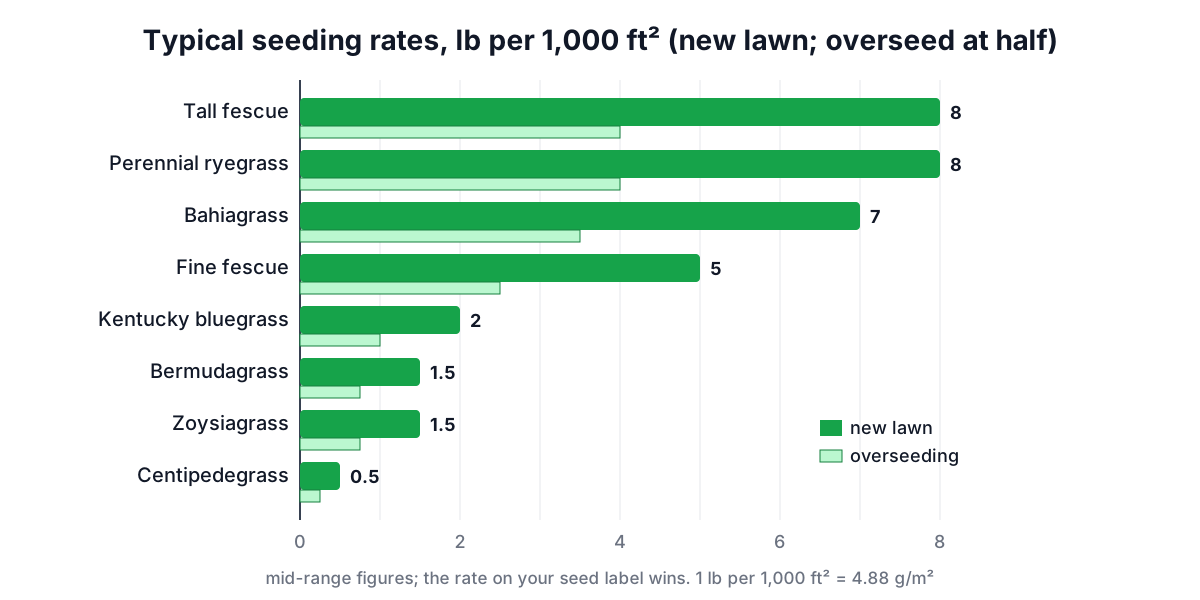
Rates come from university extension services and seed companies, and they vary between sources, between climates and between seed lots. The figures below are typical ranges for seeding bare soil. The rate on your seed bag is the one to follow, because it reflects that cultivar's seed size and the lot's germination.
| Grass | Season | New lawn, lb per 1,000 ft² | g/m² |
|---|---|---|---|
| Tall fescue | cool | 7 to 9 | 34 to 44 |
| Perennial ryegrass | cool | 7 to 9 | 34 to 44 |
| Fine (red) fescue | cool | 4 to 6 | 20 to 29 |
| Kentucky bluegrass | cool | 1 to 3 | 5 to 15 |
| Sun and shade mixes | cool | 4 to 6 | 20 to 29 |
| Bermudagrass (hulled) | warm | 1 to 2 | 5 to 10 |
| Zoysiagrass | warm | 1 to 2 | 5 to 10 |
| Centipedegrass | warm | 0.25 to 1 | 1 to 5 |
| Bahiagrass | warm | 5 to 10 | 24 to 49 |
| Buffalograss | warm | 1 to 3 | 5 to 15 |
UMass Extension, for example, lists 7 to 9 lb for tall fescue and perennial ryegrass, 1 to 2 lb for Kentucky bluegrass and 4 to 6 lb for red fescue. Warm-season figures come from southern extension services and seed labels; centipedegrass in particular is quoted anywhere from a quarter of a pound to a pound or two. St. Augustinegrass is not on the list because it is almost always planted as sod, plugs or sprigs rather than seed.
Why the spread? Seed size. The rate aims at a target number of seeds per square foot, and a tall fescue seed is many times heavier than a bluegrass seed. Bluegrass spreads by rhizomes and fills in over time, so it can start thinner; tall fescue is a bunch grass that relies on a dense initial stand.
New lawn or overseeding
Overseeding drops seed into an existing lawn to thicken it, introduce a better cultivar or repair thin areas. The usual guidance is about half the new-lawn rate, because the existing grass already covers much of the ground. For tall fescue that is about 4 lb per 1,000 square feet; for bluegrass about 1 lb.
Overseeding works best when seed reaches soil. Mow low, rake out thatch or use a slit seeder or core aerator first, then seed. Bare patches inside an overseeded lawn deserve the full new-lawn rate.
Worked seed examples
| Lawn | Grass | Job | Rate | Seed |
|---|---|---|---|---|
| 50 x 40 ft (2,000 ft²) | Tall fescue | New | 8 lb | 16 lb |
| 2,000 ft² | Tall fescue | Overseed | 4 lb | 8 lb |
| 5,000 ft² | Kentucky bluegrass | Overseed | 1 lb | 5 lb |
| 3,000 ft² | Bermudagrass | New | 1.5 lb | 4.5 lb |
| 200 m² | Tall fescue | New | 39 g/m² | 7.8 kg |
Seed is sold in bags from a pound or two up to 50 lb. Round up to whole bags; leftover seed keeps for a season or two if it is stored cool and dry, though germination declines with age.
More seed is not better. Sowing at double the rate produces a crowded stand of thin seedlings that compete for light and water and are more prone to disease, and the extra seed costs money. Uneven spreading is the more common problem: split the seed in two and spread half walking north and south, the other half east and west.
Timing
Cool-season grasses (fescues, bluegrass, ryegrass) germinate best when soil is around 50 to 65 °F, which in most of the northern US means late summer to early autumn, with spring as second choice. Warm-season grasses (bermuda, zoysia, centipede, bahia, buffalo) need warm soil, roughly 65 to 70 °F and above, so they are sown in late spring and early summer. Seed sown at the wrong time either sits dormant or germinates into weather that kills it.
Ordering sod
Sod is mature turf cut with a thin layer of soil and sold in slabs or rolls. Common sizes in the US are 16 by 24 inch slabs (2.67 square feet), 18 by 24 inch slabs (3 square feet) and 2 by 5 foot rolls (10 square feet). In the UK and Europe turf is usually sold in rolls of about 1 square metre. Farms stack pieces on pallets that typically cover 400 to 500 square feet, but this varies, so ask yours.
area to order = lawn area x (1 + extra %)
pieces        = ceiling(area to order / piece area)
pallets       = pieces x piece area / pallet coverage
Allow 5% extra for a simple rectangular lawn and 10% where there are curves, beds and trees to cut around. For 1,000 square feet of 16 by 24 inch slabs with 5% extra that is 1,050 / 2.67 = 394 pieces, or 2.33 pallets of 450 square feet. For 2,000 square feet it is about 4.7 pallets: order five.
Sod is perishable. On a warm day the inner pieces of a pallet heat up within a day, so schedule delivery for when you can lay it. Prepare the soil first: grade it, rake it smooth and firm, and moisten it. Lay pieces with staggered joints like brickwork, pressed tight but not overlapping, then roll and water deeply so the soil below is wet.
Seed or sod?
Seed is much cheaper in materials: a bag of tall fescue for 2,000 square feet costs a small fraction of five pallets of sod. Sod gives an instant, usable lawn, chokes out weeds from day one and works on slopes where seed would wash away. Seed needs weeks of regular watering and a gentle hand until it establishes. The calculator lets you enter local prices for both and compare them for the same area.
Sources and further reading
- UMass Extension, "Seeding rate considerations" (cool-season seeding rates).
- University extension turf publications and seed labels for warm-season rates.
- Unit conversion: 1 lb = 453.59237 g; 1 ft² = 0.09290304 m².
Plan your own lawn with the Grass Seed and Sod Calculator, and price topsoil or mulch for beds with the Gravel and Mulch Calculator.
Related searches
- grass seed per 1000 sq ft
- tall fescue seeding rate
- overseeding rate
- how many pallets of sod
- sod pallet coverage
- seed vs sod cost
- when to plant grass seed
- grass seed g per m2