
How Many Bricks and How Much Mortar? Estimating Masonry Walls
Units per area from brick size and joint, why modular brick gives 675 per 100 ft², mortar by geometry, face-shell bedding for block, collar joints and BIA waste allowances.
· 10 min read
Counting bricks looks like simple division: wall area over brick face. The catch is that every brick in a wall takes up its own face plus a share of the mortar joints around it, and that share changes the answer by 10 to 20%. Mortar has its own geometry, and hollow concrete block uses mortar very differently from solid brick. This post covers the formulas, the published reference figures, and the allowances that turn a theoretical count into an order, with examples you can rerun in the Brick and Block Calculator.
The module: brick size plus one joint
Lay a brick in running bond and look at the rectangle it "owns": its length plus one head joint, by its height plus one bed joint. The number of units per unit area is one over that rectangle.
units per area = 1 / ((length + joint) x (height + joint))
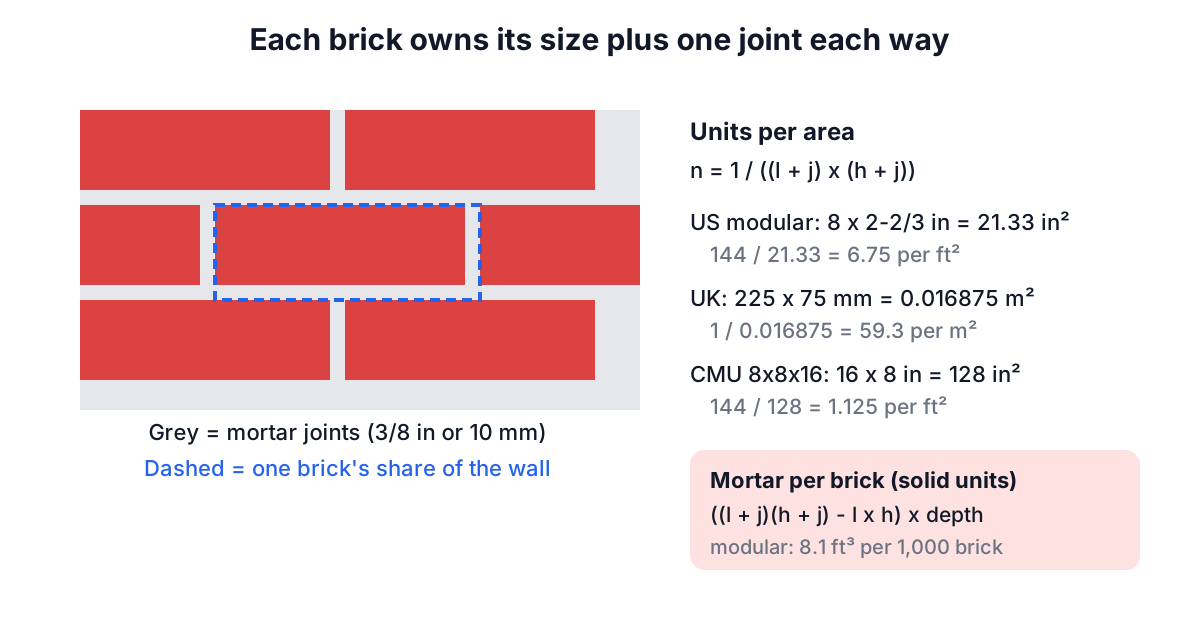
US modular brick is designed around this. Its specified size is 3-5/8 x 2-1/4 x 7-5/8 in, so with a 3/8 in joint it occupies 8 in of length, and three courses rise exactly 8 in. One brick therefore owns 8 x 2-2/3 = 21.33 square inches, and 144 / 21.33 = 6.75 brick per square foot. The Brick Industry Association's Technical Note 10 lists exactly 675 modular brick per 100 square feet at a 3/8 in joint. A non-modular "standard" brick 8 in long gives 655 per 100 square feet.
Other common sizes:
| Unit | Actual size | Joint | Units per area |
|---|---|---|---|
| US modular brick | 3-5/8 x 2-1/4 x 7-5/8 in | 3/8 in | 6.75 per ft² |
| US standard brick | 3-5/8 x 2-1/4 x 8 in | 3/8 in | 6.55 per ft² |
| CMU 8x8x16 | 7-5/8 x 7-5/8 x 15-5/8 in | 3/8 in | 1.125 per ft² |
| UK brick | 215 x 102.5 x 65 mm | 10 mm | 59.3 per m² |
| Indian modular (IS 1077) | 190 x 90 x 90 mm | 10 mm | 50 per m² |
| Indian traditional | 230 x 110 x 70 mm | 10 mm | 52.1 per m² |
These are per wythe, a single leaf of units one brick thick. A double-wythe wall, such as the 230 mm "one brick" wall common in India or a US brick wall with a collar joint, needs twice as many.
Openings and bond
Subtract doors and windows from the gross wall area before multiplying. A 20 x 8 ft garden wall with a 3 x 7 ft door and two 3 x 4 ft windows loses 45 of its 160 square feet, leaving 115 square feet, or 776 modular brick net.
Running and stack bond use the module directly. Bonds that turn units sideways as headers (English, Flemish, common bond with a header course every sixth course) put more brick into the same face area because a header shows only its end. BIA TN 10 gives correction factors; for example, full headers every fifth course add one fifth to the count. If your wall uses a decorative bond, apply the factor before adding waste.
Mortar by geometry
For solid units with full mortar beds, the mortar per unit is the volume of the unit's module minus the volume of the unit:
mortar per unit = ((l + j) x (h + j) - l x h) x depth
For modular brick that is (8 x 2.667 - 7.625 x 2.292) x 3.625, about 14 cubic inches, or 8.1 cubic feet per 1,000 brick. BIA TN 10 Table 4 gives the same 8.1 cubic feet per 1,000 modular brick and 5.5 cubic feet per 100 square feet of wall. Double-wythe walls with a filled collar joint add the joint's volume: a 3/8 in collar joint holds 100 x 0.03125 = 3.13 cubic feet per 100 square feet, which is BIA's Table 5 figure.
Hollow concrete block is different. TMS 602 and normal practice lay hollow units with face-shell bedding: mortar goes only on the two face shells, typically 1-1/4 in thick on an 8 in unit, not across the webs and cores. That uses roughly a third of the mortar a full bed would. Cells that are reinforced get grout later, which is a separate quantity measured by the cell volume.
Waste and turning mortar into bags
The theoretical numbers exclude waste. BIA recommends adding at least 5% to brick for breakage and cutting and 15 to 25% to mortar for droppings, mortar left on boards and batches that stiffen before use. The same TN 10 notes the mason's rule of eight bags of masonry cement per 1,000 modular brick and calls it a very rough estimate that includes an unspecified amount of waste. The geometric method plus a stated allowance is easier to defend.
To buy materials for site-mixed mortar, use a dry volume factor, the same idea as for concrete in Concrete Mix Ratios and the 1.54 Dry Volume Factor, but smaller because there is no coarse aggregate: about 1.27 to 1.33. For a 1:n cement to sand mortar:
dry volume    = wet mortar x 1.33
cement volume = dry volume / (1 + n)
sand volume   = dry volume - cement volume
In the US, ASTM C270 proportions masonry cement mortar at about one part masonry cement to 2.25 to 3 parts damp loose sand, and a bag of masonry cement is counted as one cubic foot. In India, brick walls typically use 1:6 cement mortar, and 1:4 for half-brick partitions and exposed work, with 50 kg bags of cement at 1,440 kg/m³.
Worked examples
US garden wall. 776 net modular brick plus 5% is 816 to buy. Mortar is 776 x 0.0081 = 6.3 cubic feet, or 7.5 with 20% waste. At 1:3 with a 1.33 factor, cement is 7.5 x 1.33 / 4 = 2.5 cubic feet, so three 70 lb bags of masonry cement, and sand is about 7.5 cubic feet.
Indian nine-inch wall. A 5 x 3 m wall in 230 x 110 x 70 mm brick, two leaves with a 10 mm collar joint, with a 0.9 x 2.1 m door and a 1.2 x 1.2 m window. Net area is 11.67 m², and 52.1 brick per m² per leaf gives 1,216 brick, or 1,277 with 5%. Mortar is much higher per square metre than in the US wall, 0.64 m³ wet with waste, because smaller bricks mean more joints. At 1:6 that is 3.5 bags of cement and 0.73 m³ of sand.
Block planter. A 40 x 4 ft wall of 8x8x16 CMU is 160 square feet, 180 blocks net and 189 with 5%. Face-shell bedding needs only about 2.8 cubic feet of mortar including waste.
Common mistakes and limits
- Dividing by the brick face without the joint. For modular brick that gives about 8.4 per square foot instead of 6.75, a 24% overestimate.
- Using nominal block sizes (8 x 16 in) as actual sizes and then adding a joint, which double-counts the joint.
- Forgetting the second wythe in a cavity or solid double wall.
- Computing hollow block mortar as if the units were solid.
- Ignoring corners, piers and returns, which need extra units to keep the bond.
Masonry walls that retain soil, carry floors or resist wind need structural design: reinforcement, lintels over openings, wall ties for veneers and movement joints. Those details come from an engineer and the governing code (TMS 402/602 in the US, Eurocode 6 in Europe, IS 1905 in India).
For the footing under the wall, use the Concrete Calculator for volume and the Rebar Calculator for the steel. If the wall is part of a room you are finishing, the Square Footage Calculator and the Drywall Calculator cover the inside faces.