
Concrete Mix Ratios and the 1.54 Dry Volume Factor Explained
Where the 1.54 factor comes from, how 1:2:4 becomes bags of cement, what IS 456 Table 9 says about nominal mixes, and why water-cement ratio matters more than the ratio printed on the drawing.
· 10 min read

A drawing that says "1:2:4" is giving a recipe by loose volume: one part cement, two parts sand, four parts coarse aggregate. It does not say how many bags to buy for a 3 cubic metre slab. Getting from the ratio to an order needs three numbers that are easy to misremember: the dry volume factor, the bulk density of cement, and the water-cement ratio. This post explains where each one comes from, with numbers you can reproduce in the Concrete Mix Ratio Calculator.
Why dry materials take up more room than concrete
Pour a bucket of dry coarse aggregate and it is about 35 to 45% air. Sand poured on top runs into those voids, and cement paste fills the smaller gaps between sand grains. So the loose volumes of the ingredients do not add up to the volume of concrete they make. In practice, one cubic metre of compacted concrete needs about 1.52 to 1.57 cubic metres of dry, loose materials. Indian and South Asian textbooks and site engineers use 1.54, and the figure also absorbs some bulking of damp sand and a little loss in handling.
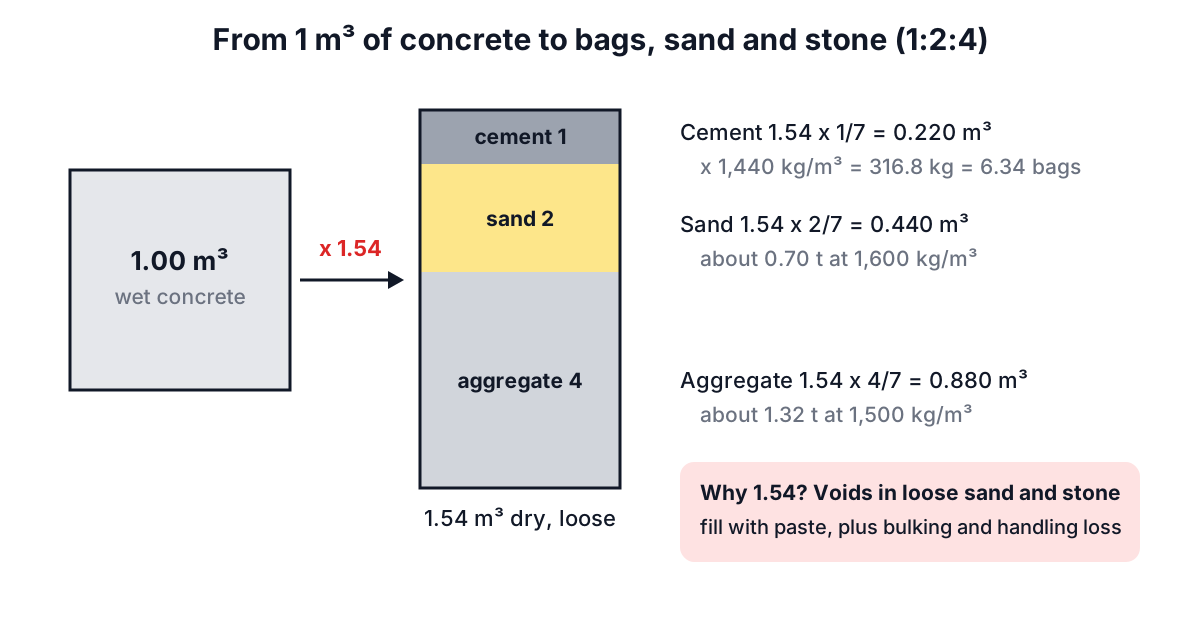
With the factor in hand, the arithmetic is a proportion:
dry volume       = wet volume x 1.54
cement volume    = dry volume x c / (c + s + a)
cement mass      = cement volume x 1,440 kg/m³
bags             = cement mass / 50 kg
sand, aggregate  = dry volume x s / (c + s + a), dry volume x a / (c + s + a)
water (litres)   = w/c x cement mass (kg)
For 1 m³ of 1:2:4, the parts add to 7, so cement is 1.54 / 7 = 0.220 m³. At the conventional bulk density of 1,440 kg/m³, that is 316.8 kg, or 6.34 bags of 50 kg. Sand is 0.44 m³ and aggregate 0.88 m³. Those are the figures you will find in most Indian estimating textbooks, which is a useful check that the method matches local practice.
The 1,440 kg/m³ figure is a convention for loose cement and makes a 50 kg bag 0.0347 m³ (34.7 litres). In the US the convention is different: a sack of portland cement is 94 lb and is taken as one loose cubic foot, a bulk density of 94 lb/ft³ (about 1,506 kg/m³). The calculator offers both. With the US rule, a cubic yard of 1:2:3 needs 27 x 1.54 = 41.6 ft³ of dry material, and one sixth of it, 6.93 ft³, is also 6.93 sacks.
Nominal mixes and IS 456 Table 9
The familiar ratios map to strength grades. IS 456:2000 clause 9.3 allows nominal mix concrete only for grades up to M20 and gives the proportions by mass in Table 9:
| Grade | Total aggregate per 50 kg cement | Traditional volume ratio | Max water per 50 kg cement |
|---|---|---|---|
| M5 | 800 kg | 1:5:10 | 60 L |
| M7.5 | 625 kg | 1:4:8 | 45 L |
| M10 | 480 kg | 1:3:6 | 34 L |
| M15 | 330 kg | 1:2:4 | 32 L |
| M20 | 250 kg | 1:1.5:3 | 30 L |
Fine to coarse aggregate is generally 1:2 by mass, adjustable between 1:1.5 and 1:2.5 depending on grading. If you convert the volume ratios with a bag volume of 0.0347 m³ and a loose aggregate density near 1,550 kg/m³, you land within a few percent of the Table 9 masses, which is how the two descriptions coexist on Indian sites. Grade M20 means a characteristic cube strength of 20 MPa at 28 days; the nominal mix is a recipe expected to get there with ordinary materials and care, but the code still requires acceptance testing.
Richer mixes cost more cement. Per cubic metre, 1:3:6 needs about 4.4 bags, 1:2:4 about 6.3 and 1:1.5:3 about 8.1, so stepping from M15 to M20 adds 27% more cement. The calculator's reference table lists every common ratio side by side.
Water-cement ratio: the number that controls strength
Duff Abrams showed in 1918 that, for workable concrete made from sound materials, strength falls as the ratio of water to cement rises. That relationship, not the 1:2:4 ratio, is what governs strength and durability. Every extra litre of water that makes the mix easier to place leaves pores behind when it evaporates.
Water by mass is simply the w/c ratio times the cement mass. For the 1:2:4 cubic metre above at w/c 0.5, that is 158 litres. IS 456 Table 5 limits the maximum free w/c ratio for reinforced concrete from 0.55 in mild exposure to 0.45 in severe and 0.40 in extreme exposure, and ACI 318 sets similar limits by exposure class. Damp sand already carries water, often 3 to 6% by mass, which counts toward the total. When the mixer operator adds water "until it looks right", the effective w/c ratio can easily drift past 0.6.
A worked slab, step by step
A 5 x 4 m floor slab 150 mm thick is 3.0 m³. With 5% added for waste it is 3.15 m³. In 1:2:4:
- Dry volume = 3.15 x 1.54 = 4.85 m³.
- Cement = 4.85 / 7 = 0.693 m³ x 1,440 = 998 kg = 19.96, so 20 bags of 50 kg.
- Sand = 4.85 x 2 / 7 = 1.39 m³, about 2.2 t at 1,600 kg/m³ loose.
- Aggregate = 4.85 x 4 / 7 = 2.77 m³, about 4.2 t at 1,500 kg/m³.
- Water at w/c 0.5 = 0.5 x 998 = 499 litres.
Bulk densities of sand and stone vary with grading and moisture, roughly 1,450 to 1,700 kg/m³ for dry loose sand and 1,400 to 1,650 for 20 mm stone. If your supplier sells by the tonne, ask for their figure and enter it.
Common mistakes and the limits of nominal mixes
- Skipping the dry factor. Splitting the wet volume by the ratio under-orders every material by about a third.
- Batching damp sand by volume. Moist sand bulks by 20 to 30%, so a bucket of wet sand holds less sand than a bucket of dry sand. The mix ends up rich in cement and short of sand, and the sand's water raises the w/c ratio.
- Treating the ratio as a strength guarantee. Two 1:2:4 mixes from different quarries and different crews can differ widely in strength.
- Using nominal mixes for structural grades above M20. IS 456 requires design mixes for higher grades. In the US, ACI 211.1 proportions mixes by absolute volume from trial batches, and ACI 318 accepts concrete by strength tests, not by recipe.
Nominal mixes are a sensible way to batch small pours, footings, blinding and non-structural slabs where ready-mix is not available. For anything that carries significant load or must meet a specified strength, use a design mix proportioned by a lab and verify it with cube or cylinder tests.
If you need the volume first, the Concrete Calculator handles slabs, columns, walls and steps, and Estimating Concrete, Flooring, Tile and Gravel covers bag yields for premixed concrete. For the steel that goes in the slab, see the Rebar Calculator and Rebar Takeoff for Slabs. Mortar for masonry follows the same dry-volume logic with a smaller factor, covered in How Many Bricks and How Much Mortar?.