
How Much to Feed a Dog or Cat: RER, Calories and Grams
The RER = 70 x kg^0.75 formula worked through, life-stage factors for puppies, adults and seniors, turning calories into grams or cups, and adjusting by weight.
· 6 min read
Two dogs eat from the same bag of kibble. One weighs 5 kg, the other 40 kg, eight times as much. If the bag says "feed 25 g per kg", the big dog gets eight times the food. It actually needs about 4.8 times as many calories, so it ends up overfed, and over a year the extra adds up to kilos of fat. Feeding charts work on rough bands. The formula vets use works on how energy really scales with body size.
This guide walks through that formula, the factors that turn it into a daily target, and how to convert calories into grams or cups of your own food. The Pet Feeding Calculator does the same arithmetic and shows its working. Everything here is a starting estimate for healthy pets, not veterinary advice; pets that are pregnant, ill or on a prescription diet need a plan from your vet.
Step 1: resting energy requirement (RER)
RER is the energy a pet burns lying quietly in a comfortable room: keeping its heart beating, its organs working and its body warm. For dogs and cats the standard formula is:
RER (kcal/day) = 70 x (body weight in kg) ^ 0.75
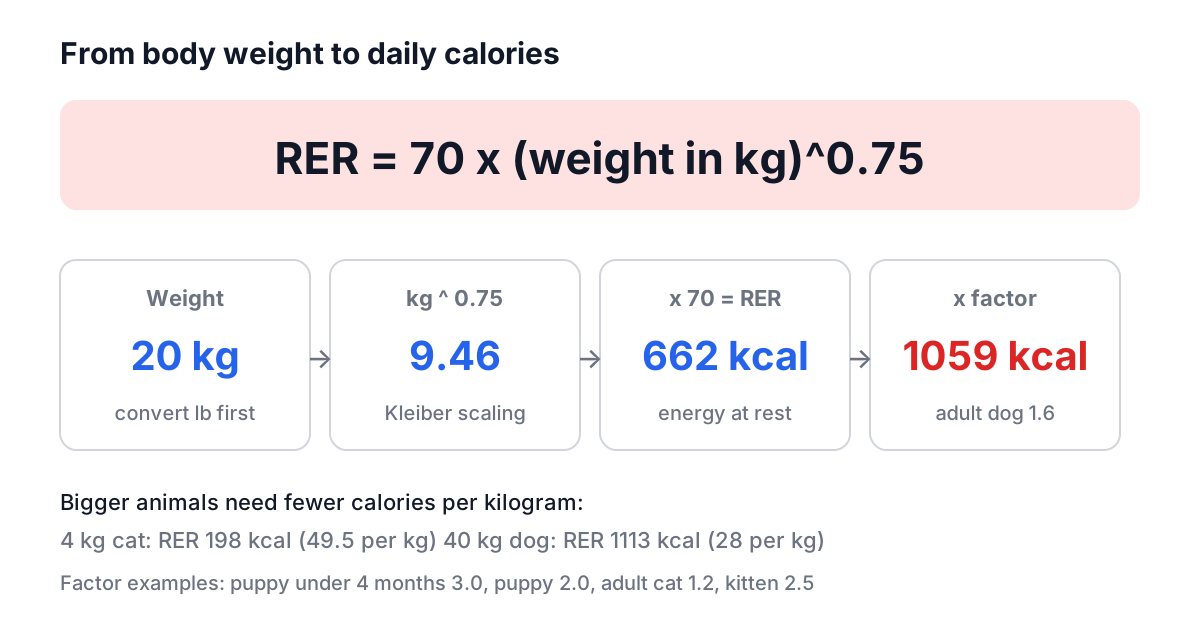
The exponent 0.75 is Kleiber's law. Across mammals from mice to elephants, energy use grows with body mass to the three-quarters power. A bigger body has less surface area per kilogram and loses heat more slowly, so each kilogram costs less to run. That is the whole reason per-kilogram feeding rules break down at the extremes.
| Body weight | kg ^ 0.75 | RER (kcal/day) | RER per kg |
|---|---|---|---|
| 2 kg | 1.68 | 118 | 59 |
| 4 kg | 2.83 | 198 | 49.5 |
| 10 kg | 5.62 | 394 | 39 |
| 20 kg | 9.46 | 662 | 33 |
| 40 kg | 15.91 | 1113 | 28 |
You can do the 0.75 power on a phone calculator without a power key: take the square root, take the square root of that, and multiply the two results. For 20 kg: sqrt(20) = 4.47, sqrt(4.47) = 2.11, and 4.47 x 2.11 = 9.46. In a spreadsheet it is simply =70*POWER(20,0.75).
Step 2: multiply by a life-stage factor
Pets do more than lie still, and growth, pregnancy and neutering all change energy needs. Vets multiply RER by a factor. These are the figures commonly used in veterinary nutrition tables, and the ones the calculator applies:
| Pet and stage | Factor x RER |
|---|---|
| Puppy, under 4 months | 3.0 |
| Puppy, 4 months to adult | 2.0 |
| Adult dog, neutered | 1.6 |
| Adult dog, intact | 1.8 |
| Dog prone to weight gain, or senior | 1.2 to 1.4 |
| Dog on a weight loss plan (at ideal weight) | 1.0 |
| Working or very active dog | 2.0 to 5.0 |
| Kitten | 2.5 |
| Adult cat, neutered | 1.2 |
| Adult cat, intact | 1.4 |
| Cat prone to weight gain | 1.0 |
| Late pregnancy and nursing | 2.0 up to 6 to 8 at peak lactation |
The calculator uses 1.6 for adult dogs, 1.4 for senior dogs, 1.2 for adult cats and 1.1 for senior cats, then multiplies again by an activity setting from 0.8 (very low) to 1.4 (very high). Moderate activity is 1.0, so the life-stage factor alone applies. For Pregnant/Nursing it uses 2.0 and tells you that real needs rise much higher in late pregnancy and while nursing.
Worked example: a 20 kg adult dog
In the Pet Feeding Calculator, choose Dog and Adult, enter 20 kg and 4 years, pick Dry Food, leave Activity at Moderate and click Calculate Feeding.
- RER = 70 x 20^0.75 = 70 x 9.46 = 662 kcal
- Daily energy = 662 x 1.6 (adult) x 1.0 (moderate) = 1059 kcal
- Grams = 1059 / 375 x 100 = 282 g a day, two meals of 141 g
Change the unit to lbs and enter 44: the calculator converts with 1 lb = 0.45359237 kg (44 lb is 19.96 kg) before applying the exponent, and you get 1058 kcal. Getting the unit wrong is the single biggest error people make. Entering a 44 lb dog as 44 kg roughly doubles the answer.
For a cat the same steps give smaller numbers. A neutered 4 kg cat: RER 198 kcal, times 1.2 is 238 kcal a day. A very inactive indoor cat at activity 0.8 drops to about 190.
Step 3: turn calories into your food
Calories are the reliable part of the estimate. Grams depend on how energy-dense your food is, and that varies a lot:
| Food type | Typical kcal per 100 g | Calculator assumes |
|---|---|---|
| Dry kibble | 330 to 450 | 375 |
| Wet food (cans, pouches) | 70 to 130 | 100 |
| Raw | 120 to 250 | 165 |
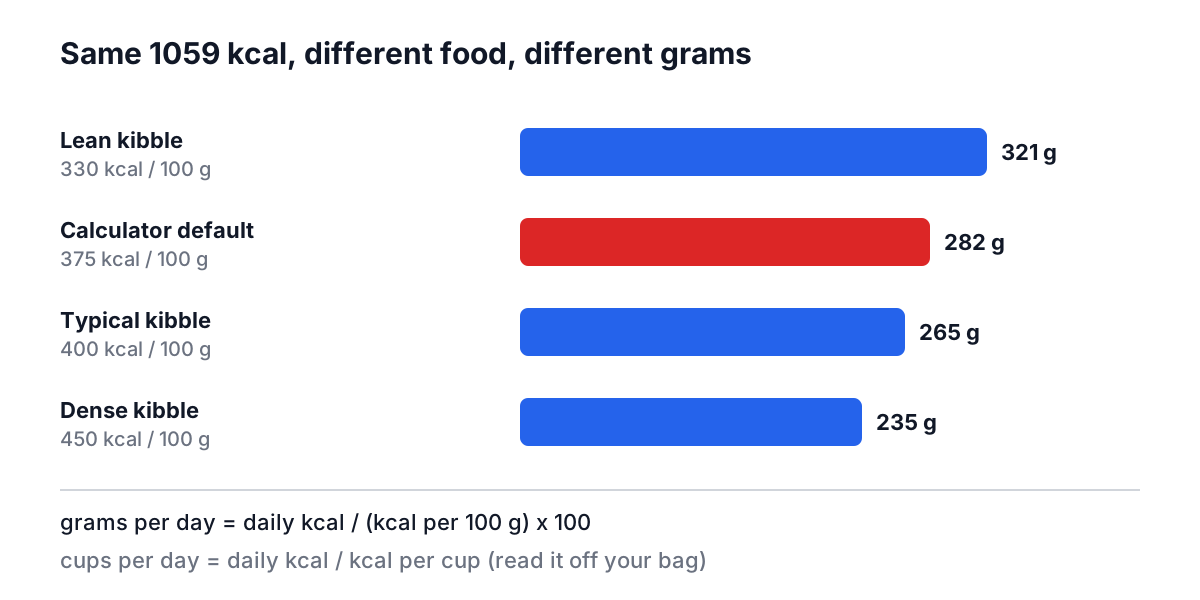
The label on your bag or can lists metabolisable energy, usually as kcal/kg and kcal per cup or per can. Divide your daily calories by that number:
grams per day = daily kcal / (kcal per kg / 1000)
cups per day  = daily kcal / kcal per cup
For the 20 kg dog on a food with 3,900 kcal/kg (390 per 100 g): 1059 / 3.9 = 272 g. If the label says 360 kcal per cup: 1059 / 360 = 2.9 cups. Weigh it on a kitchen scale the first few times; a hand-scooped "cup" can easily be 20% over.
Step 4: adjust by weighing, not by guessing
Any formula is an average. Individual dogs and cats of the same weight can differ by 30% or more in what they actually burn, because of muscle mass, coat, temperament and neutering. The fix is simple:
- Feed the estimate for two to four weeks.
- Weigh at the same time of day on the same scale. Log it in the Pet Weight Tracker.
- If weight is rising and it should not be, cut by about 10%. If it is falling, add 10%.
- Repeat until weight is steady at the ideal your vet agrees on.
For weight loss, vets often calculate RER at the target weight rather than the current one and feed close to 1.0 x that, aiming for a loss of 1 to 2% of body weight a week in dogs and a little slower in cats. Cats in particular should never be crash-dieted; rapid weight loss can trigger hepatic lipidosis.
Common mistakes
- Feeding for current weight in an overweight pet. That holds the weight where it is. Use the ideal weight.
- Forgetting treats and chews. A dental chew can be 70 to 100 kcal. Keep treats under about 10% of the daily total and take them out of the meal amount.
- Trusting the bag chart blindly. Charts span wide weight bands and are written for active, intact animals. Most pet dogs are neither.
- Per-kilogram rules for very small or very large pets. The 0.75 exponent exists precisely because those rules fail at the ends.
- Applying dog maths to rabbits. Rabbits should have unlimited hay, with pellets measured as a small extra. The calculator's rabbit figure covers pellets only, and its bird figure is a rough average across species with very different needs.
A sensible routine
Work out the calorie target once, translate it into grams for the food you actually buy, and write that number on the bin. Weigh monthly and adjust in small steps. Revisit the numbers when life changes: at four months and again at adulthood for a puppy, after neutering, and when your pet enters its senior years (the Pet Age Calculator and the dog and cat age guide help you spot that point). If you track spending too, food is usually the biggest steady line in the Pet Expense Calculator.