
How to Calculate Your Freelance Hourly Rate (and Day Rate)
Work back from take-home pay to an hourly rate: billable hours, utilisation, taxes including US self-employment tax, expenses employers used to cover, and quoting day rates.
· 10 min read
The most common pricing mistake new freelancers make is to take their old salary, divide it by 2,080 hours and charge that. It feels fair, and it guarantees a pay cut. An employer paid for your holidays, your sick days, part of your pension and health cover, your laptop and your payroll taxes, and it paid you for every hour you sat in a meeting or answered email. As a freelancer you cover all of that yourself and you only get paid for the hours a client agrees to buy. This guide works backwards from the income you want to keep to the rate you need to charge. The Freelance Hourly Rate Calculator does the same steps with your numbers.
This is general information, not tax advice. Tax rules depend on your country, your business structure and the year, so check your own figures with an accountant.
The rate formula in four steps
- Working days = 52 x days per week - vacation - public holidays - sick days
- Billable hours = working days x hours per day x billable share
- Revenue needed = (target take-home / (1 - tax rate) + business expenses) / (1 - extra margin)
- Hourly rate = revenue needed / billable hours; day rate = hourly rate x hours per day
Each step is worth a closer look, because each hides an assumption that moves the result a lot.
Step 1: how many days you can work
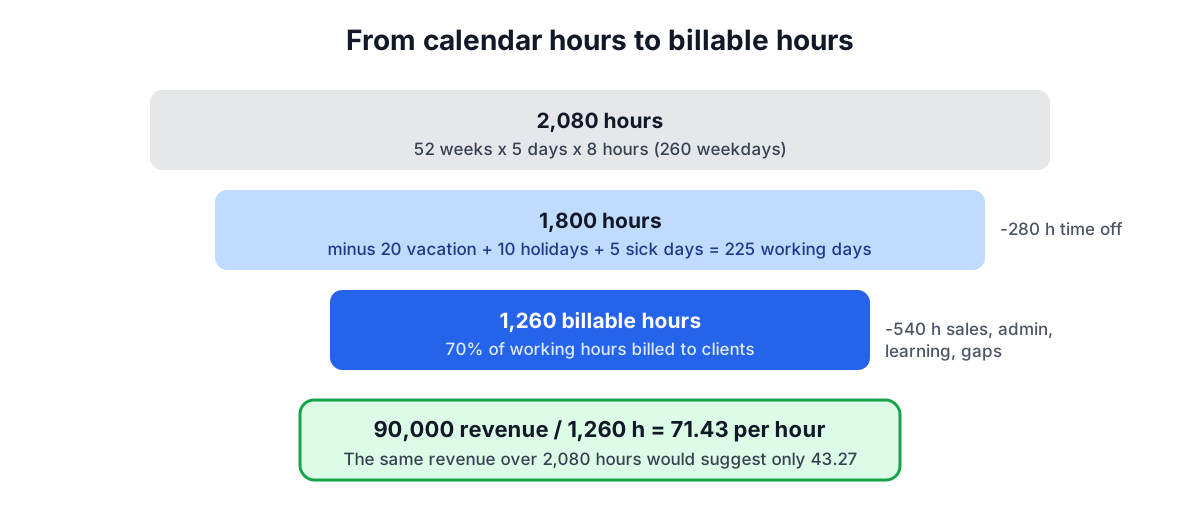
A year has 52 weeks, so five days a week gives 260 weekdays. Take away the days you will not work:
- Vacation. Employees in many countries get 20 to 30 days. You will need a break too, and clients book around holidays anyway.
- Public holidays. Around 8 to 13 a year depending on the country.
- Sick days. Nobody plans to be ill. Allow five or so.
With 20 days of vacation, 10 holidays and 5 sick days you have 225 working days.
Step 2: billable hours and utilisation
Not every working hour can be billed. Freelancers spend time finding work (proposals, calls, networking), running the business (invoicing, bookkeeping, tax), learning, and waiting between projects. The billable share, or utilisation, is the fraction of working hours a client pays for.
| Billable share | Hours a year (225 days x 8 h) | What it often looks like |
|---|---|---|
| 40-50% | 720-900 | First year, building a client base |
| 60-70% | 1,080-1,260 | Established, a few steady clients |
| 75-85% | 1,350-1,530 | Long full-time contracts through an agency |
| 90%+ | 1,620+ | Rare, and leaves no time for sales |
The difference is large. At 50% you have 900 hours to earn the year's revenue; at 70%, 1,260. Be honest here; overestimating utilisation is the second most common pricing mistake.
Step 3: tax and expenses
Gross up for tax
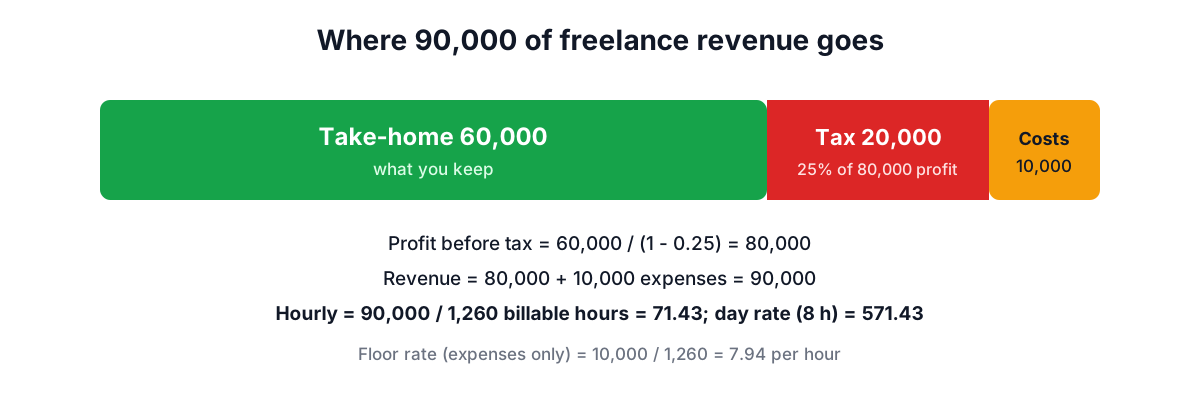
If you want to keep 60,000 and your effective tax rate on profit is 25%, you need 60,000 / (1 - 0.25) = 80,000 of profit before tax. Dividing by (1 - rate) rather than multiplying by (1 + rate) is the correct way: 25% of 80,000 is 20,000, leaving exactly 60,000.
The rate to use is your effective rate on business profit: total tax and social contributions divided by profit. Some country notes:
- United States. Self-employed people pay self-employment tax of 15.3% (12.4% for Social Security, up to the annual wage base, and 2.9% for Medicare) on 92.35% of net earnings, plus federal and possibly state income tax. Half of the self-employment tax is deductible when working out income tax. Combined effective rates of 25% to 35% are common for middle incomes.
- United Kingdom. Sole traders pay income tax and Class 4 National Insurance on profits, through Self Assessment.
- Elsewhere. Social contributions for the self-employed vary widely. Use last year's return or ask an accountant for a realistic figure.
Add business expenses
List what the business pays for in a year. Include the costs an employer used to carry:
- Health insurance (especially in the US) and income protection.
- Pension or retirement contributions you intend to make.
- Computer, phone, software subscriptions and their replacement.
- Professional indemnity and liability insurance.
- Accountant, bank fees and payment processing fees.
- Coworking space or a share of home office costs.
- Training, conferences, books.
- Marketing: website, portfolio, travel to meet clients.
Add a margin
A business with no margin has nothing for a slow quarter or a client who pays late. An extra margin of 5% to 15% builds a buffer. Like tax, it is grossed up: revenue = cost / (1 - margin).
Worked example
Target take-home 60,000; expenses 10,000; effective tax 25%; five days a week, eight hours a day; 20 vacation days, 10 holidays, 5 sick days; 70% billable; no extra margin.
- Working days = 260 - 35 = 225
- Billable hours = 225 x 8 x 0.70 = 1,260
- Profit before tax = 60,000 / 0.75 = 80,000
- Revenue = 80,000 + 10,000 = 90,000
- Hourly rate = 90,000 / 1,260 = 71.43
- Day rate = 71.43 x 8 = 571.43
Rounded up for quoting: 75 an hour, 575 or 600 a day. With a 10% margin the revenue becomes 100,000 and the hourly rate 79.37. At 50% utilisation instead of 70%, the rate needed is 100.00.
Compare that with the naive approach. A 60,000 salary divided by 2,080 hours is 28.85 an hour, less than half of what is needed. Even a 90,000 salary-equivalent divided by 2,080 gives 43.27. That is why freelance rates often land at 1.5 to 2.5 times the equivalent employee's hourly pay.
The floor rate
The calculator also shows a floor rate: expenses / billable hours. In the example, 10,000 / 1,260 = 7.94 an hour. Below that, every hour you bill loses money before you pay yourself anything. It is a useful sanity check when a client pushes hard on price.
Day rates and project prices
Many consultants and contractors quote by the day. A day rate is the hourly rate times the hours in a billable day, though there are good reasons to adjust it:
- Offer a small discount for blocks of days or a monthly retainer, because they reduce the time you spend selling.
- Charge more for a single day, especially with travel, because it is hard to fill the rest of the week.
- Be clear about what a day is (seven and a half or eight hours) and how overtime is handled.
For fixed-price projects, estimate the hours, multiply by your rate, and add contingency for scope changes; 15% to 25% is common. Track actual hours afterwards to improve your estimates.
Rate is a floor, not a ceiling
The calculation tells you the minimum that sustains your business. What clients will pay depends on the value of the result, your specialism and the market. A rate that covers your costs is necessary; if clients readily accept it, it may also be too low. Review it at least once a year when expenses, taxes or your income goals change.
Sources
- IRS, Topic no. 554, Self-employment tax; and Schedule SE instructions.
- HMRC, Self Assessment and National Insurance for the self-employed (gov.uk).
Put in your own numbers in the Freelance Hourly Rate Calculator, then bill your first client with the Invoice Generator.
Related searches
- how to calculate freelance hourly rate
- freelance day rate
- billable hours per year
- utilization rate freelancer
- self employment tax 15.3
- salary to contractor rate
- freelance rate formula
- minimum hourly rate freelancer