
How to Compare Unit Prices and Spot the Real Bargain
Price per ounce, per 100 g and per item done properly: multipacks, coupons, ounces versus fluid ounces, and when the bigger pack is not the cheaper one.
· 8 min read
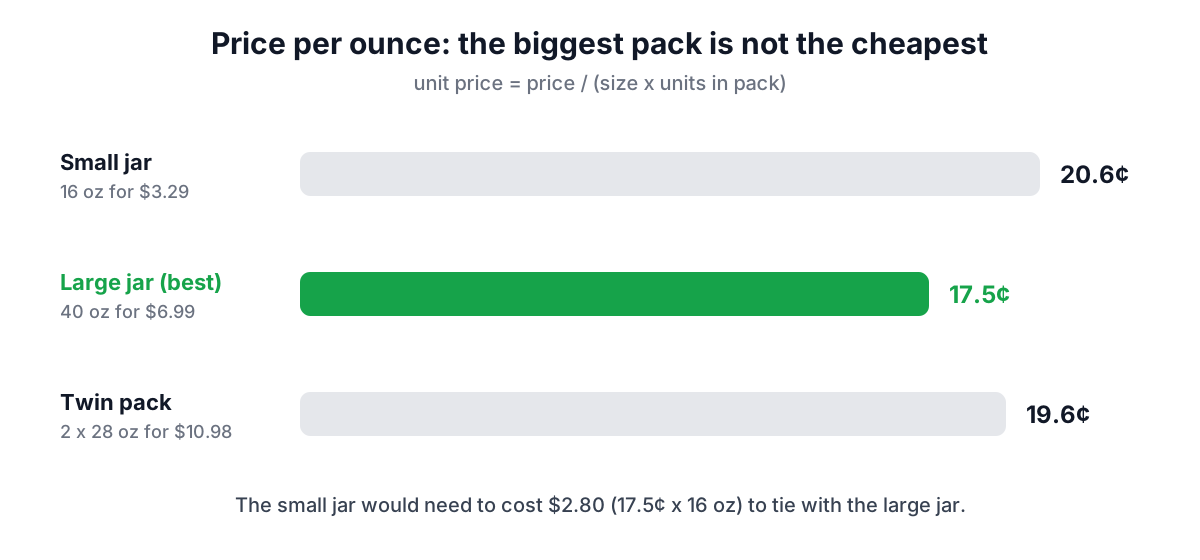
Two jars of the same peanut butter sit side by side: 16 ounces for $3.29 and 40 ounces for $6.99. A third shelf holds a twin pack of 28 ounce jars for $10.98. Which is cheapest? Most people guess the twin pack, because it holds the most. It is not. The answer comes from one division per package, and this guide shows how to do it properly, where shelf tags mislead, and how to handle multipacks, coupons and mixed units. The Unit Price Calculator does every step below for up to eight packages at once.
The one formula you need
A unit price is the price divided by the quantity, scaled to a base that is easy to compare:
unit price = (price - coupon) / (size x units in pack) x base size
The base can be 1 ounce, 1 pound, 100 grams, 1 litre, 1 gallon or 1 item. It does not matter which you pick, as long as every package uses the same one.
For the peanut butter:
| Package | Total ounces | Price | Price per ounce |
|---|---|---|---|
| Small jar | 16 | $3.29 | $0.2056 |
| Large jar | 40 | $6.99 | $0.1748 |
| Twin pack | 2 x 28 = 56 | $10.98 | $0.1961 |
The 40 ounce jar wins at about 17.5 cents an ounce. The twin pack holds more peanut butter, but at 19.6 cents an ounce it costs 12.2% more per ounce than the single large jar. The small jar costs 17.7% more.
The price that would make it a tie
Knowing that one package is 17.7% dearer is useful, but at the shelf a more practical question is: how cheap would it have to be? Multiply the best unit price by the other package's quantity.
For the small jar, $0.17475 x 16 oz = $2.80. If the 16 ounce jar ever goes on sale below $2.80, it beats the large jar per ounce. For the twin pack, $0.17475 x 56 = $9.79. The calculator shows this as "worth ... to match" under each package that is not the cheapest.
This is also the quickest way to judge a promotion. A sale tag that says "save $0.40" on the small jar takes it to $2.89, still above $2.80, so the large jar remains the better buy.
Multipacks: read the small print
Multipacks are where most shelf-reading mistakes happen. The label often gives the size of one item (12 fl oz) rather than the pack (12 x 12 fl oz = 144 fl oz), and the shelf tag may use a different basis from the single-item tag next to it. Always multiply the item size by the number in the pack before dividing.
The calculator has a separate "units in pack" field for this. Enter 28 oz and 2, not 56 oz and 1; the result is the same, but you are less likely to make a mistake copying the label.
Coupons and discounts
A coupon lowers the price but not the quantity, so subtract it before you divide.
Consider paper towels or nappies sold by count: 12 for $5.49 against 30 for $12.99 with a $2.00 coupon.
| Package | Net price | Count | Per item |
|---|---|---|---|
| 12 count | $5.49 | 12 | $0.4575 |
| 30 count with coupon | $10.99 | 30 | $0.3663 |
With the coupon the big box is about 20% cheaper per item. Without the coupon it would be $12.99 / 30 = $0.433, still slightly cheaper than the 12 count but by much less. A percentage discount works the same way: work out the money off and subtract it.
Ounces are not fluid ounces
The single most common unit-price trap in the US is the word "ounce". An avoirdupois ounce is a unit of weight: exactly 28.349523125 grams. A US fluid ounce is a unit of volume: exactly 29.5735295625 millilitres. They happen to be close for water, but not for honey, oil, flour or breakfast cereal, and a shelf tag can show one product per ounce and its neighbour per fluid ounce.
The calculator refuses to rank a weight-sized package against a volume-sized one and tells you why. If one product lists both, use whichever kind of unit the other packages use.
The exact conversions it uses come from US law as published by NIST:
| Unit | Exact value |
|---|---|
| 1 ounce (weight) | 28.349523125 g |
| 1 pound | 16 oz = 453.59237 g |
| 1 US fluid ounce | 29.5735295625 ml |
| 1 US gallon | 128 fl oz = 3.785411784 l |
| 1 US quart | 32 fl oz = 0.946352946 l |
Mixing metric and US sizes
Imported products and online listings often mix units. You do not need to convert by hand: enter each package in the unit on its label and pick one comparison basis.
Milk is a good example. A 64 fl oz half gallon costs $2.49, a gallon jug $3.99 and a 1.75 litre bottle $2.19. Compared per gallon:
| Package | Size in gallons | Price per gallon |
|---|---|---|
| 64 fl oz | 0.5 | $4.98 |
| 1 gallon | 1 | $3.99 |
| 1.75 l | 0.4623 | $4.74 |
The gallon jug is cheapest; the half gallon costs 24.8% more per gallon and the 1.75 litre bottle 18.7% more.
For weights, the same logic applies. A price per pound times 2.2046 gives the price per kilogram, because a kilogram is 1,000 / 453.59237 = 2.2046 pounds. $2.49 a pound is $5.49 a kilogram.
When the cheapest per unit is not the best buy
Unit price tells you which package gives the most product per dollar. It does not tell you whether you will use it. A few cases where the cheapest-per-unit package is the wrong choice:
- Perishables. A large bag of salad, bread or soft fruit only saves money if you eat it before it spoils. Throwing away a third of a bargain pack makes it the expensive option.
- Concentrates. Laundry detergent, squash and cleaning products come in different strengths. Compare per load, per wash or per serving instead of per ounce; set the unit to items and enter the number of loads as the size.
- Storage and cash flow. Bulk buys tie up money and cupboard space. For a household on a tight budget, the cheaper pack per week can be the better choice.
- Quality differences. A store brand and a name brand are not always interchangeable; unit price compares cost, not quality.
A quick routine at the shelf
- Find the unit price on each shelf tag and check the basis (per oz, per fl oz, per count, per 100 sheets). If they differ, ignore the tags and calculate.
- For each package, note the price, the size of one unit and the number in the pack.
- Subtract any coupon or loyalty discount you will actually use.
- Divide and compare on one basis. On a phone, the Unit Price Calculator keeps everything in one place and shows the price each loser would need to match.
- Sanity-check perishability and how much you need.
For the other side of the shopping trip, the Discount Calculator works out sale prices and the Sales Tax Calculator adds tax. If you are cooking with what you bought, the Recipe Scaler resizes a recipe to the pack you have; see how to scale a recipe.
Common questions
Do shelf tags always show the unit price? Not everywhere. Unit pricing rules vary by state in the US, and where they exist they do not always require the same basis for every product. That is why the same aisle can show prices per ounce, per count and per 100 sheets.
Is the unit price on the tag right? Usually, but tags can be out of date when a price changes or a promotion starts. If the numbers look odd, divide the price on the product by its size yourself.
What about deposit or recycling fees? Bottle deposits are refundable, so leave them out if you return the containers. Non-refundable fees are part of the price.
Sources
- National Institute of Standards and Technology, NIST Handbook 44 and Special Publication 811 (units of measurement): definitions of the avoirdupois pound (0.45359237 kg), ounce, US fluid ounce and US gallon.
- National Institute of Standards and Technology, NIST Handbook 130, Uniform Unit Pricing Regulation: the model rule many US states adopt for shelf unit prices.
- Worked examples computed with the RedBison Unit Price Calculator.
Related searches
- how to calculate unit price
- price per ounce calculator
- is the bigger size cheaper
- ounces vs fluid ounces
- price per 100g comparison
- compare multipack prices
- unit price with coupon
- grocery shelf tag unit price