
How to Scale a Recipe Up or Down Without Ruining It
Scale factors from servings and pan sizes, turning 1.125 cups into something you can measure, what not to multiply straight, and why baking times stay put.
· 9 min read
Scaling a recipe sounds like simple multiplication, and for a pot of soup it mostly is. The trouble starts with the details: 3/4 cup times 1.5 is 1.125 cups, which no measuring cup shows; a third of a tablespoon is a strange amount to measure; a cake recipe written for an 8-inch round pan needs more than double the batter for a 9 by 13 inch pan; and three eggs halved is one and a half eggs. This guide covers how to find the right scale factor, how to turn the results into amounts you can actually measure, and which ingredients and steps should not be scaled in a straight line. The worked examples come from the Recipe Scaler, which reads a pasted ingredient list and does the arithmetic and the rounding for you.
Step 1: find the scale factor
Every scaled recipe starts with one number, the factor that every quantity is multiplied by. There are four common ways to get it.
By servings. Factor = servings you want ÷ servings the recipe makes. A recipe for 4 cooked for 6 has a factor of 6 ÷ 4 = 1.5. Cooking for 2 from the same recipe is 2 ÷ 4 = 0.5.
By pan size. For baked goods the honest question is not how many people but how much pan. If the batter should end up the same depth, the factor is the ratio of the pan areas: new area ÷ old area. Round pans use π × diameter² ÷ 4, square pans side², rectangular pans length × width. The next section has a table.
By a plain multiplier. Doubling (2), tripling (3) or halving (0.5) is just a factor typed directly. The Recipe Scaler accepts 2, 0.5, 1/3, 1 1/2 or 150%.
By the ingredient you are short of. If the recipe calls for 225 g of butter and you have 150 g, the factor is 150 ÷ 225 = 0.667, about two thirds, and everything else scales down to match. This is the "What I have" mode in the tool.
Pan sizes: why area, not diameter
Pan sizes are quoted by width, but batter fills an area, and area grows with the square of the width. Going from an 8-inch to a 9-inch round pan sounds like a one-inch change, yet the area rises from 50.3 to 63.6 square inches, 27% more. A 10-inch round holds 78.5 square inches, more than one and a half times the 8-inch.
| From | To | Areas (sq in) | Factor |
|---|---|---|---|
| 8 in round | 9 in round | 50.3 to 63.6 | 1.266 |
| 9 in round | 8 in round | 63.6 to 50.3 | 0.790 |
| 10 in round | 8 in round | 78.5 to 50.3 | 0.640 |
| 8 in square | 9 in round | 64.0 to 63.6 | 0.994 |
| 9 in round | 13 x 9 in | 63.6 to 117.0 | 1.839 |
| 8 in square | 13 x 9 in | 64.0 to 117.0 | 1.828 |
| 8 in round | 13 x 9 in | 50.3 to 117.0 | 2.328 |
Two useful facts fall out of the table. An 8-inch square pan and a 9-inch round pan are practically interchangeable (a factor of 0.994). And a 13 by 9 inch pan holds a little less than two 9-inch rounds, which is why a two-layer 9-inch cake recipe usually fits one sheet pan.
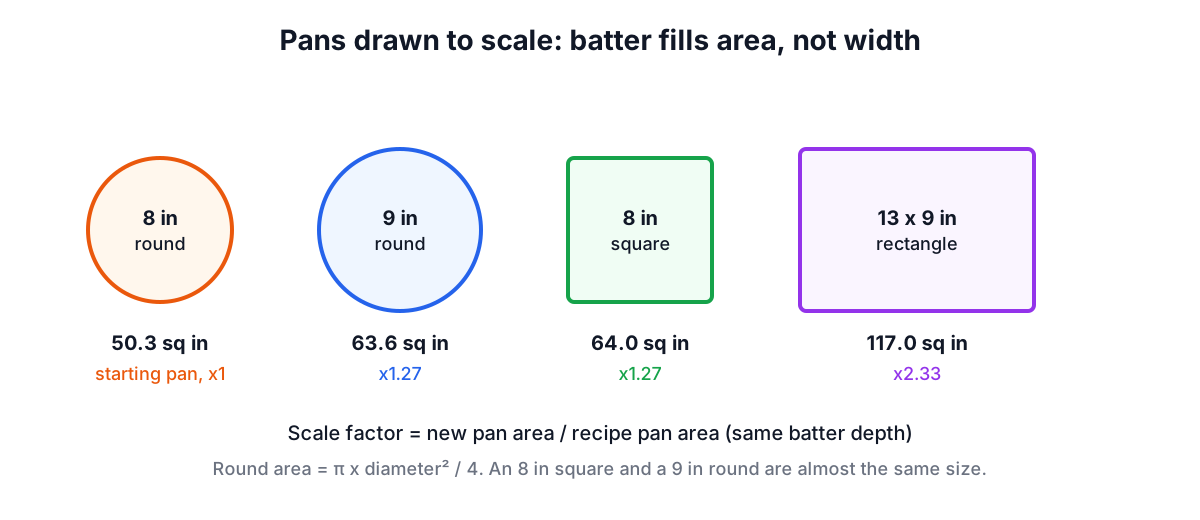
Measure pans across the inside of the rim, and use the same unit for both pans; the factor itself has no unit, so inches and centimetres both work as long as you do not mix them. The area method assumes straight sides and the same batter depth. Bundt and tube pans are better compared by volume: fill each with water from a measuring jug and divide.
Step 2: multiply, then make the numbers measurable
Multiplying is the easy part. The real work is turning 2.625 cups or 0.67 teaspoons into something you can measure with standard kitchen tools.
US customary measures nest neatly: 1 cup = 16 tablespoons = 48 teaspoons, and 1 tablespoon = 3 teaspoons. Measuring sets come in 1/4, 1/3, 1/2 and 1 cup, and in 1/8, 1/4, 1/2 and 1 teaspoon plus 1 tablespoon. That suggests sensible rounding rules, and they are the ones the Recipe Scaler applies:
- Cups round to the nearest eighth or third (1/8, 1/4, 1/3, 3/8, 1/2, 5/8, 2/3, 3/4, 7/8).
- Tablespoons round to the nearest half.
- Teaspoons round to the nearest eighth.
- Under half a cup, amounts stay in tablespoons unless they land on 1/4 or 1/3 cup, so half of 3/4 cup reads 6 tbsp rather than 3/8 cup. Larger tablespoon amounts become cups, and when cups would not round cleanly the result is split, such as "1 cup + 3 tbsp".
- Ounces of weight above 16 become pounds and ounces; grams above 1,000 become kilograms.
- Metric amounts round to whole grams or millilitres between 10 and 100, and to the nearest 5 above 100. Small metric amounts keep one decimal place.
The "tidy units" switch turns the unit conversions off if you would rather keep every line in the recipe's own unit, and the "fraction characters" switch chooses between ½ and 1/2.
Worked example: pancakes for 4, cooked for 6
Here is a buttermilk pancake recipe that serves 4, scaled by 6 ÷ 4 = 1.5:
| Original | Exact x1.5 | Recipe Scaler shows |
|---|---|---|
| 2 cups flour | 3 cups | 3 cups |
| 2 tbsp sugar | 3 tbsp | 3 tbsp |
| 2 tsp baking powder | 3 tsp | 1 tbsp |
| 1/2 tsp baking soda | 0.75 tsp | 3/4 tsp |
| 2 large eggs | 3 | 3 large eggs |
| 1 3/4 cups buttermilk | 2.625 cups | 2 5/8 cups |
| 3 tbsp melted butter | 4.5 tbsp | 4 1/2 tbsp |
Notice the baking powder: 3 teaspoons is exactly 1 tablespoon, which is one scoop instead of three. And 2 5/8 cups of buttermilk is 2 1/2 cups plus 2 tablespoons, if your measuring set has no 1/8 cup. Lines without a quantity at the start, such as "Butter for the pan", are passed through unchanged.
Worked example: an 8-inch cake baked in a 13 by 9 pan
A small cake recipe for an 8-inch round pan, moved to a 13 by 9 inch pan, has a factor of 117 ÷ 50.27 = 2.33:
| Original | Exact x2.33 | Recipe Scaler shows |
|---|---|---|
| 3/4 cup sugar | 1.746 cups | 1 3/4 cups |
| 1 cup milk | 2.328 cups | 2 1/3 cups |
| 1 tbsp vanilla | 2.328 tbsp | 2 tbsp + 1 tsp |
| 225 g butter | 523.7 g | 525 g |
| 1 1/2 tsp salt | 3.49 tsp | 1 tbsp + 1/2 tsp |
| 3 eggs | 6.98 | 7 eggs |
The rounding errors are tiny: 1 3/4 cups is within 0.3% of the exact amount, and 525 g of butter is 1.3 g over. Seven eggs is where judgement starts, since the exact figure is 6.98; if a result lands on a fraction of an egg the tool adds a note.
Ingredients that do not scale in a straight line
Proportional scaling keeps the ratios of a recipe intact, and for most ingredients that is exactly right. A few behave differently, and experienced cooks adjust them by eye:
- Eggs. They come in whole units. When a scaled recipe calls for 1 1/2 eggs, beat two and measure out three quarters of the mix, or weigh it. USDA grade sizes are set by weight per dozen (a dozen large eggs must weigh at least 24 oz), so weighing is the precise route.
- Salt, spices, chilli and strong flavourings. These are perceived by taste, not by ratio. When multiplying a savoury recipe by 3 or more, many cooks start with less and adjust at the end.
- Leaveners. Baking powder and soda scale with flour, but a very large batch in one deep pan rises differently from several small ones. Bake in pans of the original depth where you can.
- Cooking fat for the pan, frying oil, water for boiling pasta. These depend on the pan, not the quantity of food.
- Thickeners and gelatine. They scale with the liquid; check that the liquid really did scale (for example after reducing a sauce).
Time and temperature
Ingredient quantities scale; cooking times mostly do not. A cake in a larger pan at the same batter depth bakes in about the same time, because heat travels in from the top, bottom and sides over the same distance. A deeper pan, a doubled loaf or a bigger roast needs more time, often at a slightly lower temperature so the outside does not overcook before the centre is done. Start checking at the original time and use the recipe's doneness test: a skewer coming out clean, an internal temperature, a springy top. A thermometer is the most reliable guide for meat and bread.
Simmering and reducing also change. A doubled soup in the same pot takes longer to come to the boil and longer to reduce, because the surface area did not double.
Weights versus cups
Scaling exposes the weakness of volume measures. A cup of flour weighs more when it is scooped and packed than when it is spooned in and levelled, so 2 5/8 cups can vary noticeably from one cook to the next. When you scale baking by a large factor, convert the main dry ingredients to grams first. The Recipe Scaler handles grams, kilograms, millilitres and litres as well as cups, so a weighed recipe scales just as easily. For one-off conversions between cups, grams and spoons, the Cooking Converter has ingredient densities.
For reference, the legal definitions behind these units are fixed: 1 avoirdupois ounce is exactly 28.349523125 g and 1 pound is 453.59237 g. US nutrition labels use a 240 ml cup, a 15 ml tablespoon and a 5 ml teaspoon, close enough to the customary measures that the difference never matters in a kitchen.
Using the Recipe Scaler
- Paste the ingredient list, one ingredient per line. The tool reads amounts at the start of each line, including 1 1/2, 1-1/2, 1½, ½, 0.5 and ranges such as 2-3, followed by units like cups, tbsp, tsp, fl oz, oz, lb, g, kg, ml and l.
- Choose how to scale: servings, pan size, a multiplier or "What I have".
- Read the scaled list. Each changed line shows what it was, and notes appear for fractional eggs and pinches.
- Copy the result or download it as a text file. Nothing you paste leaves your browser.
Bulk shopping for a scaled recipe is easier with the Unit Price Calculator; our guide on how to compare unit prices explains the shelf-tag maths. To work out percentages and ratios by hand, the Ratio Calculator is the general-purpose tool.
Sources
- NIST Handbook 44 (2024), Appendix C, General Tables of Units of Measurement: US customary cup, tablespoon, teaspoon and fluid ounce relationships.
- NIST Special Publication 811 and the 1959 international yard and pound agreement: 1 lb = 0.45359237 kg exactly, so 1 oz = 28.349523125 g.
- US Code of Federal Regulations, 21 CFR 101.9(b)(5)(viii): household measures for nutrition labelling (1 cup = 240 ml, 1 tbsp = 15 ml, 1 tsp = 5 ml).
- USDA Agricultural Marketing Service, United States Standards, Grades, and Weight Classes for Shell Eggs (AMS 56): large eggs, minimum 24 oz per dozen.
Related searches
- how to halve a recipe
- how to double a recipe
- convert 8 inch round to 9x13 pan
- recipe conversion factor
- half of 3/4 cup
- one third of a recipe measurements
- scaling baking recipes by weight
- how many tablespoons in 1/4 cup