
How to Write an Invoice: Fields, Tax, Discounts and Terms
What an invoice must show, how to number them, Net 30 and early-payment terms, adding sales tax or extracting VAT, discounts before tax and rounding that adds up to the cent.
· 10 min read
An invoice looks like a simple document: who, what, how much, by when. Most of the trouble with invoices comes from the details around that. A number that repeats, a due date nobody agreed, a discount taken after tax instead of before, a VAT total that is a penny away from the sum of the lines. This guide goes through what an invoice needs to show, how to lay out the money so it adds up, and the terms that get you paid on time. The examples use the Invoice Generator, which builds a PDF in your browser, but the rules apply whatever software you use.
This is general information, not tax or legal advice. Tax rules for invoices differ by country and sometimes by state, so check with your tax authority or accountant before you send the first one.
What every invoice should show
Whatever the country, a clear invoice answers the same questions.
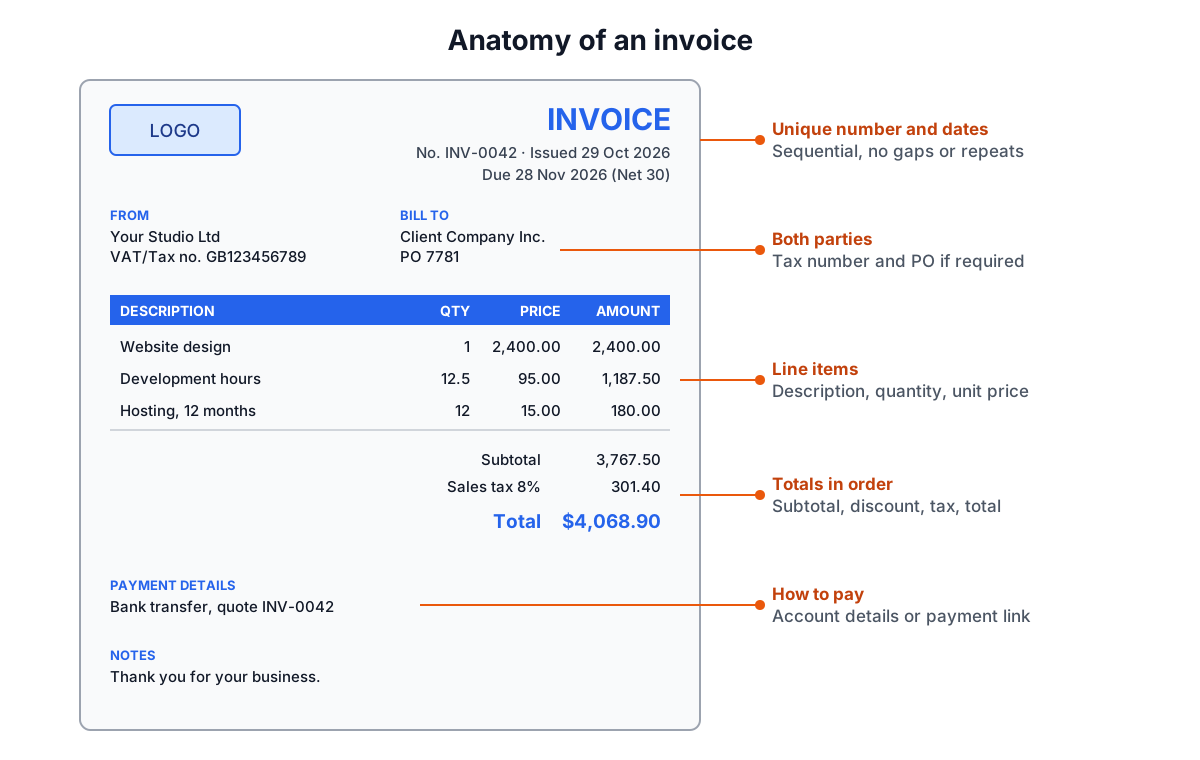
| Field | Why it matters |
|---|---|
| The word "Invoice" (or "Tax Invoice") | Tells the customer this is a request for payment, not a quote or receipt |
| A unique invoice number | Lets both sides refer to it and keeps your records in sequence |
| Issue date and due date | Starts the payment clock |
| Your business name, address and contact | Who to pay and who to ask |
| Tax registration number (if registered) | Required on VAT and GST invoices |
| Customer name and address | Who owes the money |
| Description, quantity and unit price per line | What was supplied |
| Subtotal, discount, tax and total | How the amount was built up |
| Payment details | Bank account, payment link or other method |
| Purchase order or reference | Many companies cannot pay an invoice without their PO number |
Rules for VAT and GST invoices
Where a value-added tax applies, the invoice is also the document your customer uses to reclaim the tax, so the content is set out in law. In the UK, HMRC's guidance on VAT invoices asks for a unique invoice number that follows on from the last one, your business name and address, your VAT registration number, the invoice date, the time of supply if it differs, the customer's name and address, a description of each item, the quantity and the price per item excluding VAT, the rate of VAT and the total VAT charged. Across the EU, Article 226 of the VAT Directive (2006/112/EC) lists similar contents, and each member state can add its own details. Australia's GST rules require a tax invoice for sales over a set threshold, showing the ABN and the GST amount or a statement that the price includes GST.
The United States
There is no federal invoice format in the US. Sales tax is set by states, counties and cities, and the seller collects it where they have nexus. Show taxable and non-taxable lines clearly and the sales tax charged. Services are taxed in some states and not in others, which is a common reason to give lines different rates.
Numbering invoices
Invoice numbers must be unique, and in VAT systems they must follow a sequence. The format is up to you. Common patterns:
- INV-0001, INV-0002: simple and sortable.
- 2026-001: restarts each year, with the year making each number unique.
- ACME-014: a client prefix plus a sequence, useful if you work for a few large clients.
Avoid gaps and reuse. If an invoice is wrong after you have sent it, issue a credit note against it and a new invoice, rather than editing and resending the same number. The Next invoice button in the generator increases the last group of digits and keeps the zero padding, so INV-0099 becomes INV-0100.
Payment terms that get you paid
Terms set the due date. Write them on the invoice in words the customer's accounts team will recognise.
| Term | Meaning |
|---|---|
| Due on receipt | Pay now |
| Net 7, Net 15, Net 30 | Full amount due 7, 15 or 30 days after the invoice date |
| Net 30 EOM | Due 30 days after the end of the month of the invoice |
| 2/10 Net 30 | 2% off if paid within 10 days, otherwise the full amount in 30 |
| 50% deposit, balance on completion | Common for projects; invoice the deposit first |
An early-payment discount is expensive for the seller. Giving 2% to be paid 20 days earlier works out to an annualised cost of about 37%, so use it when cash flow really matters. Late payment interest is the other lever: in the UK the Late Payment of Commercial Debts (Interest) Act 1998 lets businesses claim statutory interest on overdue business-to-business invoices, and many contracts set their own rate. State it in your terms if you intend to charge it.
Building the totals in the right order
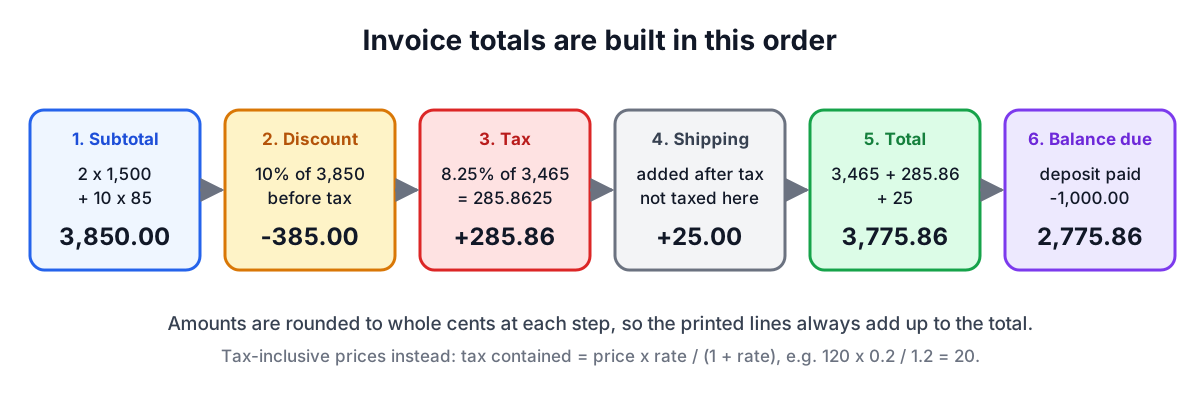
The order of operations decides whether your total matches the customer's records. The usual sequence is:
- Line amount = quantity x unit price, rounded to the currency's minor unit.
- Subtotal = sum of line amounts.
- Discount comes off the subtotal (percentage or fixed amount).
- Tax is charged on the discounted amount, once per tax rate.
- Shipping or other charges that are not taxed are added.
- Any deposit already paid is subtracted to give the balance due.
Take the generator's second example: two items at 1,500 and ten at 85 give a subtotal of 3,850.00. A 10% discount is 385.00, leaving 3,465.00. Sales tax at 8.25% is 285.8625, which rounds to 285.86. Add 25.00 shipping for a total of 3,775.86. If 1,000 has already been paid as a deposit, the balance due is 2,775.86.
Why discounts come before tax
A discount reduces the price of what was sold, so tax is charged on what the customer actually pays for the goods. Taking the discount after tax would mean charging tax on money nobody paid. Some coupon schemes and manufacturer rebates are treated differently in some US states; if you deal with those, check the state's rules.
Rounding: per line or per total?
Tax can be rounded on each line or once on the total for each rate, and the two can differ by a cent or two on long invoices. Both are accepted in most systems; HMRC, for example, allows VAT to be calculated per line or on the invoice total as long as you are consistent. The generator computes tax once per rate on the discounted total for that rate and then shares it across the lines for display, so the total is always the sum of the parts. The arithmetic is done in whole cents, which avoids the floating-point errors that make 1.005 round down in some spreadsheets.
Tax added on top versus tax included
There are two ways prices are written.
Tax exclusive (usual for US sales tax and business-to-business VAT): the prices are net and tax is added. A 100.00 item at 20% shows 100.00 + 20.00 tax = 120.00.
Tax inclusive (usual for consumer prices with VAT or GST): the price already contains the tax. The tax inside a gross price is price x rate / (1 + rate). For 120.00 at 20% that is 120 x 0.2 / 1.2 = 20.00, and the net price is 100.00. A common mistake is to take 20% of 120 (24.00), which overstates the tax.
Turn on "Prices already include tax" in the generator and the PDF says "Includes VAT 20%" with the amount contained, while the total stays at the prices you typed. You can check the arithmetic with the VAT Calculator or the Sales Tax Calculator.
Several rates on one invoice
Mixed invoices are common: zero-rated books with standard-rated courses, or taxable goods with non-taxable labour in states that do not tax services. Give each line its own rate and the totals show one tax line per rate. That is also what an auditor looks for, because each rate is reported separately on a VAT return.
Currencies and decimals
Not every currency has two decimals. The Japanese yen and Korean won have none, and the Kuwaiti and Bahraini dinars have three. The generator asks the browser's internationalisation library how many decimals the currency uses and rounds to that, so a yen invoice never shows 999.50. If you bill in a currency other than your own, agree who carries the exchange rate risk and check the rate on the day with the Currency Converter.
The PDF uses the standard Helvetica font built into every PDF reader, which covers Western European characters. A currency whose symbol is not in that set, such as the Indian rupee, is printed with its ISO code (INR 1,250.00) so the amount is never wrong.
Worked example from blank to PDF
A web designer bills a client for a project:
- 1 x website design (home page and four templates) at 2,400.00
- 12.5 hours of development at 95.00
- 12 months of hosting at 15.00
- Sales tax 8%, Net 30, issued 29 October 2026
Line amounts are 2,400.00, 1,187.50 and 180.00, a subtotal of 3,767.50. Tax at 8% is 301.40. The total is 4,068.90, due on 28 November 2026. In the generator this is the default example: fill in your own name, swap the client, and click Download PDF.
Common mistakes
- Missing PO numbers. Large companies route invoices by purchase order; without it, yours sits in a queue.
- Vague descriptions. "Services" is hard to approve. "Design of home page and four templates, October" is easy.
- Changing a sent invoice. Issue a credit note and a new invoice instead.
- Wrong tax base. Tax goes on the discounted amount, and inclusive prices need the rate / (1 + rate) formula.
- No payment details. Make paying you the easiest thing on the page.
Sources
- HMRC, VAT invoices: what a VAT invoice must show (gov.uk).
- Council Directive 2006/112/EC on the common system of value added tax, Article 226.
- Late Payment of Commercial Debts (Interest) Act 1998 (UK).
- jsPDF documentation for the standard PDF fonts and their character set.
Ready to make one? Open the Invoice Generator. If you are still working out what to charge, the Freelance Hourly Rate Calculator works back from the income you want to keep.
Related searches
- how to write an invoice
- what to include on an invoice
- invoice number format
- net 30 meaning
- vat invoice requirements uk
- discount before or after tax on invoice
- tax inclusive price vat calculation
- invoice rounding per line or total
- free invoice pdf