
Saving for a Goal When Prices Keep Rising
How CPI inflation is measured and applied, how to size a monthly deposit for a target date, and how to set a savings goal that still buys what you planned.
· 8 min read
A savings goal is a number and a date: 60,000 for a house deposit in seven years, 15,000 for an emergency fund by next summer. Two forces work on that plan while you save. Interest helps, by adding money you did not deposit. Inflation works against you, by raising the price of whatever the goal was meant to buy. A plan that ignores either one lands in the wrong place.
This guide covers how inflation is measured and applied, how a savings deposit is calculated, and how to combine the two so the money you end up with still does the job. The numbers come from the Savings Goal Calculator and the Inflation Calculator, so you can reproduce each one. It explains the arithmetic, not which account or investment to choose.
How inflation is measured
In the US, the headline measure is the Consumer Price Index for All Urban Consumers, CPI-U, published monthly by the Bureau of Labor Statistics. BLS prices a fixed basket of goods and services (food, rent, fuel, medical care, clothing and so on) and expresses its cost relative to a base period, 1982-84 = 100. BLS also publishes an annual average for each year, and those annual figures go back to 1913.
To convert money between years you divide one index value by the other:
Value in year B = Amount × CPI(B) ÷ CPI(A)
The annual average CPI-U was 38.8 in 1970 and 321.943 in 2025. So 100 dollars of 1970 spending needs about 830 dollars in 2025, and a 1970 dollar buys roughly 12 cents of what it did then.
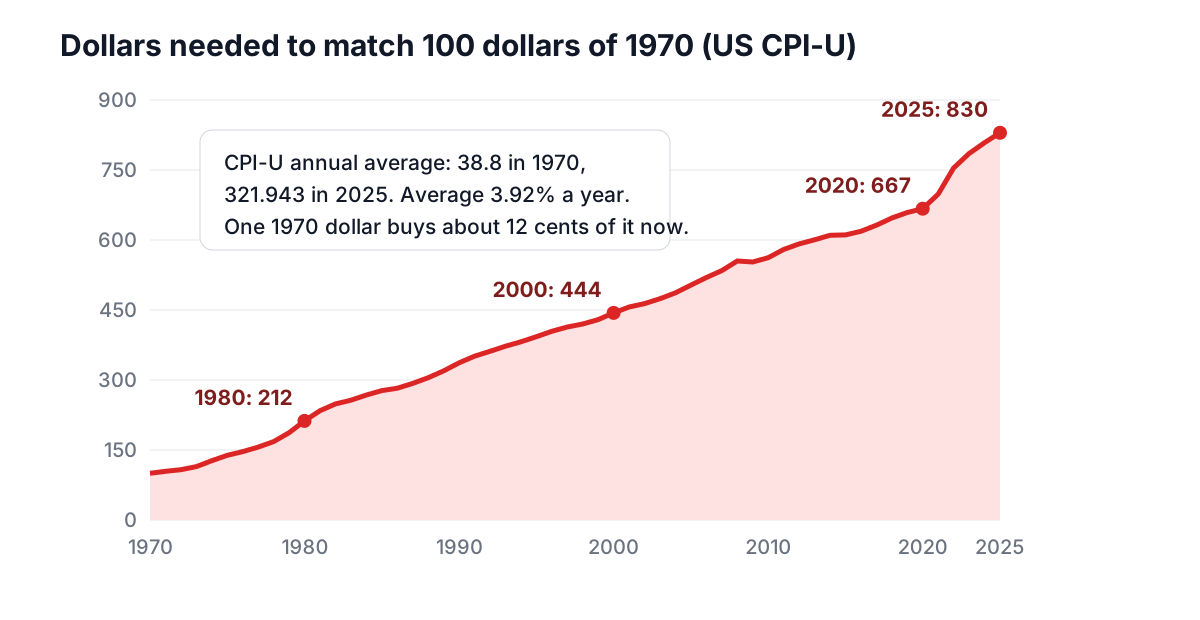
The average yearly rate between two years is the compound rate that links them: (CPI(B) ÷ CPI(A))^(1 ÷ years) − 1. From 1970 to 2025 that is 3.92% a year, and from 2000 to 2025 it is 2.53%. The averages hide large swings. Annual average prices fell about 0.4% in 2009 and rose about 13.5% in 1980. Between 2020 and 2022 alone they rose 13.1%.
A few caveats are worth knowing before you rely on the index:
- Annual averages differ from monthly comparisons. Comparing two calendar-year averages gives a slightly different answer from comparing, say, January of one year with September of another. The Inflation Calculator uses annual averages, which is the right choice for "what was a 1995 salary worth" questions.
- Your own inflation differs from the average. The basket weights reflect average urban spending. If rent, childcare or tuition is a large share of your budget, your personal rate has probably been higher.
- The data has gaps and revisions at the edges. BLS marks the October 2025 monthly index as unavailable, so its 2025 annual average is based on the other eleven months. The calculator uses the published annual figure as it stands.
Projecting inflation forward
The future has no index yet, so planning uses an assumed rate:
Future cost = Today's cost × (1 + r)^t
Today's value of a future amount = Future amount ÷ (1 + r)^t
At 3.5%, a 60,000 cost of living doubles in about 20 years, to 119,387. At 3%, a million dollars received 30 years from now buys what 411,987 buys today. A quick mental check is the rule of 72: divide 72 by the rate to get the years it takes prices to double. At 3% that is 24 years, close to the exact 23.4.
Which rate to assume is a judgment call. The Federal Reserve targets 2% a year (measured by a related index, PCE), the 2000 to 2025 CPI average was about 2.5%, and the 1970 to 2025 average was about 3.9%. For a plan you will rely on, run a central case and a pessimistic one.
How a savings deposit is calculated
A savings plan has a starting balance P, a deposit D each period, a rate i per period and n deposits. The balance at the end is the future value of the starting money plus the future value of the deposits:
FV = P(1 + i)^n + D × [((1 + i)^n − 1) ÷ i]
Solving that for D gives the deposit needed to reach a goal G:
D = (G − P(1 + i)^n) ÷ [((1 + i)^n − 1) ÷ i]
Take a 50,000 goal in five years, with 5,000 already saved, in an account paying 4.5% compounded monthly. The monthly rate is 0.375%, there are 60 deposits, and the deposit comes out at 651.44. Over the five years you pay in 39,086, the original 5,000 grows to about 6,259, and interest on the deposits supplies the remainder.
The same formula solved for n tells you how long a deposit you can afford will take. At 500 a month instead, the goal is reached on the 76th deposit, six years and four months in. The exact solution is 75.2 deposits, and the calculator rounds up because a goal is only met when the money is actually there.
Three settings change the answer in small but real ways:
- Deposit timing. Depositing at the start of each month gives every deposit one more month of interest. The deposit for the example falls from 651.44 to 649.00.
- Compounding frequency. The calculator converts the quoted annual rate to the rate per deposit period with (1 + r/m)^(m/p) − 1, where m is compounding periods and p deposits per year. Daily compounding with monthly deposits earns slightly more than monthly compounding.
- Taxes. Interest in an ordinary taxable account is taxed every year. Entering an after-tax rate, such as 4.5% × (1 − 0.22) = 3.5%, gives a more honest deposit.
How much does interest really help?
Over short horizons, much less than people hope. To collect 20,000 in two years you need 833.33 a month with no interest and 801.83 a month at 4%. Interest saves about 31 a month. The deposit does nearly all the work, which is why short-term goals belong in safe accounts: chasing a higher return cannot change the outcome much, while a loss can.
Over long horizons the balance shifts dramatically.
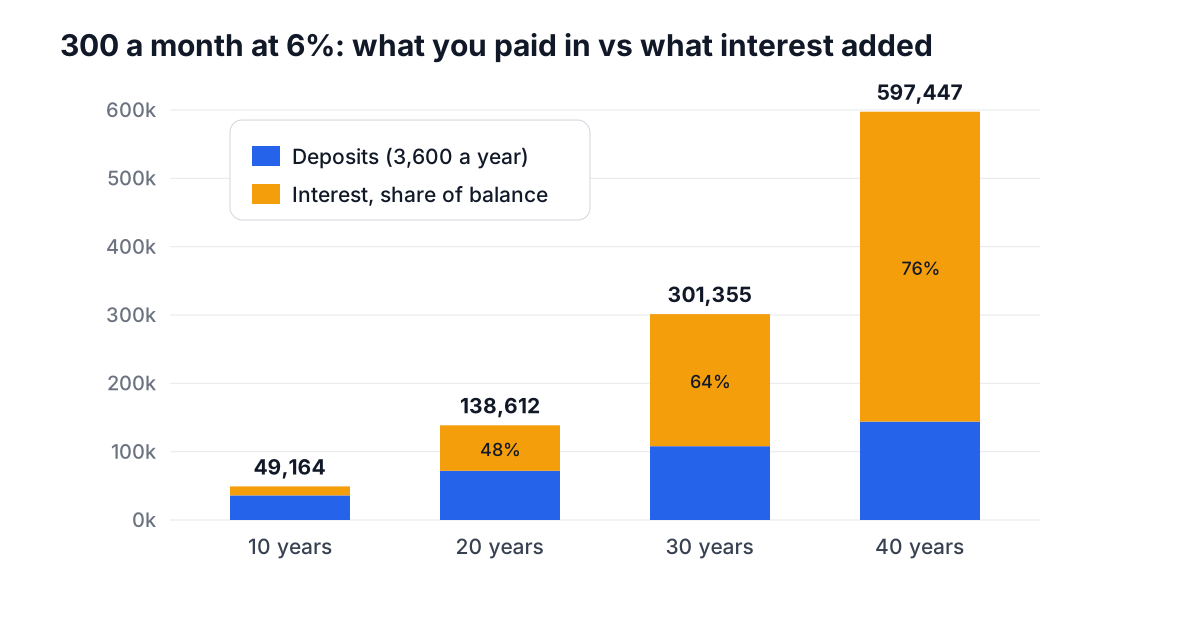
Saving 300 a month at 6% grows to 49,164 after ten years, of which 13,164 is interest. After 40 years the balance is 597,447 and interest makes up three quarters of it. Time does more than the rate or the deposit size, which is the main argument for starting long-term saving early. For the investment side of long horizons, the compound interest guide goes further.
Putting the two together: goals in present-day money
Here is the mistake most savings plans make. You want a 60,000 house deposit and you plan to buy in seven years. House prices and deposits rise with inflation, so if prices rise 3% a year the same home needs a 73,792 deposit in seven years.
With 10,000 already saved at 4.5% compounded monthly:
| Goal used in the plan | Monthly deposit |
|---|---|
| 60,000 (today's price) | 470.01 |
| 73,792 (inflated at 3% for 7 years) | 610.00 |
The plan that ignores inflation reaches its number on schedule and still falls about 13,800 short of what the purchase costs. The fix is a two-step routine:
- Use the Inflation Calculator in assumed-rate mode to turn today's price into the price in the target year.
- Enter that future amount as the goal in the Savings Goal Calculator and solve for the deposit.
Real returns: what the account actually earns you
The gap between your interest rate and inflation is your real return. The exact relationship is:
Real rate = (1 + nominal rate) ÷ (1 + inflation) − 1
An account paying 4.5% when inflation runs at 3% earns a real 1.46% a year, not 1.5%. The subtraction shortcut is close at low rates and drifts further off as rates rise. When the account pays less than inflation, the real rate is negative: the balance grows in dollars but buys less every year. 10,000 left at 5% for ten years becomes 16,289, worth 12,121 in present-day money at 3% inflation.
For a quick check of whether savings are keeping up, compare the account's rate with recent CPI. Between 2024 and 2025 annual average CPI-U rose 2.63%, so a savings account paying less than that lost purchasing power over the year, before tax.
A short checklist
- State the goal in the money of the year you need it, not today's.
- Use the rate the account actually pays, after tax if the interest is taxed each year.
- Pick the deposit frequency and timing that match how you will really save, and set up the transfer on payday.
- Rerun the plan once a year with the current balance, rate and inflation, and adjust the deposit rather than the goal.
- Keep short-term goals in safe accounts, where the deposit matters far more than the rate.