
How Compound Interest Works: Frequency, Deposits and the Formula
Why 10% compounded monthly is not 10%, what A = P(1 + r/n)^(nt) really says, how deposits change the maths, and the mistakes that throw calculations off.
· 6 min read
Put 10,000 in an account paying 10% a year and leave it for 30 years. If the interest is simple, you end with 40,000. If it compounds once a year, you end with 174,494. Same rate, same money, same time, and one answer is more than four times the other. Nothing else in personal finance has that much leverage hiding inside a definition.
This guide walks through what compounding actually does, how the formula works, why the frequency matters less than people think, and the handful of mistakes that make calculations wrong. The numbers come from the Compound Interest Calculator and the Interest Calculator, so you can reproduce every one of them. It is an explanation of the maths, not advice on where to keep your savings.
Simple interest versus compound interest
Simple interest is paid only on the original principal. The formula is I = P × r × t: 10,000 at 10% earns 1,000 every year, forever. The balance grows in a straight line.
Compound interest is paid on the principal plus the interest already earned. In year one you earn 1,000. In year two you earn 10% of 11,000, which is 1,100. In year three, 10% of 12,100, which is 1,210. Each year's interest is bigger than the last, so the balance curves upward.
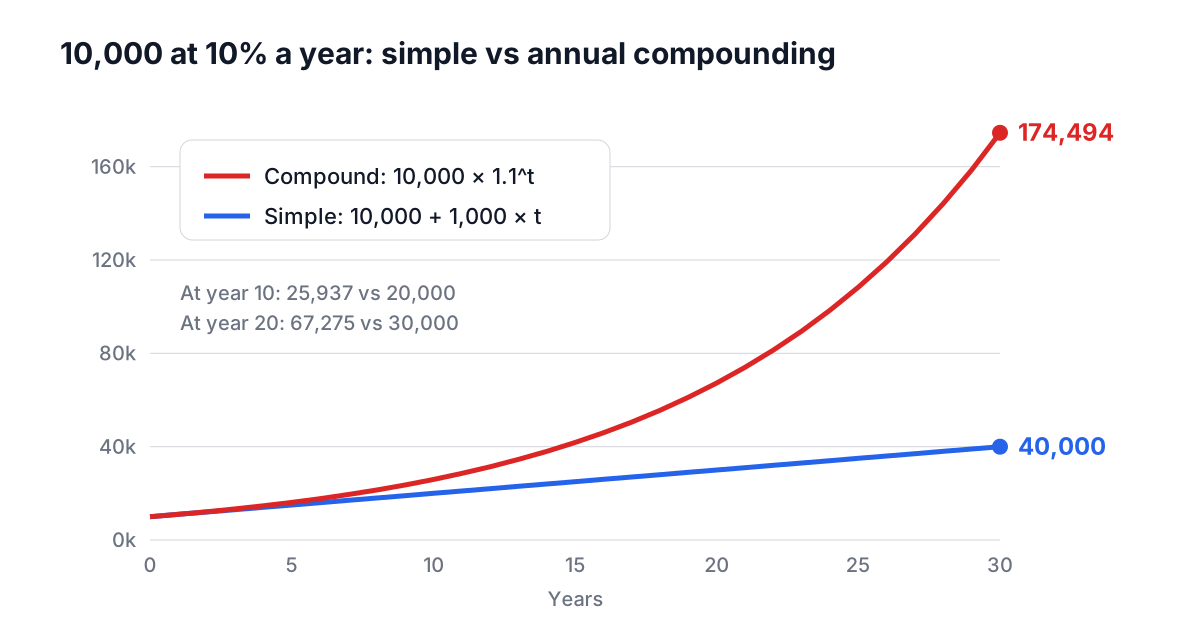
Over short periods the difference is small. Over three years it is 3,000 against 3,310. That is why people underestimate it: the curve looks like a line for the first decade and then bends hard. Between year 20 and year 30, the compounding balance grows by more than 107,000, while the simple-interest balance grows by 10,000.
The Interest Calculator is the quickest way to see this for your own numbers. Enter a principal, a rate and a time, then flip Interest Type between Simple Interest and Compound Interest. The Growth chart changes from a straight line to a curve.
The formula, piece by piece
The standard compound interest formula is:
A = P (1 + r/n)^(n t)
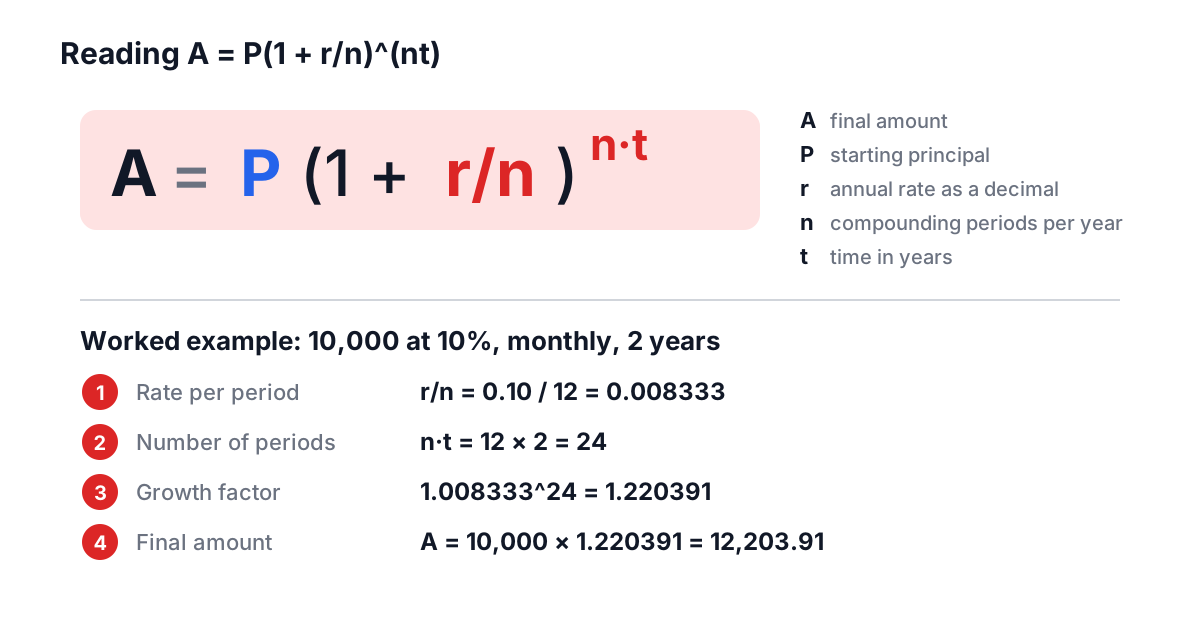
- P is the principal, the starting balance.
- r is the nominal annual rate as a decimal (10% is 0.10).
- n is how many times a year interest is compounded (12 for monthly).
- t is the time in years.
- r/n is the rate per compounding period, and n × t is the number of periods.
For 10,000 at 10% compounded monthly for two years: the rate per period is 0.10 / 12 = 0.008333, there are 24 periods, and A = 10,000 × 1.008333^24 = 12,203.91. Interest earned is A − P = 2,203.91.
The calculator applies this one period at a time instead of in a single exponent. The result is identical when there are no deposits, and it lets the tool add money along the way and handle partial years. A term of 1.5 years with annual compounding gets one full period and then half a period, rather than being silently rounded down to one year.
How much does compounding frequency matter?
Banks advertise daily compounding as if it were a big deal. It is not, once you are past monthly. Here is 10,000 at a nominal 10% for three years:
| Compounding | Periods per year | Final amount | Effective annual rate |
|---|---|---|---|
| Annually | 1 | 13,310.00 | 10.00% |
| Semi-annually | 2 | 13,400.96 | 10.25% |
| Quarterly | 4 | 13,448.89 | 10.38% |
| Monthly | 12 | 13,481.82 | 10.47% |
| Daily | 365 | 13,498.03 | 10.52% |
The jump from annual to monthly is worth 172. The jump from monthly to daily is worth 16. Even continuous compounding, the mathematical limit, only reaches an effective rate of e^0.10 − 1 = 10.517%.
The effective annual rate column is what regulators make banks publish, as APY in the US or AER in the UK. It already includes compounding, which leads to the most common mistake below.
Adding regular deposits
Most people do not deposit once and walk away. They add money every month. The calculator handles this under Additional Principal Contributions, with a deposit amount and a frequency.
Take the same 10,000 at 10% compounded monthly for two years and add 100 a month. The result is 14,848.60: 10,000 of principal, 2,400 of deposits and 2,448.60 of interest. The year-by-year table shows 12,303.69 at the end of year one.
Two conventions matter here:
- Deposits are credited at the end of each compounding period. This is the ordinary annuity convention used by most textbook and bank formulas. A deposit starts earning interest from the next period. If you deposit at the start of each month instead, multiply the deposit part of the result by (1 + periodic rate).
- Deposits follow the compounding schedule. If the account compounds annually and you pay in monthly, the year's deposits earn nothing until the year ends, because that is when the account credits interest. Pick the compounding frequency of the account, not of your standing order.
Setting the principal to 0 and using only deposits is a useful way to model a new savings habit. At 7% compounded monthly, 200 a month grows to about 104,200 over 20 years, of which 48,000 is your money.
The rule of 72
For quick mental arithmetic, divide 72 by the annual rate to get the number of years it takes money to double. At 6%, about 12 years. At 9%, about 8 years. At 7.2%, ten years: 1.072^10 = 2.004.
It works because ln(2) is about 0.693, and 72 is a convenient number near 69.3 with lots of divisors. It is accurate to within a few months for rates between about 4% and 15%. It also works in reverse for inflation: at 3% inflation, prices double in about 24 years.
Mistakes that throw calculations off
Entering an APY as if it were a nominal rate. If a bank quotes 5% APY and you enter 5% compounded monthly, you double-count the compounding and get an effective 5.12%. Enter an APY as an annual rate compounded annually.
Mixing up the rate period. "1% a month" is not "12% a year compounded annually"; it is 12.68% effective. The Compound Interest Calculator has a separate Rate Duration so you can enter the rate exactly as quoted, and its Calculation Summary prints the rate per compounding period it actually used. Check that line whenever a result looks too good.
Rounding the term down. A deposit held for 18 months earns 18 months of interest. Enter 1.5 years, not 1.
Using simple interest for an account that compounds. It understates the result, and the error grows every year. Use simple interest only when interest is paid out rather than added to the balance, such as a bond coupon or a flat-rate loan. The Simple Interest Calculator and its guide cover that case.
Forgetting tax and inflation. A 5% nominal return with 3% inflation is roughly a 2% real return, before any tax on the interest. Compound interest works on your purchasing power only through the real rate.
When compounding works against you
Everything above applies to debt too. A credit card at 24% APR compounded monthly has an effective rate of about 26.8%. A balance left unpaid doubles in about three years. For loans you are paying down, the maths is amortization rather than pure compounding, and the EMI loan amortization guide explains how each payment splits between interest and principal.
Putting it to use
Start with your actual account: its rate as quoted, its compounding frequency, and how often you deposit. Put those into the Compound Interest Calculator, check the Calculation Summary, and look at the year-by-year table rather than just the final number. Then try one change at a time: a higher deposit, five more years, a lower rate. Time and deposits usually move the result far more than the compounding frequency, so that is where the effort pays off. For investments with variable returns, the SIP vs lump sum guide shows how the same ideas apply to monthly investing.