
APY, Bond Yields and SIP Returns: Reading the Rate Correctly
Why the same 12% can mean three different things: APR vs APY, bond-equivalent yields and duration, and the two SIP conventions that make calculators disagree.
· 9 min read
"12%" sounds like a precise number, but it can mean three different things depending on who is quoting it. A bank means something exact by a 4.5% APY, a bond desk means something else by a 6% yield, and two SIP calculators can disagree on what 12% a year does to a monthly instalment. This guide explains the conventions behind the APY Calculator, the Bond Yield Calculator and the SIP Calculator, so you can read a quoted rate correctly and check one product against another.
APR, APY and why compounding matters less than you think
APR is a nominal rate: the yearly rate before interest earns interest. APY is what you actually earn in a year once compounding is counted. For n compounding periods a year:
APY = (1 + APR / n)^n − 1
APY = e^APR − 1            (continuous compounding)
APR = n × ((1 + APY)^(1/n) − 1)
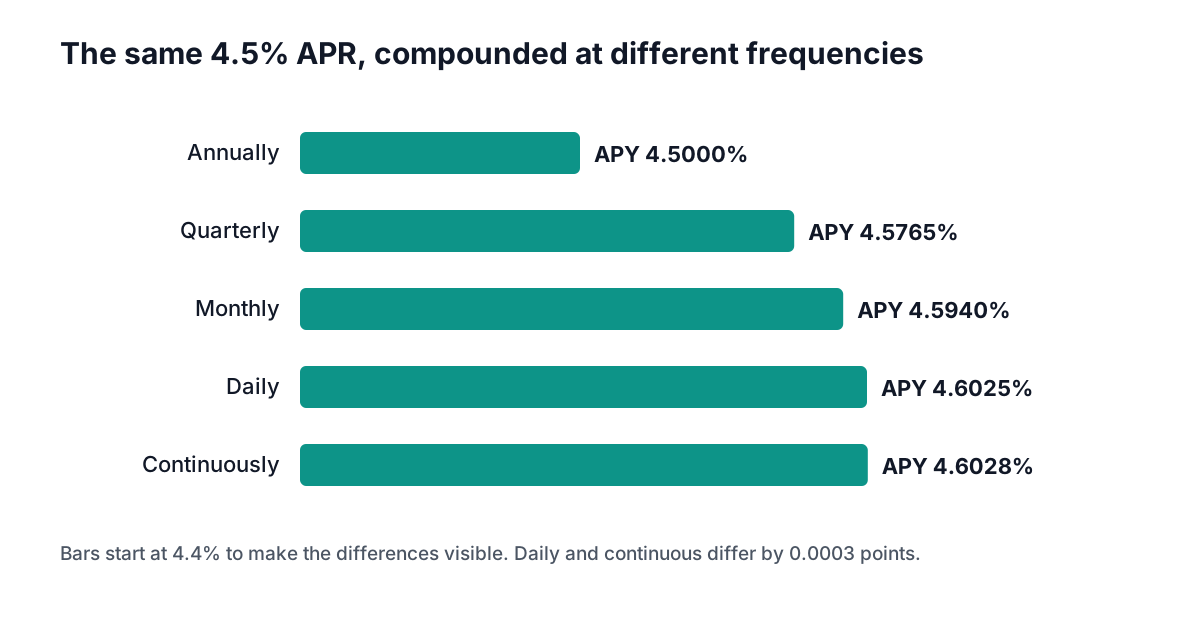
The chart shows a 4.5% APR at five frequencies. Moving from annual to monthly compounding adds almost a tenth of a point. Moving from daily to continuous adds 0.0003 points. A "compounded continuously" headline is mathematically real and financially trivial.
In the US, the Truth in Savings Act (Regulation DD) requires banks to advertise deposit yields as APY, using APY = 100 × [(1 + interest / principal)^(365 / days in term) − 1]. Its own example of $61.68 of interest on $1,000 over 365 days gives 6.17%, and the APY Calculator's tests reproduce that and the regulation's other worked examples. For a one-year term the regulation's formula and the compounding formula are the same thing.
This has a practical consequence for CDs. Because the advertised number is already an APY, a $10,000 one-year CD at 4.25% APY earns exactly $425 whatever the compounding. Treat 4.25% as an APR compounded daily instead and you would expect about $434. The CD panel therefore takes the APY by default and converts it to the APR for the compounding you choose.
What breaking a CD early really costs
Early-withdrawal penalties are usually expressed as days or months of interest. On a five-year CD of $25,000 at 4% APR compounded monthly, a 12-month penalty is $1,000. Withdraw after one year and the balance of about $26,018 shrinks to $25,018.54: a year of saving for $18. Withdraw after six months and you get back less than you put in, which some banks allow by taking the penalty from principal.
The judgment call is simple to state: a long CD's higher rate is only worth having if you are confident you will not need the money. If you might, compare the shorter CD's total with the long CD's total minus the penalty at the month you are worried about. The calculator shows that early-exit value for any month.
Bond yields: a rate you have to solve for
A bond's price is the present value of its coupons and principal, discounted at its yield. US quotes use a bond-equivalent yield, an annual rate compounded at the coupon frequency. For a 10-year bond with a 5% coupon paid twice a year, priced at a 6% yield, each half-year is discounted at 3%:
price = Σ 25 / 1.03^k (k = 1..20) + 1000 / 1.03^20 = 925.61
Going the other way, from a price to a yield, has no algebraic solution. The calculator solves it numerically: Newton's method for speed, kept inside a bisection bracket so it can never wander off. At a price of $1,100 the same bond yields 3.789% to maturity.
Two shortcuts are worth knowing and distrusting. Current yield is annual coupon ÷ price: 50 ÷ 925.61 = 5.402%. It ignores the $74.39 gain to par at maturity, so a discount bond's true return is higher than its current yield, and a premium bond's lower. Yield to call asks what you earn if the issuer redeems early. If the $1,100 bond is callable in five years at $1,020, the yield to call is 3.192%, and the lower of the two (the yield to worst) is the realistic expectation, since issuers call bonds when rates have fallen.
Clean and dirty prices
Between coupon dates the seller has earned interest that the buyer will receive with the next coupon. Screens quote the clean price; the buyer pays the dirty price, which adds that accrued interest. With 9.75 years left on our bond, half a semiannual period has passed, so accrued interest is $12.50 and at a 6% yield the clean price is $926.89 while the invoice is $939.39. Real settlements count days with the bond's own convention (actual/actual for Treasuries, 30/360 for many corporates); the calculator's fractional-period approach is close to 30/360.
Duration, convexity and interest-rate risk
Macaulay duration is the present-value-weighted average time until you receive the bond's cash flows. Modified duration, Macaulay ÷ (1 + yield per period), estimates the percentage price change for a one-point move in yield. For our 10-year bond at 6%, Macaulay duration is 7.895 years and modified duration 7.665, so a one-point rise in yields should cut the price by roughly 7.7%.
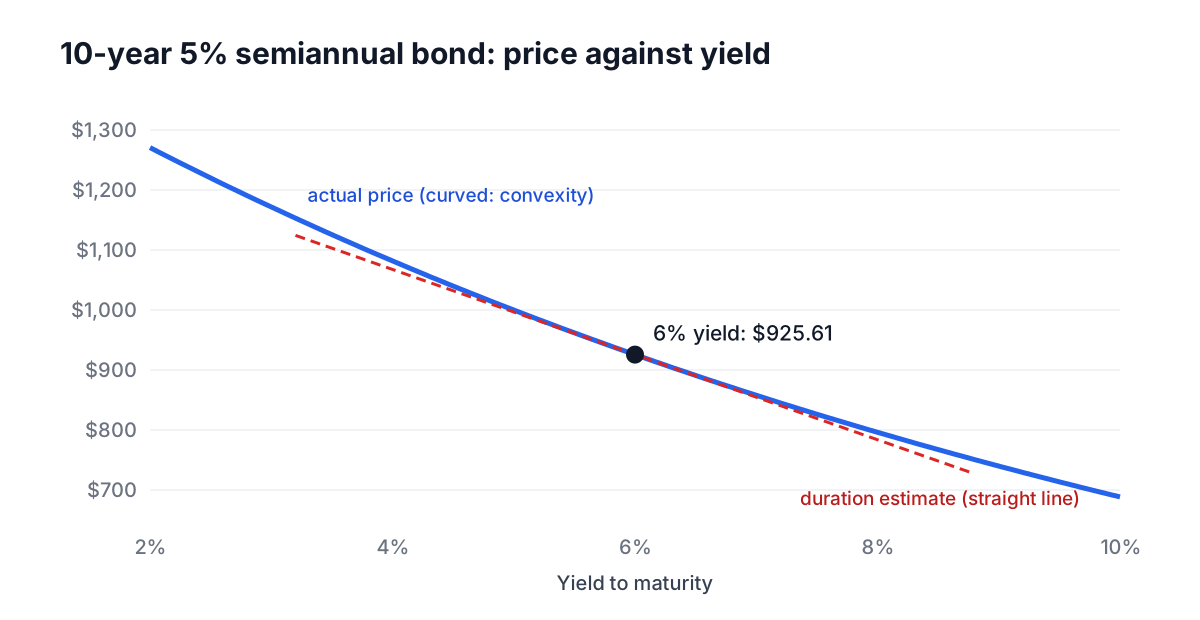
The real curve bends away from the straight duration line on both sides, which is convexity. In practice the full price falls 7.32% (to $857.88) when yields rise a point and rises 8.04% (to $1,000) when they fall a point. The asymmetry is in the bondholder's favour, and it is larger for long bonds and zero-coupon bonds. A useful sanity check: a zero-coupon bond's Macaulay duration equals its maturity, because there is only one cash flow.
SIPs: two conventions, two answers
A SIP invests a fixed amount at the start of each month. Summing each instalment's growth gives the future value of an annuity due:
FV = P × [((1 + i)^n − 1) / i] × (1 + i)
The disagreement between SIP calculators is all in i. Most use the annual rate ÷ 12, so 12% becomes 1% a month. Some fund houses, including HDFC Mutual Fund's calculator, and Groww use i = (1 + annual)^(1/12) − 1, about 0.949% a month, so that 12% means exactly 12% a year rather than the 12.68% that 1% a month compounds to. For ₹10,000 a month over 10 years at 12%, the first gives ₹23,23,391 and the second ₹22,40,359. Moving the instalment to the end of the month gives ₹23,00,387. None is wrong; they answer slightly different questions, and the SIP Calculator lets you match whichever one you are checking.
A step-up changes the answer far more than any convention. Raising the same SIP by 10% each year lifts the 10-year value to ₹33,74,326 on ₹19,12,491 invested. And time matters more still: reaching ₹1 crore at a steady 12% needs about ₹43,041 a month over 10 years but only about ₹10,009 over 20. For a deeper look at investing gradually against investing at once, read SIP vs Lump Sum.
Reading any quoted rate
Before comparing two numbers, ask three questions. Is it nominal or effective (APR or APY)? How often does it compound or pay? And is it a promise (a CD's APY) or an assumption (a fund's expected return, a bond's yield if held to maturity)? The Compound Interest Calculator is useful for the first two; the third is where most bad comparisons come from. A 4.25% CD and a 12% equity SIP are not on the same scale, because only one of them is guaranteed.