
Intermittent Fasting Schedules: 16:8, 18:6, OMAD and the Evidence
How the common fasting windows work, what happens metabolically, what controlled trials found about weight loss, who should not fast and how to start without misery.
· 9 min read
Intermittent fasting has gone from fringe idea to one of the most popular ways of eating in a decade. Its appeal is simplicity: instead of counting everything you eat, you decide when you eat. This guide explains the common schedules, what happens in the body during a fast, what controlled trials have actually found, who should not fast, and how to start in a way you can keep up. The Intermittent Fasting Timer tracks your fasts and plans your daily window.
The main schedules
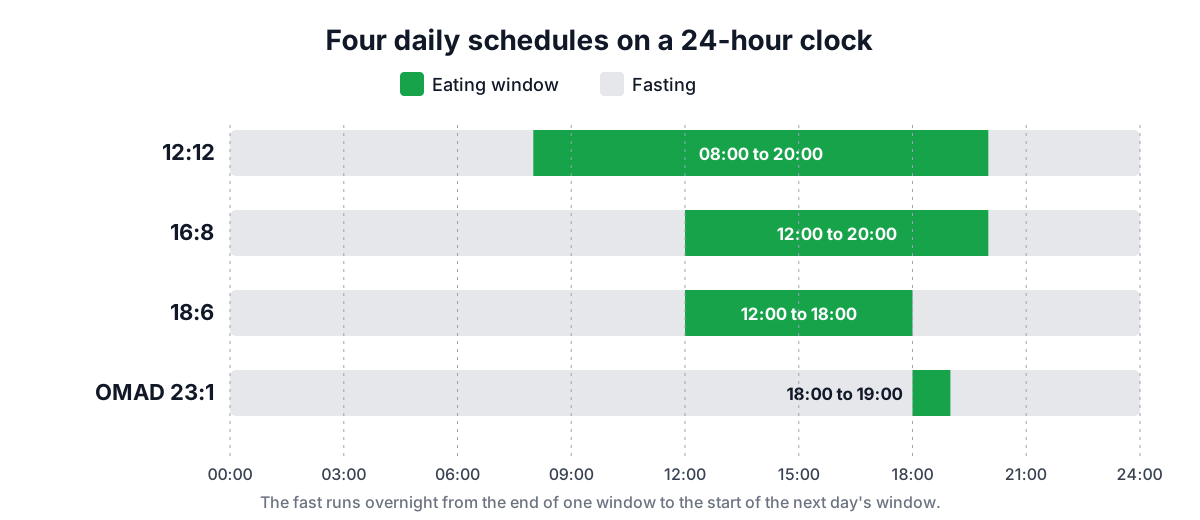
"Intermittent fasting" covers several different patterns. The ones people track with a timer are forms of time-restricted eating: you eat within a window of the same hours each day and fast for the rest.
| Pattern | Fast | Eating window | Example window |
|---|---|---|---|
| 12:12 | 12 h | 12 h | 08:00 to 20:00 |
| 14:10 | 14 h | 10 h | 09:00 to 19:00 |
| 16:8 | 16 h | 8 h | 12:00 to 20:00 |
| 18:6 | 18 h | 6 h | 12:00 to 18:00 |
| 20:4 | 20 h | 4 h | 15:00 to 19:00 |
| OMAD (23:1) | 23 h | about 1 h | 18:00 to 19:00 |
Other approaches fast on whole days rather than hours. Alternate-day fasting alternates normal days with days of very little food. The 5:2 diet has five normal days and two non-consecutive days of about 500 to 600 kcal. Longer fasts of 24 hours or more are done occasionally by some people; these carry more risk and are best done with medical guidance if at all.
A 12:12 pattern is close to what many people already do if they stop eating after dinner and have breakfast twelve hours later. 16:8 is the most studied time-restricted pattern and the one most people mean by "intermittent fasting".
What happens during a fast
After a meal your body runs mainly on glucose from food, and insulin helps store the excess, partly as glycogen in the liver and muscles. As hours pass without food, insulin falls and the liver releases glucose from its glycogen stores to keep blood sugar steady. Over roughly 12 to 36 hours, depending on activity and the last meal, liver glycogen runs low and the body leans more on fat: fatty acids are released from fat tissue and the liver turns some of them into ketones, which the brain and muscles can use.
In a widely cited 2019 review in the New England Journal of Medicine, Rafael de Cabo and Mark Mattson call this the "metabolic switch" and argue that repeatedly flipping it, from glucose to fat-based fuel and back, may drive some of the benefits seen in animal studies, including improved insulin sensitivity and stress resistance. Much of this evidence comes from animals, and claims about specific processes switching on at specific hours, such as autophagy "starting at 16 hours", go beyond what human studies have shown.
What the trials show about weight
If fasting worked mainly through some special metabolic effect, people should lose more weight with it than with ordinary calorie cutting at the same intake. The best trials suggest that is not the case:
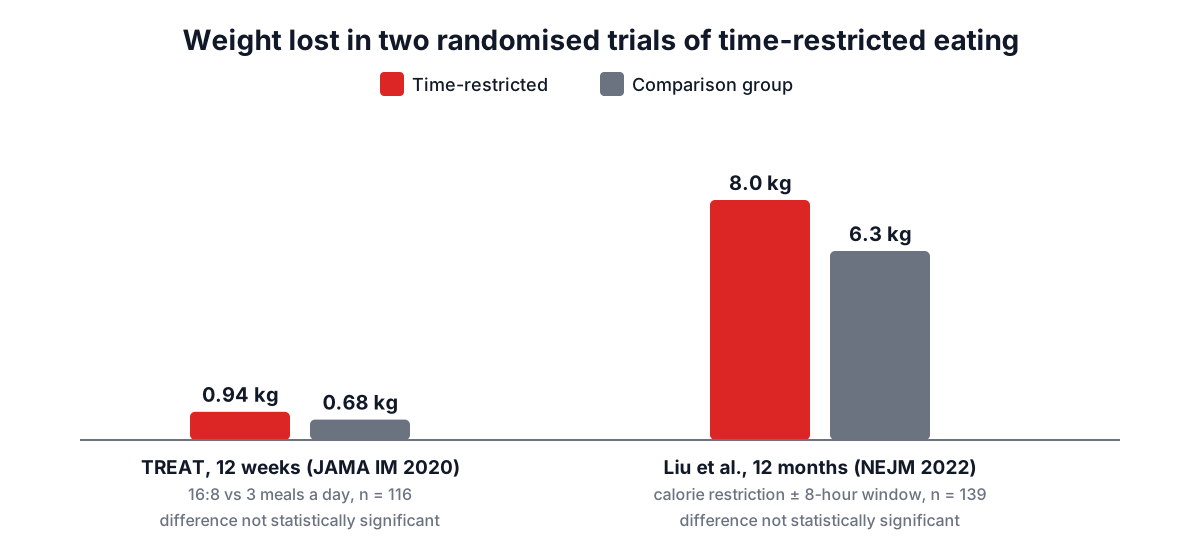
- TREAT trial (2020). Dylan Lowe and colleagues randomised 116 adults with overweight or obesity to 16:8 eating or three structured meals a day for 12 weeks, published in JAMA Internal Medicine. The 16:8 group lost 0.94 kg and the control group 0.68 kg, a difference that was not statistically significant. The 16:8 group lost a worrying share of the weight as lean mass.
- NEJM trial (2022). Deying Liu and colleagues in China randomised 139 adults with obesity to calorie restriction with an 8:00 to 16:00 eating window or to the same calorie restriction without time limits, for 12 months. Weight loss was 8.0 kg versus 6.3 kg, again not significantly different, and blood pressure, glucose and lipids changed similarly.
- Meta-analyses comparing intermittent fasting with continuous calorie restriction generally find similar weight loss for both.
The practical conclusion is that intermittent fasting works about as well as other diets, by helping people eat less. For people who find a clear "kitchen closed" rule easier than counting, that is a real advantage; for others it is not.
Does the timing of the window matter?
There is some evidence that eating earlier in the day is better for metabolism than eating late, because the body clock makes insulin sensitivity higher in the morning. In a small but tightly controlled 2018 study in Cell Metabolism, Elizabeth Sutton and colleagues fed eight men with prediabetes the same food either within a 6-hour window ending by 15:00 or over 12 hours, for five weeks each. With the early window, insulin sensitivity and blood pressure improved even though weight did not change.
That is a promising result, but it came from a handful of people under laboratory conditions. Most people choose a later window such as 12:00 to 20:00 because it fits work and family meals. The best window is the one you can keep while eating well within it.
What breaks a fast
During the fasting hours most approaches allow drinks with essentially no energy:
- Allowed: water, sparkling water, black coffee, plain tea and herbal teas.
- Grey area: a splash of milk (a few kilocalories) and zero-calorie sweeteners. Strict versions avoid them; many people find they make no practical difference.
- Breaks the fast: anything with meaningful calories, including juice, milky coffees, smoothies, sugary drinks and alcohol.
Medicines that must be taken with food are a reason to plan the window around them, or to talk to a doctor before fasting.
Who should not fast
Intermittent fasting is not appropriate for everyone. Get medical advice first, or avoid it, if any of these apply:
- Pregnancy or breastfeeding, when energy and nutrient needs are higher.
- Under 18, during growth.
- A history of eating disorders, where rigid food rules can trigger relapse.
- Diabetes treated with insulin or sulfonylureas, because of the risk of hypoglycaemia; doses usually need adjusting.
- Other conditions such as low blood pressure, kidney disease, or frailty and unintended weight loss in older adults.
Common side effects in the first week or two include hunger, headaches, irritability, poor concentration and constipation. They usually ease. Dizziness or fainting is a signal to stop and eat.
Starting without misery
- Begin with 12:12. Stop eating after dinner and have breakfast 12 hours later. Most people already do something close.
- Extend by an hour every few days towards 14:10 or 16:8. There is no need to go beyond the pattern that works for you.
- Drink plenty of water and use black coffee or tea if they help with morning hunger.
- Eat proper meals in the window, with protein at each meal, vegetables and fibre. Fasting does not cancel out large or highly processed meals.
- Keep resistance training and enough protein to protect muscle, given the lean-mass loss seen in TREAT.
- Track it for a few weeks to see what is realistic, then judge by results you care about: weight, waist, energy, sleep or blood tests.
The Intermittent Fasting Timer keeps the start time in your browser so the count survives closing the page, logs completed fasts, and has a planner that turns a first-meal time into a daily schedule.
Fasting and calories together
Because the benefit mostly comes from eating less, it helps to know your actual energy needs. The Calorie Calculator estimates maintenance calories, and the Calorie Deficit Planner turns a weight goal into a daily target. If your eating window becomes very short, the Protein Calculator helps check you are still getting enough protein in fewer meals. Our guide to calorie deficits explains how fast weight loss can sensibly go.
Summary
Time-restricted eating is a structure for eating less, not a metabolic shortcut. Trials show it works about as well as ordinary calorie restriction. Early windows may carry modest metabolic advantages, but the window you can keep matters more. Start gently, eat well within the window, protect your muscle, and skip fasting entirely if you are pregnant, young, have had an eating disorder or take glucose-lowering drugs without medical supervision.
Sources: de Cabo R, Mattson MP, Effects of intermittent fasting on health, aging, and disease, N Engl J Med 2019;381:2541-51; Lowe DA et al., JAMA Intern Med 2020;180:1491-9; Liu D et al., N Engl J Med 2022;386:1495-504; Sutton EF et al., Cell Metab 2018;27:1212-21.
Related searches
- intermittent fasting schedules
- 16 8 vs 18 6 fasting
- time restricted eating research
- what breaks a fast
- early time restricted eating
- intermittent fasting side effects
- who should not fast
- omad pros and cons