
Calorie Deficits and the 3,500 Calorie Rule: Why Loss Slows Down
Where the 3,500 kcal per pound rule came from, why Hall et al. showed it overpredicts long-term loss, safe deficit sizes, intake floors and how to re-plan.
· 6 min read

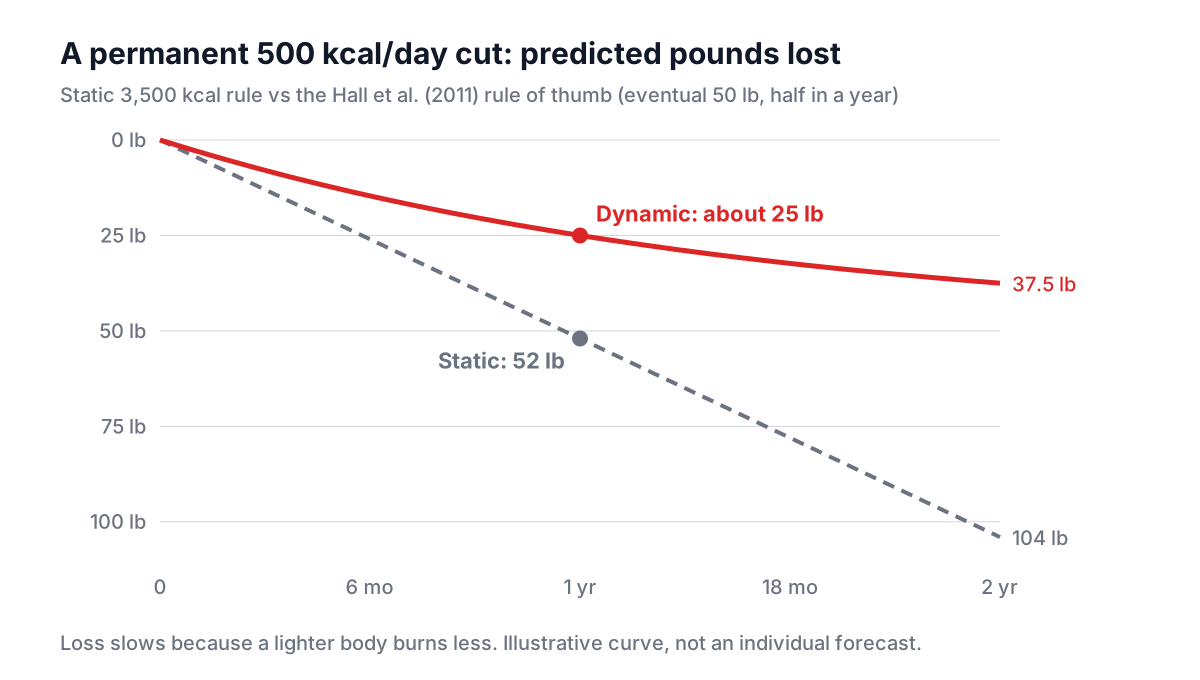
Cut 500 kcal a day, lose a pound a week, lose 52 pounds in a year. The arithmetic is tidy and it appears in diet books, apps and clinic leaflets. Almost nobody who keeps that deficit for a year loses 52 pounds, and that is not usually because they cheated. The rule assumes your body keeps burning the same amount while it shrinks. It does not.
This guide covers where the 3,500 kcal rule came from, what the research says actually happens, how big a deficit makes sense, why intake floors exist, and how to use the Calorie Deficit Planner without being misled by its goal date. It is general information, not medical advice. Talk to a clinician before dieting if you have a medical condition, are pregnant, or have a history of disordered eating.
Where 3,500 calories per pound came from
In 1958 Max Wishnofsky estimated the energy stored in a pound of human body fat tissue at about 3,500 kcal. In metric terms that is roughly 7,700 kcal per kilogram. As a statement about stored energy, it is a fair approximation: fat tissue is mostly fat at about 9 kcal per gram, plus some water and protein.
The problem came later, when the number was turned into a forecast. Divide any deficit by 3,500 and you get a weekly loss that continues forever. That only works if your energy expenditure stays fixed, and it does not.
Why loss slows down
When you lose weight, several things lower your daily energy use:
- Smaller body, lower BMR. Under the Mifflin-St Jeor equation, each kilogram lost lowers predicted BMR by 10 kcal. Multiply by your activity factor and the effect on TDEE is 12 to 19 kcal per kg.
- Moving a lighter body costs less. Walking, climbing stairs and exercise all burn less at a lower weight.
- Adaptive changes. Hormonal and behavioural adjustments, including less unconscious movement, can lower expenditure a little beyond what size alone predicts.
So a fixed intake that was 500 kcal below maintenance on day one is a smaller deficit by month three, and smaller again by month six. Eventually intake and expenditure meet, and weight settles at a new, lower level.
In 2011 Kevin Hall and colleagues published a mathematical model of this in The Lancet, built from controlled feeding studies. Their headline rule of thumb for adults with overweight: every sustained change of 10 kcal a day in intake leads to an eventual weight change of about 1 lb (roughly 24 kcal a day per kg), with about half of it reached in the first year and most of it within three years. By that rule a permanent 500 kcal cut leads to about 50 lb of eventual loss, but only around half of that in the first year, not 52 lb. The NIH Body Weight Planner is based on this model.
How big should the deficit be?
The common guidance is a deficit of about 500 to 750 kcal a day, aiming for 0.5 to 1 kg (1 to 2 lb) a week at first. The US NHLBI obesity guideline adds two useful anchors: aim to lose about 10% of starting weight over roughly six months as a first goal, and reassess from there.
| Deficit | Early weekly loss (static rule) | Notes |
|---|---|---|
| 250 kcal | about 0.5 lb / 0.23 kg | Easy to sustain, slow to show on the scale |
| 500 kcal | about 1 lb / 0.45 kg | The usual default |
| 750 kcal | about 1.5 lb / 0.68 kg | Faster, harder to sustain, more risk to muscle |
Bigger deficits are not automatically better. They make it harder to eat enough protein and micronutrients, increase muscle loss, and raise the chance of giving up. Diets below about 800 kcal a day are classed as very low calorie diets and are meant to be medically supervised.
Intake floors
Many guidelines suggest that women should not eat below about 1,200 kcal a day and men below about 1,500 kcal without supervision. These are practical floors rather than biological constants, but they keep a diet within reach of basic nutrient needs.
Small, older or sedentary people hit the floor quickly. A 40-year-old woman at 150 cm and 50 kg who is lightly active has a TDEE of about 1,480 kcal. A 500 kcal cut would take her to 980, so the planner holds her at 1,200, a real deficit of only 280 kcal. If TDEE is already at or below the floor, the planner says it cannot plan a deficit at all, because the only way to create one safely is to move more.
Walking through the planner
The Calorie Deficit Planner estimates TDEE with Mifflin-St Jeor and an activity factor, then applies a Conservative (250), Moderate (500) or Aggressive (750) kcal deficit, subject to the floor. It converts the deficit to weight with 7,700 kcal per kg and reports the rate in kg or lb depending on your unit choice.
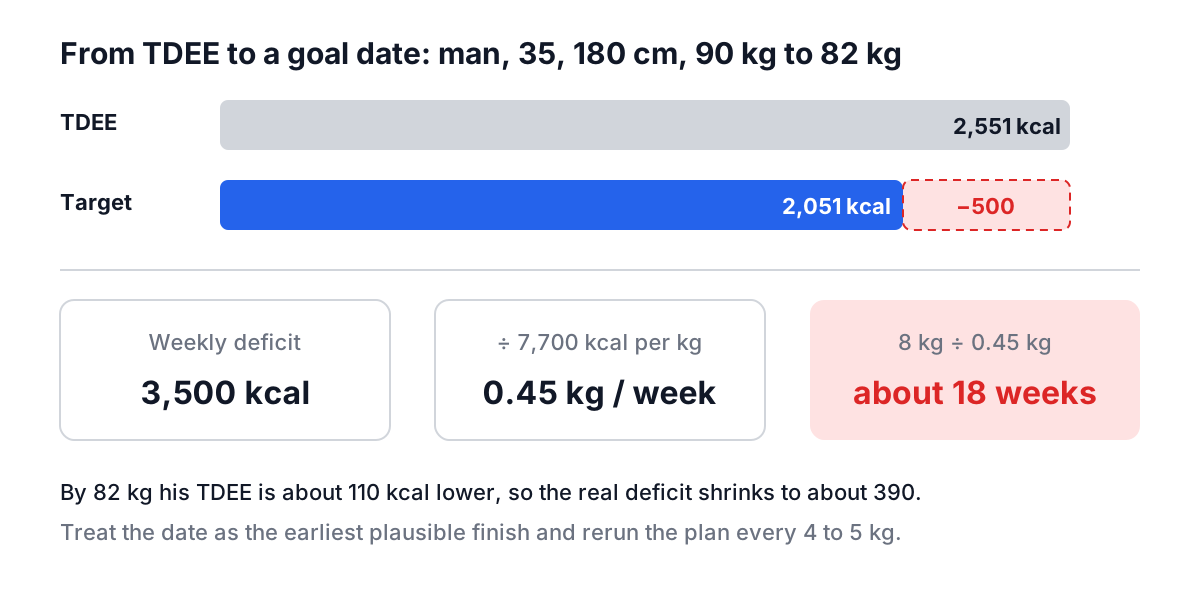
Take a 35-year-old man, 180 cm, 90 kg, lightly active, aiming for 82 kg with a moderate deficit:
BMR    = 10 × 90 + 6.25 × 180 − 5 × 35 + 5 = 1,855 kcal
TDEE   = 1,855 × 1.375                      = 2,551 kcal
Target = 2,551 − 500                        = 2,051 kcal
Weekly = 500 × 7 / 7,700                    = 0.45 kg
Weeks  = 8 kg / 0.45 kg                     ≈ 17.6, shown as 18
His 8 kg goal is under 10% of 90 kg, so the planner accepts it. A target of 80 kg (11%) would be rejected with a suggestion to set a smaller first goal.
Read the 18 weeks as the earliest plausible date. By 82 kg his BMR would be 80 kcal lower and his TDEE about 110 kcal lower, so the same 2,051 kcal intake would be a deficit of around 390 kcal by the end. Averaging the shrinking deficit puts the plan at about 20 weeks before any adaptation, which is why rerunning the plan every 4 to 5 kg matters.
Common mistakes
- Trusting the date. It comes from a static rule. Add a buffer for any plan longer than three months.
- Judging progress weekly. Water and glycogen shifts can hide a week of fat loss or fake one. Compare two- to four-week averages of morning weights.
- Never recalculating. Your maintenance number falls as you lose weight. Rerun the plan at each new stage.
- Overestimating activity. A higher activity level inflates TDEE and quietly erases the deficit. The TDEE guide explains how to choose.
- Cutting protein with calories. Keep protein high to protect muscle; the Protein Calculator gives a target.
- Mixing units. Weight and height must be in the same system. The planner accepts 47 to 98 inches or 120 to 250 cm, and 66 to 660 lb or 30 to 300 kg.
Making a plan you can keep
Start with a moderate deficit and a first goal of no more than 10% of your weight. Weigh in the morning, track the weekly average, and expect the first fortnight to look better than reality and month three to look worse. When progress stalls for three or four weeks, rerun the Calorie Deficit Planner at your new weight before cutting further, and remember that adding activity raises the ceiling you are eating under. If you want to check what a healthy end weight looks like, the BMI guide covers what that number can and cannot tell you.