
Cups, Grams and Shoe Sizes: Everyday Conversions That Trip People Up
Why a cup of flour is not a cup of sugar, how US, metric and Australian spoons differ, how gas marks map to Fahrenheit, and why shoe sizes never line up between countries.
· 9 min read
Some conversions are pure arithmetic: inches to centimetres, pounds to kilograms. Others look like arithmetic but depend on a hidden assumption. "How many grams in a cup?" has no single answer, because it depends on what is in the cup and which country's cup you mean. "What is a US 10 in European sizes?" depends on whose chart you trust. This guide explains the assumptions behind the Cooking Measurement Converter and the Shoe Size Converter, so you can see where the numbers come from and where they stop being exact.
Volume is not weight
A cup measures space. A gram measures mass. To get from one to the other you need the density of the ingredient, how many grams fit in a given volume. Water is the easy case: 1 ml weighs 1 g, so a US cup of water is 236.6 g. Almost nothing else in a kitchen is that convenient.
Flour is full of air. A cup of all-purpose flour spooned into the cup and levelled weighs about 120 g, according to the King Arthur Baking ingredient weight chart. Granulated sugar packs tightly and weighs 198 g per cup. Honey is denser than water, at 21 g per tablespoon or about 336 g per cup. Put those side by side and a "cup" spans a factor of almost three.
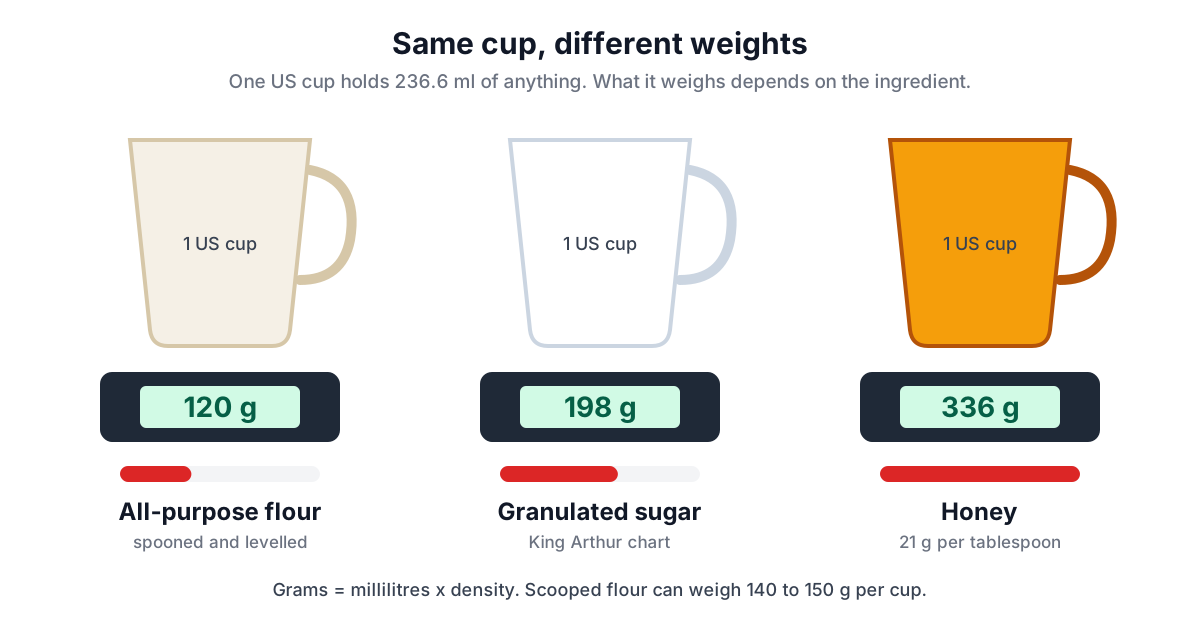
The converter stores a weight per US cup for each of its 27 ingredients and converts through density: grams = millilitres x (grams per cup / 236.588). Dry baking ingredients use the King Arthur figures; milk (244 g per cup), heavy cream (238 g) and vegetable oil (218 g) use USDA FoodData Central household measures.
Even with the right density, volume measurement has a technique problem. The 120 g flour figure assumes you spoon flour into the cup and sweep the top level. Dip the cup into the bag and press, and the same cup can hold 140 to 150 g. That 20% swing is the difference between a tender cake and a dry one, and it is the main reason professional and most modern baking recipes are written in grams. If you bake from the same recipe often, weigh your usual cup once, or convert the recipe to grams and use a scale from then on.
Which cup? US, metric and imperial
The second assumption is the size of the measuring tools. They are not the same everywhere:
| Unit | Volume |
|---|---|
| US cup | 236.6 ml (half a US pint) |
| US "legal" cup on nutrition labels | 240 ml |
| Metric cup (UK, Australia, NZ, Canada today) | 250 ml |
| Old British imperial cup | 284 ml |
| US tablespoon | 14.8 ml |
| Metric tablespoon | 15 ml |
| Australian tablespoon | 20 ml |
| US teaspoon / metric teaspoon | 4.93 ml / 5 ml |
For most cooking the 6% gap between US and metric cups does not matter. For baking it can: 2 metric cups of flour weigh about 254 g, against 240 g for 2 US cups. The Australian tablespoon is the one that really catches people out. At 20 ml it is a third larger than the US or UK spoon, so an Australian recipe calling for a tablespoon of baking powder means 4 teaspoons, not 3.
Liquid measures have the same split. A US fluid ounce is 29.57 ml and a UK fluid ounce is 28.41 ml, but a US pint has 16 of them (473 ml) and a UK pint has 20 (568 ml). "A pint of milk" in a British recipe is 20% more than in an American one.
In the US, butter is often measured in sticks. One stick is a quarter pound: 4 ounces, 113 g, 8 tablespoons or half a cup. The wrapper markings are tablespoons.
Oven temperatures and gas marks
Fahrenheit and Celsius convert exactly: °C = (°F - 32) x 5/9. 350°F is 176.7°C. Recipes print 180°C because oven dials work in 10 degree steps and nobody sets 177. That rounding is harmless; an oven's own thermostat typically swings more than that.
British gas ovens use gas marks, which follow a neat pattern. Gas mark 1 is 275°F, and each mark above adds 25°F, so gas 4 is 350°F, gas 6 is 400°F and gas 9 is 475°F. Below 1 the scale halves: gas 1/2 is 250°F and gas 1/4 is 225°F.
Fan or convection ovens blow hot air over the food, which transfers heat faster. The usual adjustment is about 20°C (25°F) lower than a conventional oven, so a 180°C recipe becomes 160°C fan. Many recipes written in the UK give both. If your results run dark, an inexpensive oven thermometer is the best check; dials are often 10 to 25°F out.
Scaling a recipe
Scaling is multiplication by one factor: servings wanted / servings in the recipe. Going from 4 to 6 servings is 1.5, so 2 1/4 cups of flour becomes 3 3/8 cups and 3/4 cup of sugar becomes 1 1/8 cups. The scaler in the cooking converter does each line, then writes the answer back as the nearest eighth or third, which matches measuring cups and spoons.
The arithmetic is exact. What does not scale linearly is the physical side of cooking:
- Eggs come in whole units. 1.5 eggs means beating two and using three quarters, or rounding and adjusting liquid.
- Leavening and salt are often scaled slightly less than linearly when a batch is doubled or more.
- A bigger cake in a deeper pan bakes from the outside in for longer. Lower the temperature by 10 to 15°C and check early.
- Pan area grows with the square of the diameter: a 10 inch round pan holds 1.56 times as much as an 8 inch pan, not 1.25 times.
Shoe sizes: three counting systems
Shoe sizes are a conversion problem of a different kind. The systems were invented separately and count in different steps:
- UK and US count in barleycorns, an old unit of one third of an inch (8.47 mm). Each full size is one barleycorn longer.
- EU counts in Paris points of two thirds of a centimetre (6.67 mm).
- Japan and Mondopoint (ISO 9407) simply use the foot length, in centimetres or millimetres.
Because a UK size step is 8.47 mm and an EU step is 6.67 mm, the two scales slide past each other. A UK size and a half covers roughly two EU sizes, and no fixed offset converts one to the other across the whole range. Every published chart is a rounding of one scale onto another, which is why charts from different brands disagree by half a size.
The cleanest way to convert is through foot length. ISO/TS 19407, the ISO specification on converting sizing systems, gives formulas based on foot length that include the usual allowance for the shoe being slightly longer than the foot. The Shoe Size Converter uses them:
- EU = 1.5 x foot length (cm) + 2
- UK adult = 3 x foot length (inches) - 23
- US men's = UK + 1, US women's = UK + 2
- Japan = foot length in cm; Mondopoint = foot length in mm
A men's US 10 works back to a foot of 10 2/3 inches (27.1 cm). That is UK 9, EU 42.6 (sold as 42 or 43, or 42.5 by brands that make half sizes) and Japan 27.
Children's sizes start their own count: UK child = 3 x foot (inches) - 10 and US child = 3 x foot - 9.75, running up to 13.5, after which they roll onto the adult (UK) or youth (US) scale at size 1.
Where the numbers stop being exact
All of these conversions are honest about a model, and each model has limits. Ingredient densities are averages; brands of flour and the humidity in your kitchen shift them by a few percent. Shoe formulas describe the systems, but brands build on their own lasts, and US women's sizing in particular has two conventions (men's + 1 and men's + 1.5). Sports shoes are often sized differently from dress shoes from the same company.
The practical rule is the same for both: use the converter to get close, then trust a measurement over a label. For cooking, that measurement is a kitchen scale. For shoes, it is your foot against a wall and a ruler, and the brand's own chart. For straight unit changes that do not depend on an ingredient or a sizing system, the general Unit Converter covers length, mass, volume and temperature, and the Fraction Calculator helps when a scaled recipe lands on an awkward fraction.