
Your Menstrual Cycle in Numbers: Periods, Ovulation and the Fertile Window
How cycle length is counted, why ovulation sits about 14 days before the next period, where the six-day fertile window comes from, and how far to trust a prediction.
· 8 min read
Period trackers and ovulation calculators all rest on a handful of simple rules: count the cycle from the first day of bleeding, put ovulation about 14 days before the next period, and call the six days ending on ovulation the fertile window. Each rule is a reasonable average. None of them is a promise about any particular month.
This guide explains where those rules come from, how to measure your own numbers, how the Period Calculator and Ovulation Calculator apply them, and how much weight to put on the dates they produce. It is general information, not medical advice.
How a cycle is counted
Day 1 of a menstrual cycle is the first day of real bleeding, not spotting beforehand. The cycle ends the day before the next period starts. Cycle length is therefore the number of days from one period start to the next.
Period length is a separate number: how many days you bleed, usually two to seven. A 28-day cycle with a 5-day period starting on 1 October 2026 gives a next period from 29 October to 2 November. The end date is the start plus four, not five, because the first day counts as day 1.
The 28-day cycle is a teaching average. ACOG describes 21 to 35 days as typical for adults, and longer, less regular cycles are common in the first few years after periods begin. A large analysis of more than 600,000 cycles logged in a tracking app (Bull and colleagues, npj Digital Medicine, 2019) found a mean of 29.3 days, and only about 13% of cycles were exactly 28 days. Cycles shortened slightly with age through the late thirties and forties.
To find your own average, write down the start dates of your last three to six periods and average the gaps. If the starts were 3 July, 31 July and 29 August, the gaps are 28 and 29 days, so the average is 28.5. The Period Calculator does this for you in its past dates panel.
The two halves of the cycle
A cycle has two phases separated by ovulation, the release of an egg from the ovary.
The follicular phase runs from day 1 to ovulation. Follicle-stimulating hormone (FSH) recruits a group of follicles, one becomes dominant, and rising oestrogen thickens the uterine lining. This phase is the flexible one. Stress, illness, travel, weight change and breastfeeding can all lengthen it, and it is the main reason one person's cycle differs from another's.
The luteal phase runs from ovulation to the day before the next period. After a surge of luteinising hormone (LH) triggers ovulation, the empty follicle becomes the corpus luteum and produces progesterone for about two weeks. If no pregnancy occurs, progesterone falls and the next period begins. The luteal phase is steadier, usually 12 to 14 days, though 10 to 16 days is within the normal range.
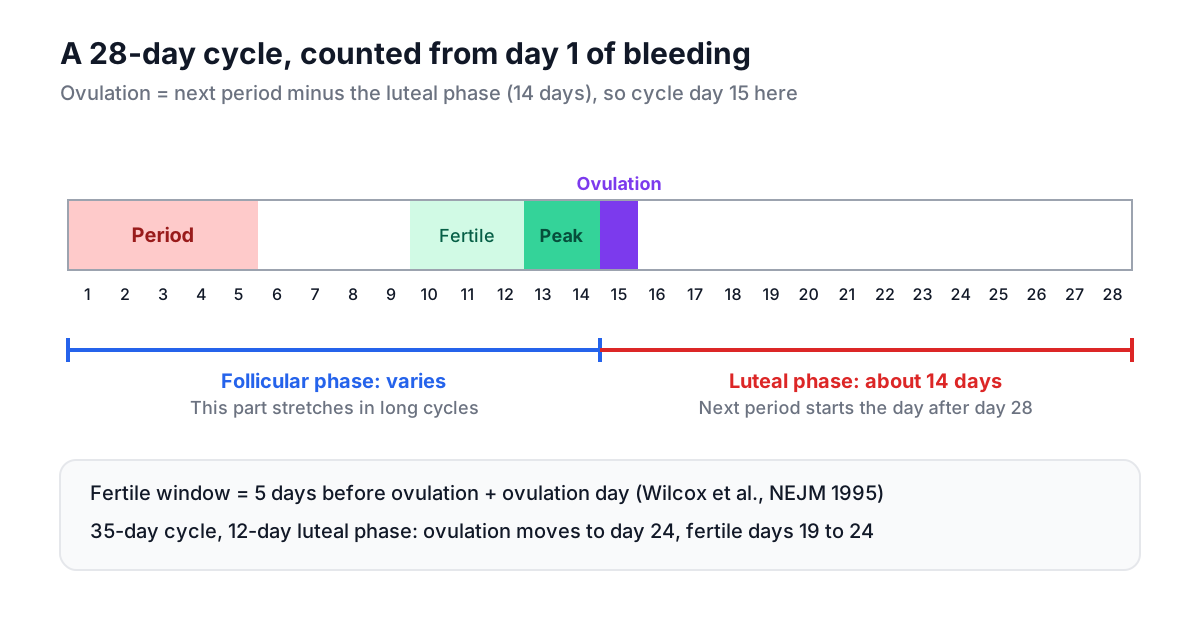
That asymmetry is why calculators count backwards. Ovulation is placed at the next expected period minus the luteal phase:
Ovulation = last period start + cycle length - luteal phase
For a 28-day cycle and a 14-day luteal phase, that is cycle day 15. For a 35-day cycle with a 12-day luteal phase, it is day 24. A rule of "ovulation on day 14" would be ten days early in the second case.
Where the six-day fertile window comes from
In 1995 Allen Wilcox, Clarice Weinberg and Donna Baird published a study in the New England Journal of Medicine that still anchors fertility advice. They followed 221 women who were trying to conceive, measured daily urine hormones to pinpoint ovulation, and recorded intercourse. Every pregnancy came from sex during a six-day span: the five days before ovulation and ovulation day itself. The chance of conception per act was about 10% five days before ovulation and rose to roughly a third in the last two days before ovulation and on the day itself.
The biology fits. Sperm can survive in fertile cervical mucus for up to about five days, while an egg can be fertilised for only around 12 to 24 hours after release. So the window opens well before ovulation and closes soon after it. The Ovulation Calculator shades the six-day window and highlights the last three days as the most fertile.
How far to trust a calendar prediction
A follow-up analysis of the same data (Wilcox, Dunson and Baird, BMJ, 2000) asked how well the textbook "days 10 to 17" rule matched real fertile windows. Only about 30% of women had their entire fertile window inside those days. Even among women with regular cycles, the fertile window could fall on very different days from one month to the next, and some women had a chance of being fertile on almost any cycle day.
That has three practical consequences:
- For trying to conceive, use the calendar as a starting point. Begin LH ovulation tests two or three days before the predicted window, and switch to the test result when the two disagree. A positive test usually means ovulation within 24 to 36 hours.
- For avoiding pregnancy, calendar predictions alone are not reliable contraception. Fertility awareness methods that do work combine several daily signs and need training; a calculator is not one of them.
- For planning around periods, expect the actual start to land within a few days of the prediction, and re-enter the real date each month so errors do not accumulate across a year.
Exporting predictions to a calendar
Both calculators can download an .ics file, the iCalendar format that Google Calendar, Apple Calendar and Outlook all import. Each period or fertile window is written as an all-day event. In iCalendar, an all-day event's end date is exclusive (RFC 5545), so a period from 29 October to 2 November is stored with an end of 3 November. Using all-day dates rather than timed events means the entries stay on the right days if you travel across time zones.
Dates are handled as plain calendar days throughout, rather than as midnight timestamps. That avoids a classic bug where a date entered in one time zone shifts back a day when converted to UTC.
Signs worth discussing with a clinician
Cycle variation of a few days is normal. Some patterns are worth raising with a doctor or nurse:
- Cycles regularly shorter than 21 days or longer than 35 days in adults.
- No period for three months or more when you are not pregnant.
- Bleeding that lasts more than seven days or soaks a pad or tampon every hour or two.
- Bleeding between periods or after sex.
- Trying to conceive for 12 months without success, or 6 months if you are 35 or older.
Common causes of irregular cycles include polycystic ovary syndrome, thyroid conditions, high prolactin, significant weight change and intense training. They are usually treatable once identified.
Putting the tools together
Use the Period Calculator to predict and export your next periods, and to work out your average cycle from past dates. Use the Ovulation Calculator when you want the fertile window and the best days for an ovulation test. Once a test is positive, the Pregnancy Due Date Calculator takes your last period date and cycle length and turns them into a due date, and the pregnancy due date guide explains how that date is set and later checked by ultrasound.