
How a Due Date Is Calculated, and How Much Weight to Gain
Naegele's rule, cycle-length and IVF adjustments, when a scan overrides your period date, trimester boundaries, and the IOM 2009 weight gain ranges explained.
· 9 min read
A due date looks precise: a single day printed on a scan report or an app. In reality it is the midpoint of a window several weeks wide, worked out with a convention that predates ultrasound by more than a century. Knowing how that number is produced makes it easier to read your notes, to understand why a scan might move the date, and to see why only a small share of babies arrive on the day itself.
This guide walks through the arithmetic behind each dating method, the rules clinicians use to choose between them, how trimesters and term are defined, and the 2009 Institute of Medicine (IOM) guidance on weight gain that is usually discussed at the same appointments. It is general information, not medical advice.
Why pregnancy is counted from the last period
Pregnancy dating starts on the first day of the last menstrual period (LMP), about two weeks before conception. That sounds odd until you remember that, before home ovulation tests and early scans, the LMP was the only date most people could recall with confidence. The convention stuck, so "6 weeks pregnant" means six weeks since the LMP, or about four weeks since conception.
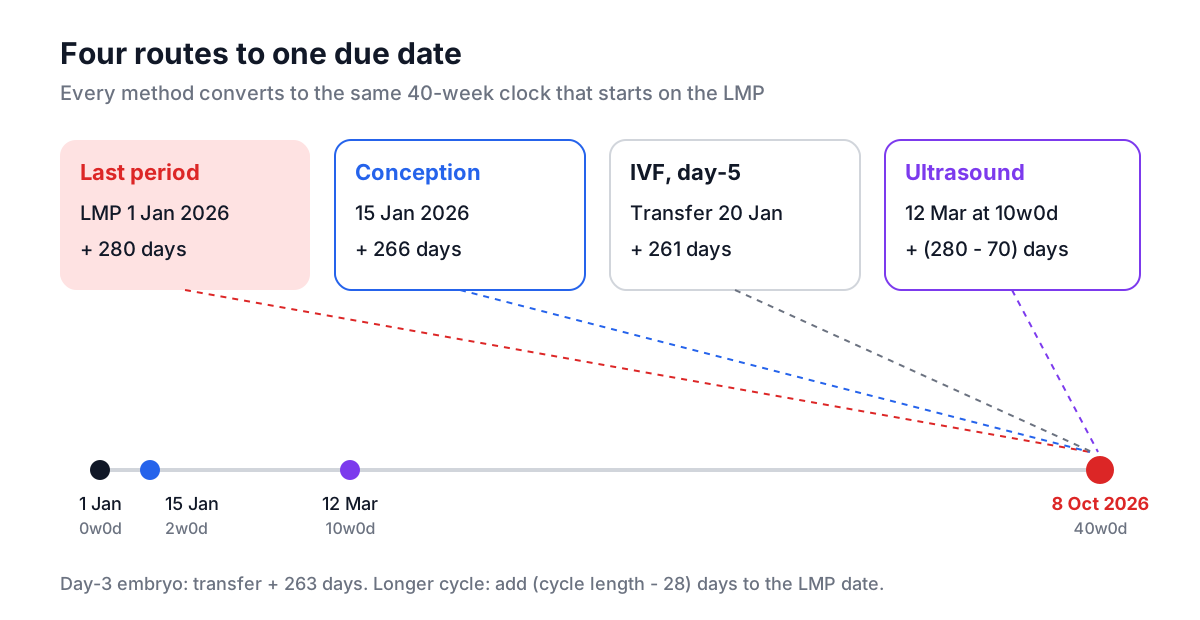
The standard pregnancy is 280 days, or 40 weeks, from the LMP. That assumes a 28-day cycle with ovulation on day 14. Conception therefore sits at 2 weeks 0 days, and the due date is 266 days after conception.
The German obstetrician Franz Naegele popularised a shortcut in the early 1800s: take the LMP, add seven days, subtract three months and add one year. For an LMP of 1 January 2026 that gives 8 October 2026, which is exactly 280 days later. The shortcut and the day count can disagree by a day when February falls in the window, because months are not equal lengths. An LMP of 1 January 2024 gives 8 October by the hand rule but 7 October by counting 280 days, since 2024 had 29 February. The Pregnancy Due Date Calculator counts days, so leap years are handled exactly.
Adjusting for cycle length
The 280-day rule hides an assumption about ovulation. In a 35-day cycle, ovulation usually happens around day 21, not day 14, because the extra days fall in the first half of the cycle (the follicular phase). The second half, the luteal phase, tends to stay close to 14 days. So the simple fix is to move the due date by the difference between your cycle length and 28:
Due date = LMP + 280 days + (cycle length - 28)
With a 35-day cycle and an LMP of 1 January 2026, the due date moves from 8 October to 15 October. With a 24-day cycle it moves back to 4 October. If your cycles vary by more than a few days from month to month, no adjustment will rescue the LMP date, and an early scan matters more.
Conception, IVF and ultrasound dating
If you know when conception happened, add 266 days. That is the same as treating the conception day as 2 weeks 0 days.
IVF pregnancies are the most precisely dated of all, because the age of the embryo on transfer day is known. ACOG Committee Opinion 700, Methods for Estimating the Due Date (2017), says IVF due dates should come from the embryo age and the transfer date. The arithmetic works out as 266 days minus the embryo age:
| Embryo at transfer | Add to transfer date |
|---|---|
| Day 3 (cleavage stage) | 263 days |
| Day 5 (blastocyst) | 261 days |
| Day 6 (blastocyst) | 260 days |
A day-5 transfer on 20 January 2026 gives 8 October 2026, the same date as the LMP example above. Frozen and fresh transfers use the same rule.
An ultrasound gives a gestational age on the day of the scan, for example 10 weeks 0 days. The due date is the scan date plus 280 days minus that age. A scan on 12 March 2026 measuring 10w0d (70 days) also gives 8 October.
When the scan wins
In the first trimester, the crown-rump length of the embryo is closely linked to age, so early scans are accurate to within about five to seven days. ACOG's rule is to keep the LMP date unless the scan disagrees by more than a set margin, which widens as pregnancy advances and growth starts to vary between babies:
- Before 9 weeks: change the date if the difference is more than 5 days.
- From 9 weeks to 13 weeks 6 days: more than 7 days.
- From 14 to 15 weeks 6 days: more than 7 days.
- From 16 to 21 weeks 6 days: more than 10 days.
- From 22 to 27 weeks 6 days: more than 14 days.
- From 28 weeks: more than 21 days.
Once a date has been set from a good early scan, later scans are not used to move it again. A baby measuring big or small at 30 weeks is a question about growth, not about dating. If your notes show a scan-based date, enter that scan into the calculator so its milestone dates match your care team's.
Trimesters, term and the milestones in between
ACOG divides pregnancy into three trimesters: the first runs to 13 weeks 6 days, the second from 14w0d to 27w6d and the third from 28 weeks. Since 2013 ACOG has also split "term" into bands, because outcomes differ across the old 37 to 42 week span:
| Label | Gestational age |
|---|---|
| Preterm | before 37w0d |
| Early term | 37w0d to 38w6d |
| Full term | 39w0d to 40w6d |
| Late term | 41w0d to 41w6d |
| Post-term | 42w0d and later |
Typical milestones in US practice include first-trimester screening with a nuchal translucency scan between 11w0d and 13w6d, cell-free DNA screening from 10 weeks, an anatomy scan around 18 to 22 weeks, glucose screening for gestational diabetes at 24 to 28 weeks, the Tdap vaccine between 27 and 36 weeks as recommended by the CDC, and a group B strep swab at 36w0d to 37w6d. Other countries schedule some of these differently, which is why the calculator labels them as typical windows.
Only about 4 to 5% of babies are born on their due date. A better mental model is a bell curve centred on 40 weeks, with most births between 37 and 42.
How much weight to gain
Weight gain guidance is based on body mass index before pregnancy, because the gain linked with the best outcomes for parent and baby differs by starting weight. The IOM (now the National Academy of Medicine) published the current ranges in 2009, adopting the WHO adult BMI categories:
| Pre-pregnancy BMI | Total gain, one baby | Weekly in 2nd and 3rd trimester |
|---|---|---|
| Under 18.5 | 12.5 to 18 kg (28 to 40 lb) | 0.51 kg (about 1 lb) |
| 18.5 to 24.9 | 11.5 to 16 kg (25 to 35 lb) | 0.42 kg (about 1 lb) |
| 25 to 29.9 | 7 to 11.5 kg (15 to 25 lb) | 0.28 kg (about 0.6 lb) |
| 30 and over | 5 to 9 kg (11 to 20 lb) | 0.22 kg (about 0.5 lb) |
The weekly rates assume only 0.5 to 2 kg in the first trimester, which matches the reality that nausea often holds weight steady early on. For twins the IOM gave provisional totals: 17 to 25 kg for a healthy BMI, 14 to 23 kg if overweight and 11 to 19 kg with obesity. There was not enough evidence to set a twin range for an underweight BMI.
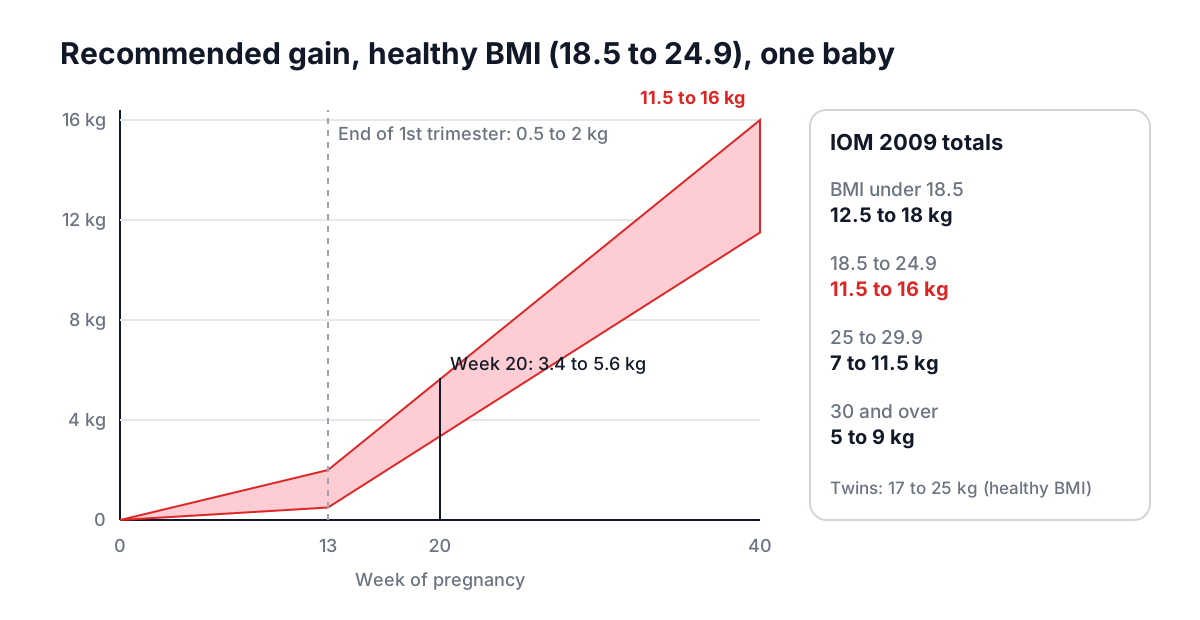
The IOM tables give a total and a weekly slope, not a curve. The Pregnancy Weight Gain Calculator draws one by rising evenly to the first-trimester allowance at week 13, then evenly to the total at week 40. For someone who was 65 kg at 165 cm (BMI 23.9), that gives about 3.4 to 5.6 kg by week 20. The pound figures come from the IOM's own pound table rather than from converting kilograms, so 25 to 35 lb appears as 25 to 35 lb, not 25.4 to 35.3.
Reading the numbers sensibly
Two judgment calls matter more than the arithmetic. First, the due date is an estimate whose quality depends on the input: an IVF transfer date or an early scan is far more reliable than a half-remembered LMP with irregular cycles. Second, weight gain bands describe populations. A single weigh-in outside the band means little; a steady trend away from it, or a sudden jump with swelling or headaches, is worth raising promptly.
If you are still planning a pregnancy, the menstrual cycle and ovulation guide and the Ovulation Calculator cover the other end of the timeline, and the BMI Calculator explains the BMI categories used above.