
How Much Protein Do You Need? From the 0.8 g/kg RDA to Training
What the 0.8 g/kg RDA covers, why the ISSN suggests 1.4 to 2.0 g/kg for people who train, how age and dieting change the number, and how to hit it with real food.
· 6 min read
A 70 kg office worker and a 70 kg rower can both be told they need "56 grams of protein a day", and for one of them that is close to right. The 56 g figure is the adult Recommended Dietary Allowance, 0.8 g per kilogram, and it was never meant as a target for people trying to build or keep muscle. The gap between that floor and what training research supports is wide, often double.
This guide explains what the RDA covers, what sports nutrition bodies recommend for active people, how age and dieting change the number, and how the Protein Calculator turns all of that into grams per day. It is general information, not medical advice. Anyone with kidney disease or a protein restriction should follow their clinician.
What the 0.8 g/kg RDA actually means
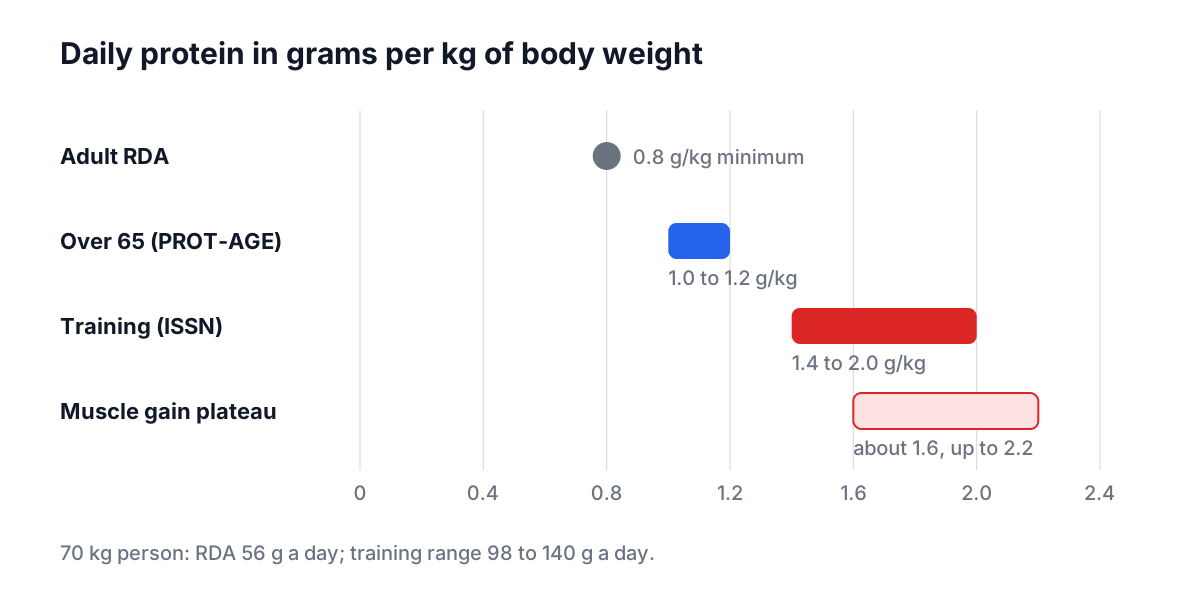
The US National Academies set the RDA for protein at 0.8 g per kg of body weight per day for adults, based on nitrogen balance studies: the intake at which the body stops losing more nitrogen than it takes in. The RDA is set high enough to cover about 97 to 98% of healthy adults' minimum requirement.
Two words in that sentence matter: minimum and healthy. The RDA is the amount that prevents deficiency in a sedentary population. It says nothing about the intake that best supports muscle growth, recovery from training, keeping muscle while dieting, or ageing. Most adults in wealthy countries already eat more than it.
How much protein people who train need
The International Society of Sports Nutrition position stand on protein and exercise (Jäger et al., 2017) is the most cited summary. Its main points:
- For building and maintaining muscle, an overall daily intake of 1.4 to 2.0 g/kg is sufficient for most exercising people.
- Higher intakes, around 2.3 to 3.1 g/kg of fat-free mass, may help lean, resistance-trained people keep muscle during a calorie deficit.
- Spreading intake across meals, roughly every 3 to 4 hours, with about 20 to 40 g per meal, is a reasonable pattern.
A 2018 meta-analysis by Morton and colleagues in the British Journal of Sports Medicine found that gains in lean mass from resistance training levelled off at around 1.6 g/kg a day, with 2.2 g/kg as the upper end of the confidence interval. So the evidence points to a plateau, not "more is always better".
Age, dieting and other shifts
Older adults. Muscle responds less to the same protein dose as we age, a pattern called anabolic resistance. The PROT-AGE study group (Bauer et al., 2013) recommended 1.0 to 1.2 g/kg for healthy people over 65, and more for those who are ill or very active. Muscle loss with age (sarcopenia) is a real driver of falls and frailty, so this is one of the most useful adjustments to get right.
Calorie deficits. When energy is short the body is more willing to break down muscle. Higher protein during a diet helps preserve lean mass, and protein is also the most filling macronutrient per calorie. This is why many plans hold protein steady or raise it when cutting calories.
Endurance training. Runners and cyclists need somewhat more than the RDA for repair, though usually less than strength athletes. Carbohydrate is the bigger lever for endurance performance.
Body composition. Protein needs track lean mass more than total mass. For someone with a high body fat percentage, multiplying current weight by 1.6 or 2.0 gives an inflated number. Using a goal weight instead is a simple fix.
How the calculator builds its number
The Protein Calculator starts from a base figure by activity level, then multiplies:
| Step | Values |
|---|---|
| Base by activity | Sedentary 0.8, Light 1.0, Moderate 1.2, High 1.4, Athlete 1.6 g/kg |
| Goal factor | Maintenance × 1.0, Endurance × 1.1, Weight Loss × 1.2, Muscle Gain × 1.4 |
| Sex | Men × 1.05 |
| Age | Over 65 × 1.1 |
Daily protein is body weight in kg times the result, rounded to a whole gram, and the per-meal figure divides by three. Height is on the form but does not enter the protein calculation.
Worked example
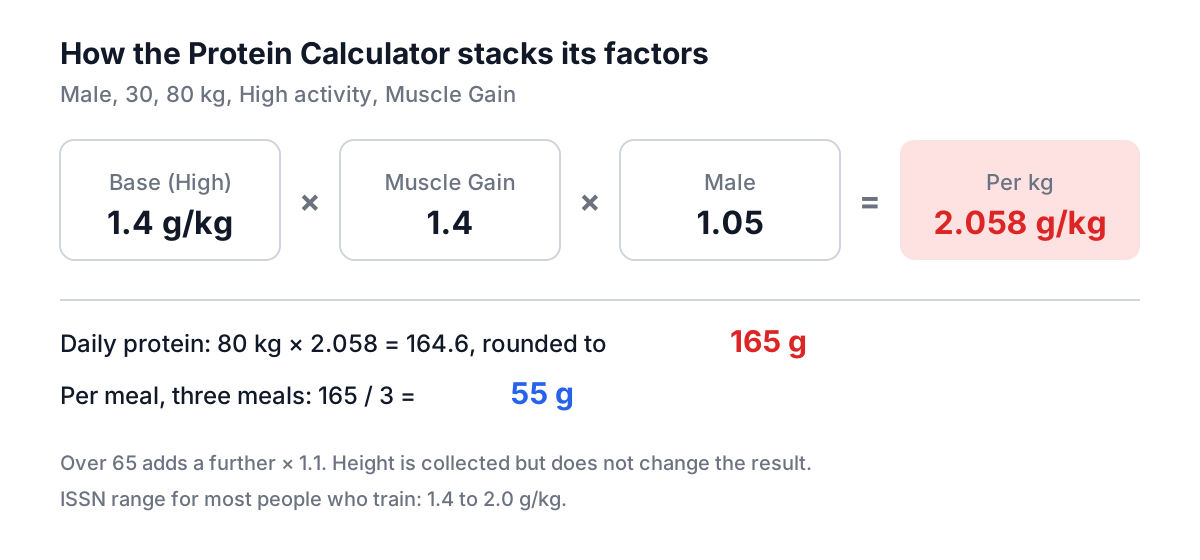
An 80 kg man, 30 years old, training hard most days (High) and aiming for muscle gain:
Base (High)          1.4 g/kg
× Muscle Gain        1.4      → 1.96 g/kg
× Male               1.05     → 2.058 g/kg
Daily protein        80 × 2.058 = 164.6 → 165 g
Per meal (3 meals)   165 / 3 = 55 g
That lands at the top of the ISSN range, which is reasonable for someone in a dedicated building phase. Compare a 60 kg, 35-year-old woman who exercises moderately and wants to lose weight: 1.2 × 1.2 = 1.44 g/kg, so 60 × 1.44 = 86 g a day, about 29 g per meal.
The stacked factors can push an athlete on a muscle gain goal to about 2.35 g/kg. That is above the range where research shows added benefit, so treat anything over roughly 2.2 g/kg as optional rather than necessary.
Hitting the number with food
Grams of protein are easy to misjudge. Some typical values (check your own labels):
| Food | Portion | Protein |
|---|---|---|
| Chicken breast, cooked | 100 g | about 31 g |
| Greek yogurt, plain | 170 g pot | about 15 to 17 g |
| Eggs | 2 large | about 12 g |
| Lentils, cooked | 200 g | about 18 g |
| Firm tofu | 100 g | about 12 to 17 g |
| Whey protein | 30 g scoop | about 22 to 25 g |
Plant proteins tend to be lower in one or more essential amino acids and slightly less digestible, so vegans often aim a little higher or mix sources across the day. The Food Labeling Guide explains how serving sizes on labels are defined, which matters when you compare products.
Common mistakes
- Using the RDA as a training target. 0.8 g/kg is a floor for sedentary adults.
- Using total body weight with high body fat. Base it on goal weight to avoid an unrealistic number.
- Eating it all at dinner. Total intake matters most, but a 15 g breakfast and a 90 g dinner leaves easy gains on the table.
- Forgetting the calories. 165 g of protein is 660 kcal. Fit it inside your calorie target, not on top of it.
- Ignoring medical limits. For healthy kidneys, intakes up to about 2 g/kg have not been shown to cause harm. Existing kidney disease is a different situation.
A practical starting point
Pick the activity level that matches a normal week, run the calculator, and see whether your current diet is anywhere near the number. If it is far below, add one protein-rich food to each meal before reaching for supplements. Reassess after a month of training. If you are cutting calories at the same time, the calorie deficit guide explains how to set the deficit, and high-protein diets are a good reason to keep an eye on fluids with the Hydration Calculator.