
Punching Force: Perimeter, Thickness and Shear Strength
How a punch shears a slug, the force formula and the d x t x 80 shortcut, shear strength values, clearance, shear angles, stripping force and the smallest hole you can punch.
· 9 min read

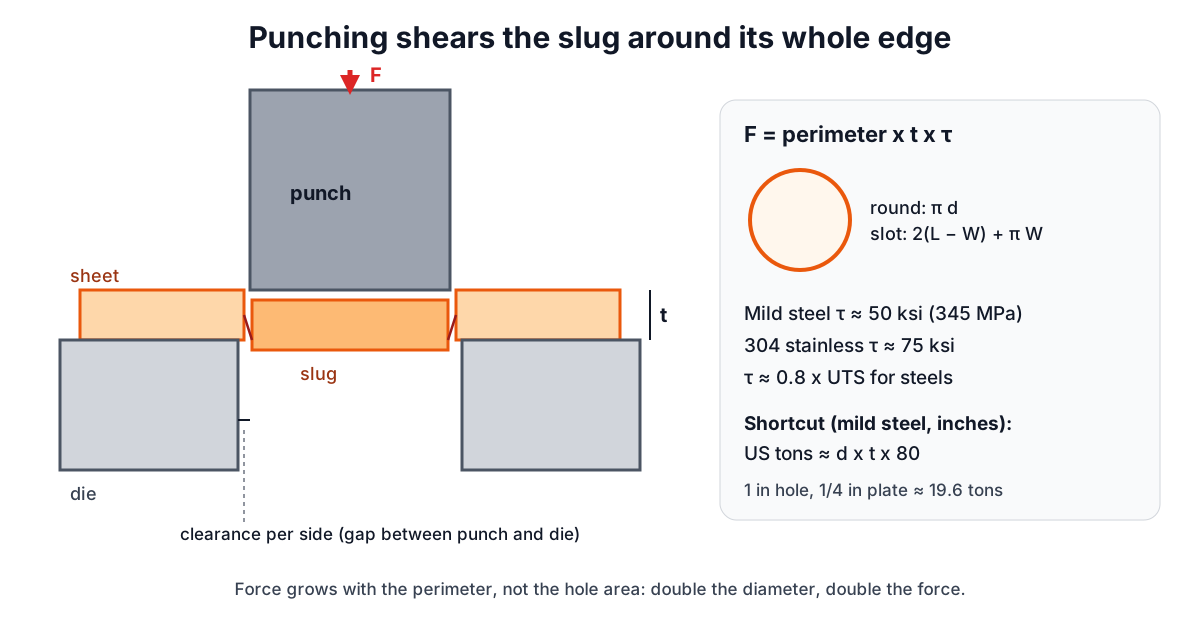
A punch does not cut the way a knife does. It pushes a slug of metal through the sheet, and the material along the edge of that slug deforms, then cracks from both the punch and die edges until the cracks meet and the slug drops out. The force the press must supply is the force to shear that whole edge through the full thickness. This post explains the formula, the shortcut ironworker operators use, the shear strength values behind them, and the practical factors (clearance, tool wear, shear angles, stripping and minimum hole size) that move real forces away from the textbook number. The Punching Force Calculator handles round, square, rectangular, slotted and custom shapes.
The formula
The sheared area is the length of the cut edge times the thickness, and the force is that area times the ultimate shear strength of the material:
F = perimeter x thickness x shear strength
The units carry through cleanly. In metric, millimetres x millimetres x MPa (N/mm²) gives newtons; divide by 1,000 for kN or by 9,806.65 for metric tonnes-force. In inch units, inches x inches x psi gives pounds-force; divide by 2,000 for US (short) tons.
Notice what is not in the formula: the area of the hole. Force grows with the perimeter, which is proportional to the diameter, so a 40 mm hole needs twice the force of a 20 mm hole, not four times. Thickness, on the other hand, scales the force directly, so doubling the sheet thickness doubles it.
Perimeters for common shapes
| Shape | Perimeter |
|---|---|
| Round hole, diameter d | π x d |
| Square, side a | 4a |
| Rectangle, a x b | 2(a + b) |
| Oblong slot, overall length L, width W | 2(L − W) + π x W |
| Any blank | total length of the cut edge |
For blanking dies and progressive tools, add every edge that cuts in the same stroke. If a die pierces four holes and blanks the outline at once, the force is the sum of all five perimeters. Corner radii on a rectangle shorten the perimeter slightly; for an exact figure, take the cut length from CAD and enter it as a custom perimeter.
Shear strength: the number that matters
The ultimate shear strength is the stress at which the material fails in shear. Punching charts commonly use:
| Material | Typical shear strength |
|---|---|
| Mild steel | 50 ksi (345 MPa), also written 25 tons/in² |
| Stainless 304, annealed | about 75 ksi (517 MPa) |
| Aluminium 5052-H32 | 20 ksi (138 MPa) |
| Aluminium 6061-T6 | 30 ksi (207 MPa) |
| Brass, half hard | about 35 ksi (241 MPa) |
| Copper, half hard | about 25 ksi (172 MPa) |
The aluminium values are the typical figures published by the Aluminum Association. The steel figures are those used in most tooling makers’ charts. Material from a different heat, a harder temper or a work-hardened coil can be well above these, so use the mill certificate when you have it.
When only the tensile strength is known, a common rule for steels is shear strength ≈ 0.8 x tensile strength (some references give 0.75). Aluminium alloys run lower, closer to 0.6 to 0.67, so the published shear values are better for them.
The ironworker shortcut: diameter x thickness x 80
Operators of ironworkers and punch presses often use a one-line rule for round holes in mild steel:
US tons ≈ diameter (in) x thickness (in) x 80
This is the full formula with the constants folded in: π x 50,000 psi / 2,000 lb per ton = 78.5, rounded up to 80. A 1 in hole in 1/4 in plate gives 1 x 0.25 x 80 = 20 tons, against 19.63 tons from the full formula. Some references use 30 tons per square inch instead of 25 to cover friction and tool wear, which turns the multiplier into about 94.
Worked examples
A 20 mm hole in 3 mm mild steel:
perimeter = π x 20 = 62.83 mm
area      = 62.83 x 3 = 188.5 mm²
force     = 188.5 x 345 = 65,030 N = 65.0 kN
          = 6.63 tonnes = 7.31 US tons
Four 30 x 10 mm slots in 2 mm 304 stainless, all in one stroke:
perimeter each = 2 x (30 − 10) + π x 10 = 71.42 mm
force          = 4 x 71.42 x 2 x 517 = 295.4 kN = 33.2 US tons
If the four punches are made slightly different in length so they enter the sheet one after another, the peak force drops toward that of a single slot, about 74 kN. Stepped punches are a cheap way to fit a job on a smaller press.
A 100 x 60 mm rectangular blank in 1.5 mm 5052-H32 aluminium: perimeter 320 mm, force 320 x 1.5 x 138 = 66.2 kN. The same blank in mild steel would need 166 kN.
What changes the real force
Clearance. The gap between punch and die, usually quoted per side as a percentage of thickness, controls how cleanly the cracks from the punch and die edges meet. Too little clearance forces a secondary shear and raises the force and tool wear; too much leaves a large burr and rollover. Tooling makers publish clearance tables by material and thickness, and typical values for mild steel are in the region of 5 to 10% per side.
Tool condition. A sharp punch concentrates stress at its edge. A worn, rounded edge spreads it out and needs more force to start the fracture. Allow a margin of 20% or more over the calculated figure when sizing a press.
Shear angle. Grinding the punch face at a slight angle, or making it rooftop shaped, means only part of the perimeter cuts at any moment. Tooling makers quote peak force reductions in the range of 15 to 25% or more, at the cost of a slightly distorted slug.
Stripping. After the slug is out, the sheet grips the punch as it springs back, and the stripper has to pull it off. Stripping force is often quoted at up to 10 to 20% of the punching force, depending on material, clearance and lubrication.
The smallest hole you can punch
The formula says nothing about whether the punch survives. A slender punch is a column, and when its diameter is smaller than the thickness of the sheet, the compressive stress in the punch approaches the strength of tool steel and it can buckle or snap. The common guideline is that the hole diameter should be at least equal to the sheet thickness for mild steel and about twice the thickness for stainless steel. Smaller holes need special guided tooling, or drilling, laser cutting or waterjet instead. The calculator warns when a round hole falls below these ratios.
From force to press selection
Once you have the force, compare it with the press rating at the working point of the stroke. Mechanical presses reach their rated tonnage only near the bottom of the stroke, so a thick part that starts cutting higher up may need more capacity than the headline number suggests. Hydraulic punches and ironworkers deliver their rated force throughout the stroke but have a throat depth and punch size limit. The hydraulic cylinder calculator converts a pressure and bore into force if you are checking a hydraulic unit.
Thickness by gauge comes from the sheet metal gauge converter, and for bending the same part after punching, see press brake tonnage, V-die width and the air-bent radius.