
Rental Property Returns: Cap Rate, Cash-on-Cash and DSCR
Run a rental deal the way lenders and investors do: NOI, cap rate, cash-on-cash return and DSCR worked through on one house, plus the costs beginners leave out.
· 6 min read
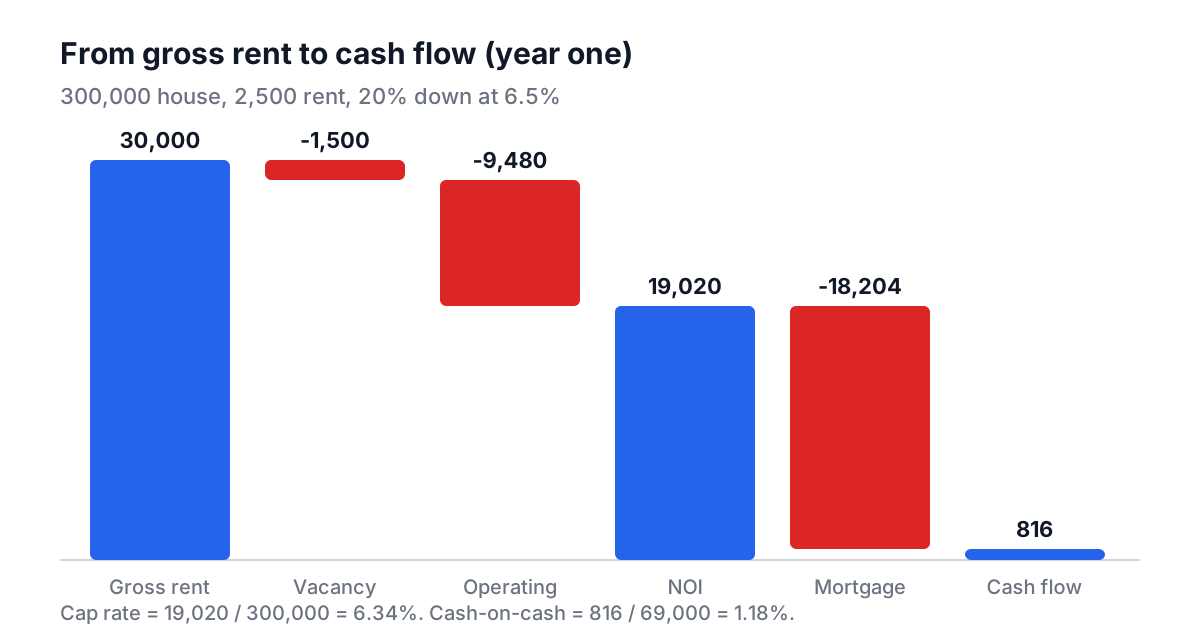
A 300,000 house that rents for 2,500 a month sounds like a decent investment: 30,000 a year in rent is a 10% gross yield. Run it properly and the picture changes. After vacancy, management, property tax, insurance and maintenance, the house earns 19,020 a year. After a 6.5% mortgage on 80% of the price, the owner keeps 816. On the 69,000 they put in, that is a cash return of 1.18%, less than a savings account.
Nothing about that deal is unusual. The gap between gross rent and real cash flow is where most first-time landlords get surprised. This guide works through the four numbers that investors and lenders use, NOI, cap rate, cash-on-cash return and DSCR, on that one house, using the Real Estate Investment Analyzer. The figures illustrate the method; they are not advice on any particular property.
Step 1: Net operating income
Net operating income (NOI) is what the property earns before financing and income tax. It is the foundation for everything else.
gross rent            = monthly rent x 12
effective income      = gross rent x (1 - vacancy rate)
operating expenses    = property tax + insurance + maintenance + management
NOI                   = effective income - operating expenses
For the example house, with 5% vacancy and an 8% management fee charged on collected rent:
| Line | Amount |
|---|---|
| Gross rent (2,500 x 12) | 30,000 |
| Vacancy (5%) | -1,500 |
| Effective income | 28,500 |
| Property tax | -3,600 |
| Insurance | -1,200 |
| Maintenance | -2,400 |
| Management (8% of 28,500) | -2,280 |
| NOI | 19,020 |
Mortgage payments are deliberately left out of NOI. That lets you compare properties regardless of how they are financed.
Step 2: Cap rate
The capitalisation rate is NOI divided by the purchase price:
cap rate = NOI / price = 19,020 / 300,000 = 6.34%
Think of it as the return you would earn buying the house with cash. It is the standard way to compare properties and markets: a 4% cap rate usually means an expensive, low-risk area where buyers expect appreciation; 9% usually means cheaper property, higher risk, or both. Cap rate says nothing about your mortgage, which is why it is only the first check.
A useful rule falls out of it straight away. If the cap rate is lower than your mortgage rate, borrowing reduces your cash return. Each borrowed dollar costs 6.5% a year in interest (plus principal) and earns 6.34% inside the property.
Step 3: Cash-on-cash return
Cash-on-cash return is what your own money earns in year one, after debt:
cash flow       = NOI - annual mortgage payments
cash invested   = down payment + closing costs
cash-on-cash    = cash flow / cash invested
The example uses 20% down (60,000) and 3% closing costs (9,000), so 69,000 invested. A 240,000 loan at 6.5% for 30 years costs 1,516.96 a month, 18,204 a year:
cash flow    = 19,020 - 18,204 = 816
cash-on-cash = 816 / 69,000 = 1.18%
That is the leverage problem in one line. The mortgage swallows 96% of NOI.
Step 4: DSCR
The debt service coverage ratio is what lenders check before approving an investment loan:
DSCR = NOI / annual debt service = 19,020 / 18,204 = 1.04
A DSCR of 1.0 means rent covers the mortgage exactly. Lenders commonly ask for 1.20 to 1.25 on rental loans, so this deal would struggle to get financed as an investment property. Working backwards, NOI would need to be about 22,755 for a DSCR of 1.25, which takes rent of roughly 2,860 a month.
How rent changes everything
Because the mortgage is fixed, cash flow is extremely sensitive to rent. The same house at 3,000 a month:
| Metric | Rent 2,500 | Rent 3,000 |
|---|---|---|
| NOI | 19,020 | 24,264 |
| Cap rate | 6.34% | 8.09% |
| Cash flow | 816 | 6,060 |
| Cash-on-cash | 1.18% | 8.78% |
| DSCR | 1.04 | 1.33 |
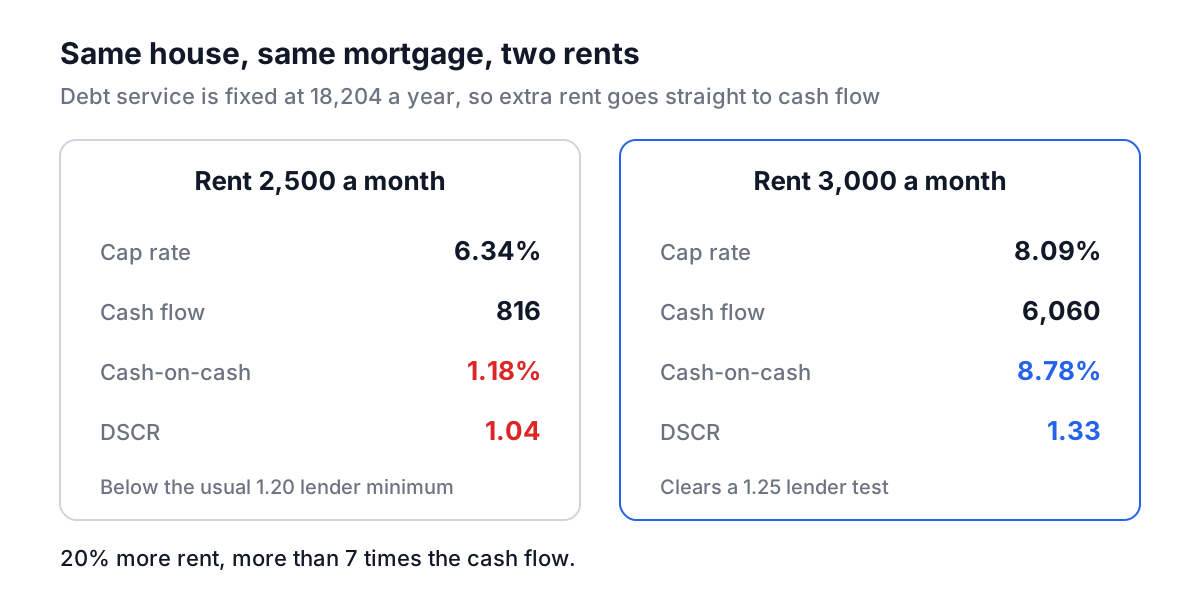
A 20% higher rent produces more than seven times the cash flow. That cuts both ways: an optimistic rent estimate is the most common way a rental analysis goes wrong. Use signed leases on comparable properties, not asking prices.
The long view: appreciation and loan paydown
Cash flow is only one of the ways a rental pays. Over ten years at 3% appreciation, the analyzer adds up:
- Cumulative cash flow: 46,547 (rent grows each year, costs are held flat)
- Appreciation: 103,175 (the house reaches about 403,000)
- Principal repaid: 36,537
Divided by the 69,000 invested, that is a total ROI of about 270%. It looks spectacular, and it leans heavily on appreciation, which nobody can promise. It also leaves out what you would pay to sell (often 5% to 10% of the price, so 20,000 to 40,000 here), income tax on cash flow, and the fact that operating costs rise over a decade too. The Investment Returns Calculator and the guide on time-weighted versus money-weighted returns are useful for turning those cash flows into an annual rate you can compare with an index fund.
Costs beginners leave out
- Capital expenditures. Roofs, boilers, appliances and flooring wear out. Many investors budget 5% to 10% of rent on top of routine maintenance.
- Vacancy between tenants. One empty month a year is 8.3% vacancy. Five percent assumes good tenants who stay.
- Management even if you self-manage. Your time has a cost; include a fee so the deal still works if you hire someone later.
- Land is not depreciable. US residential buildings depreciate over 27.5 years (3.636% a year), but only the building portion. Applying the rate to the full purchase price, including land, overstates the tax benefit.
- Rising rates on refinance. A deal that works at 5% may not at 7%.
Putting it to work
Enter a real listing in the Real Estate Investment Analyzer and click each metric card to see its formula with your numbers. Check the cap rate against your mortgage rate first, then cash-on-cash and DSCR. If the deal only works with optimistic rent or strong appreciation, lower the price until it works without them, and use that as your maximum offer. To see the full payment schedule on the loan, the EMI Calculator builds the amortisation table, and if you are weighing a home to live in rather than to let, the Rent vs Buy Calculator is the better tool.