
Sheet Metal Gauge Charts Explained: Steel, Galvanized, Stainless, Aluminium
Why one gauge number means four different thicknesses, where the Manufacturers’ Standard Gauge, the 1893 US Standard Gauge and Brown & Sharpe come from, and how to order sheet without gauge mistakes.
· 9 min read
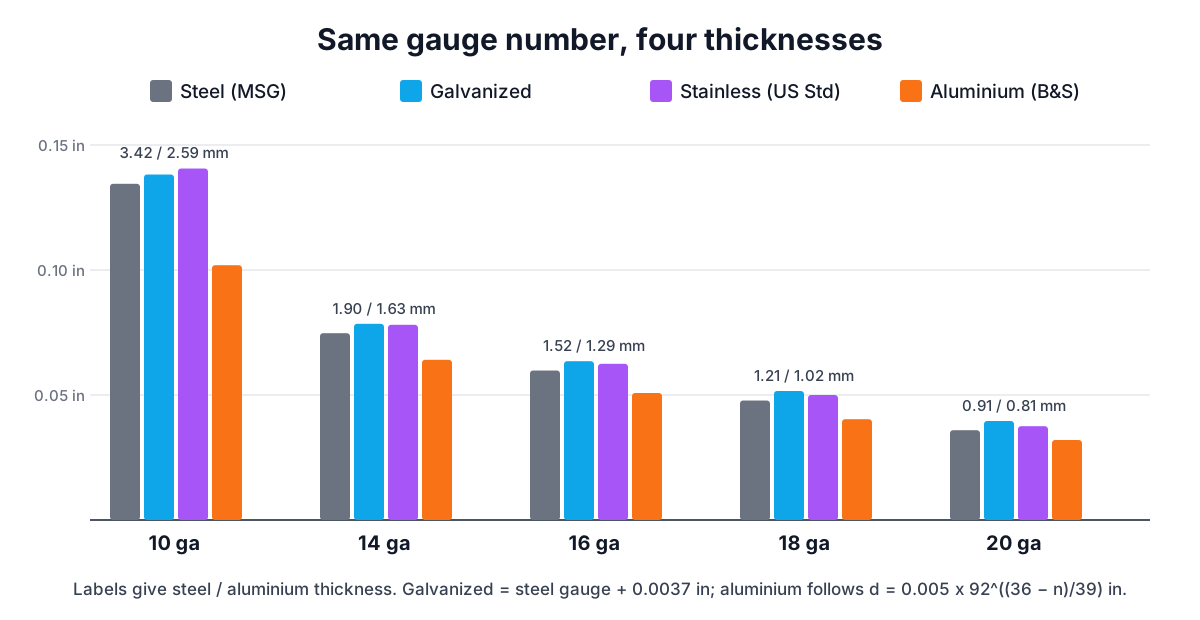
Ask for “16 gauge” at a steel service centre, an HVAC supplier, a stainless stockist and an aluminium distributor and you will be handed four sheets of four different thicknesses: 0.0598 in, 0.0635 in, 0.0625 in and 0.0508 in. All four are correct, because a gauge number is not a measurement. It is a row number in a table, and each metal family uses its own table. This post explains where the tables came from, how each one is defined, why the numbers run backwards, and how to avoid ordering the wrong sheet. The Sheet Metal Gauge Converter holds all four tables side by side.
Why higher numbers mean thinner metal
Gauges started in wire drawing. A rod was pulled through a series of dies, each slightly smaller than the last, and the gauge number counted how many draws the wire had been through. More draws, thinner wire, higher number. Sheet makers borrowed the idea, and the backward numbering stuck long after anyone was counting passes through a die.
The other legacy is that early gauges were really about weight. Sheet was sold by the pound, rolling mills could control weight more easily than thickness, and buyers cared about how many square feet they got for their money. Several sheet gauges are therefore defined from a weight per square foot, with thickness derived from an assumed density.
The four tables you will meet
Manufacturers’ Standard Gauge (carbon steel sheet). The table used for uncoated hot-rolled and cold-rolled steel sheet in North America. Each gauge has a nominal weight per square foot, and thickness is that weight divided by 41.82 lb per square foot per inch. Ten gauge, nominally 5.625 lb/ft², is 5.625 / 41.82 = 0.1345 in. Sixteen gauge at 2.5 lb/ft² is 0.0598 in, twenty gauge at 1.5 lb/ft² is 0.0359 in. This is the table printed in Machinery’s Handbook.
Galvanized sheet gauge. Zinc-coated sheet has its own gauge, which is the steel gauge plus a fixed allowance for the coating. Comparing the two columns, the difference is 0.0037 in at every gauge from 8 to 31: galvanized 16 gauge is 0.0598 + 0.0037 = 0.0635 in. The galvanized gauge is common in duct work and building products.
US Standard Gauge (stainless). In 1893 Congress set a standard gauge for sheet and plate iron and steel, still found at 15 U.S.C. 206. It was based on wrought iron at 480 lb/ft³, which is 40 lb per square foot per inch, and its thicknesses work out to tidy fractions: 16 gauge is 1/16 in (0.0625), 11 gauge is 1/8 in (0.125), 7 gauge is 3/16 in (0.1875). Carbon steel moved to the Manufacturers’ Standard Gauge, but stainless mills largely kept these values, which is why stainless gauges look like fractions.
Brown & Sharpe (aluminium, copper, brass). Non-ferrous sheet follows the Brown & Sharpe gauge, the same series as American Wire Gauge, standardised in ASTM B258. It is defined by a formula rather than a weight: 36 gauge is 0.005 in, 0000 gauge is 0.46 in, and there are 39 equal geometric steps between them.
d(n) = 0.005 x 92^((36 − n) / 39) inches
Each step is a ratio of 92^(1/39) ≈ 1.1229, so every six gauges roughly halves the thickness, and 10 gauge is 0.1019 in.
Comparing the same number across tables
| Gauge | Steel (MSG) | Galvanized | Stainless | Aluminium (B&S) |
|---|---|---|---|---|
| 10 | 0.1345 in / 3.42 mm | 0.1382 / 3.51 | 0.1406 / 3.57 | 0.1019 / 2.59 |
| 14 | 0.0747 / 1.90 | 0.0785 / 1.99 | 0.0781 / 1.98 | 0.0641 / 1.63 |
| 16 | 0.0598 / 1.52 | 0.0635 / 1.61 | 0.0625 / 1.59 | 0.0508 / 1.29 |
| 18 | 0.0478 / 1.21 | 0.0516 / 1.31 | 0.0500 / 1.27 | 0.0403 / 1.02 |
| 20 | 0.0359 / 0.91 | 0.0396 / 1.01 | 0.0375 / 0.95 | 0.0320 / 0.81 |
The three ferrous tables stay within about 5 to 10% of each other. Aluminium is the outlier, about 15% thinner than steel at 16 gauge and 24% thinner at 10 gauge. A part redesigned from steel to aluminium “in the same gauge” is therefore not only weaker because aluminium has a third of the stiffness; it is also thinner.
Going from millimetres to a gauge
Most of the world buys sheet in millimetres, and even in the US most laser and punching shops quote decimal thickness. When a drawing calls for a gauge and the supplier stocks metric sizes, pick the nearest and check the difference:
- 1.2 mm steel is nearest to 18 gauge (1.214 mm), only 0.014 mm away. A very good substitute.
- 1.5 mm steel is nearest to 16 gauge (1.519 mm), 1.3% thinner than the gauge.
- 2 mm aluminium is nearest to 12 gauge B&S (2.052 mm).
- 3 mm stainless is nearest to 11 gauge (3.175 mm), about 6% thinner than the gauge. Fine for a cover, worth checking for anything structural or anything fitted into a slot.
The converter does this search for you and flags any case where no gauge in the chosen table is within 0.1 mm.
Tolerances: gauge is nominal
A gauge thickness is a nominal value. Real sheet is rolled to a tolerance band, and the standards that set those bands are separate from the gauge tables: ASTM A568 for carbon and high-strength low-alloy steel sheet, ASTM A480 for stainless, and ANSI H35.2 for aluminium mill products. Tolerances widen with thickness and width; on a 16 gauge steel sheet a few thousandths of an inch either way is normal. Sheets also tend to be slightly thinner near the edges because the rolls bend under load.
For bending, tolerance matters more than people expect. The bend deduction and the formed angle both depend on the actual thickness, so a lot that runs at the top of the band will produce flanges a little long and angles a little open. When you calibrate a bend allowance or a press brake setting, measure the sheet with a micrometer rather than trusting the gauge number.
Ordering without gauge mistakes
- Write the decimal thickness on drawings and purchase orders. “16 ga (0.0598 in / 1.52 mm) CRS” leaves nothing to interpretation.
- Name the material and the gauge system together. “14 ga aluminium” and “14 ga steel” differ by 0.011 in.
- Do not convert gauge to millimetres with a single factor. There is no constant ratio; each table has to be looked up.
- Check heavy gauges. Above about 7 gauge (3/16 in) the material is usually called plate and sold in fractions of an inch or millimetres rather than gauge.
- Know the local conventions. Roofing copper is sold by weight in ounces per square foot, and some industries (HVAC, roofing, enclosures) have their own customary gauges.
Using the numbers downstream
Thickness feeds almost every other sheet metal calculation. The sheet metal weight calculator accepts a gauge directly and multiplies by the right density; the press brake tonnage calculator needs thickness squared, so a 6% thickness difference becomes a 12% tonnage difference; and the punching force calculator scales linearly with it. Getting the gauge table right at the start saves correcting all of those later. For the weight side of the story, including why gauge weight tables read about 2% heavier than density-based weights, see how to calculate sheet metal weight.