
Steps to Miles and Calories: Step Length, Cadence and the 10,000 Myth
How step length turns a step count into distance, measuring your own step, cadence as an intensity guide, the ACSM calorie equations and what step counts the evidence supports.
· 9 min read
Step counts are the most widely tracked health number there is, but a step count on its own says nothing about distance or energy. Turning steps into kilometres needs a step length, and turning them into calories needs speed and body weight. This guide explains how step length is estimated and measured, how cadence links steps to speed and intensity, how the American College of Sports Medicine (ACSM) equations estimate energy, and what the research says about how many steps a day are worth aiming for. The Steps to Distance and Calories Calculator does all the conversions.
Steps, strides and step length
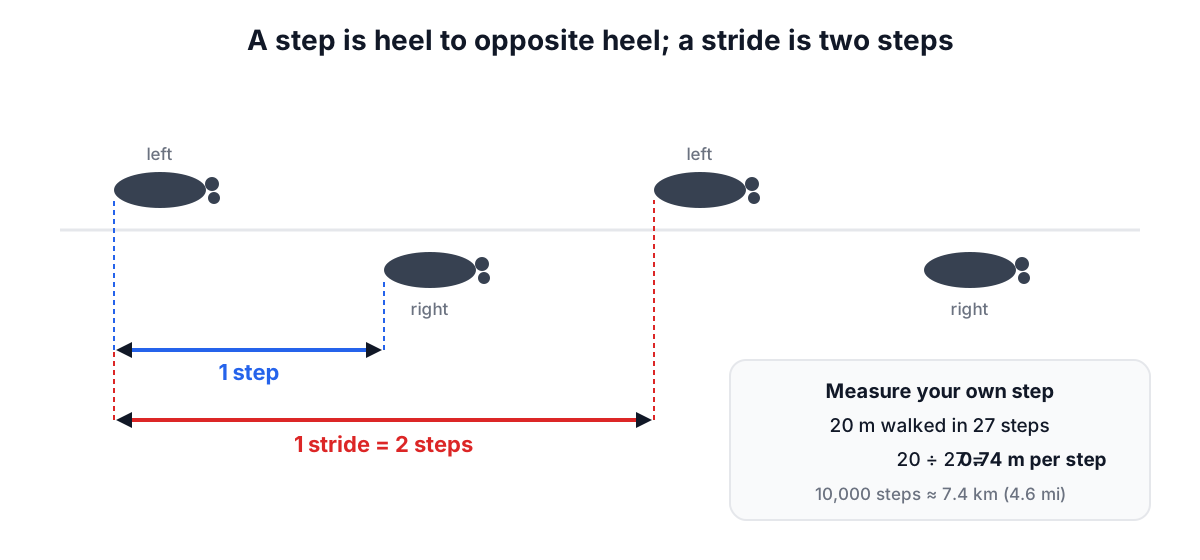
In gait research a step is the movement from one foot striking the ground to the other foot striking the ground. A stride is two steps: from one heel strike to the next strike of the same heel. Many fitness apps use "stride length" when they mean step length, so check which a device asks for. A typical adult walking step is 65 to 80 cm (26 to 31 in), and a stride is twice that.
Distance is simply steps multiplied by step length:
- 10,000 steps × 0.68 m = 6.8 km (4.2 mi)
- 10,000 steps × 0.76 m = 7.6 km (4.7 mi)
That 12% difference in step length is the whole story behind why two people with the same step count walked different distances.
Estimating step length from height
The most common rule of thumb sets walking step length at about 41% of height: height × 0.415 for men and height × 0.413 for women. A 165 cm woman gets 68.1 cm; a 180 cm man gets 74.7 cm.
| Height | Step (women, × 0.413) | Step (men, × 0.415) | Steps per mile (men) |
|---|---|---|---|
| 155 cm (5 ft 1 in) | 64.0 cm | 64.3 cm | 2,502 |
| 165 cm (5 ft 5 in) | 68.1 cm | 68.5 cm | 2,350 |
| 175 cm (5 ft 9 in) | 72.3 cm | 72.6 cm | 2,216 |
| 185 cm (6 ft 1 in) | 76.4 cm | 76.8 cm | 2,096 |
Treat this as a starting point. Real step length grows with speed, shrinks going uphill, on rough ground or in a crowd, and varies between people of the same height by 10% or more. Older adults usually take shorter steps.
Measuring your own step
A two-minute measurement beats any formula:
- Find a known distance: a running track (100 m straight), a measured path, or 20 m marked with a tape.
- Walk it at your normal pace, starting a few steps before the line so you are already moving, and count steps.
- Divide distance by steps. 20 m in 27 steps is 0.74 m per step.
- Repeat two or three times and average.
Do it again at a brisk pace if you often walk fast, and separately for running if you run. Enter the result as a measured step length in the calculator.
Cadence: the exact link to speed
Cadence is steps per minute, and many watches and phones show it. Speed, cadence and step length are tied by simple arithmetic:
step length = speed ÷ cadence
Walking at 5 km/h is 83.3 m per minute. At 110 steps per minute, each step is 83.3 / 110 = 0.76 m. Running at 10 km/h (166.7 m/min) with 170 steps per minute gives 0.98 m per step. If your device shows both pace and cadence, this is the most accurate way to get your step length for that activity.
Cadence is also a practical guide to effort. A series of studies led by Catrine Tudor-Locke, including the CADENCE-Adults study, found that about 100 steps per minute corresponds to moderate-intensity walking (roughly 3 METs) for most adults, and about 130 steps per minute to vigorous intensity. If you count your steps for 15 seconds and get 25 or more, you are walking at a moderate pace.
From steps to calories
The calculator uses the ACSM metabolic equations, the standard way exercise scientists estimate oxygen use from treadmill speed and grade:
- Walking: VO2 = 3.5 + 0.1 × S + 1.8 × S × G
- Running: VO2 = 3.5 + 0.2 × S + 0.9 × S × G
VO2 is in mL of oxygen per kg per minute, S is speed in metres per minute and G is grade as a fraction (5% incline = 0.05). The 3.5 is resting metabolism. Multiply VO2 by body weight and minutes, divide by 1000 to get litres of oxygen, and multiply by about 5 kcal per litre.
Worked example: 10,000 steps for a 165 cm, 65 kg woman walking at 5 km/h.
- Step length 68.1 cm, so distance 6.81 km.
- Time: 6.81 / 5 = 1.36 h = 81.8 minutes.
- Speed 83.3 m/min, so VO2 = 3.5 + 8.33 = 11.83 mL/kg/min (3.4 METs).
- Gross energy: 11.83 × 65 × 81.8 / 1000 × 5 = 314 kcal.
- Net energy, leaving out the 3.5 resting part: 8.33 × 65 × 81.8 / 1000 × 5 = 221 kcal.
The net figure is the one to compare with food, because you would have burned the resting part anyway.
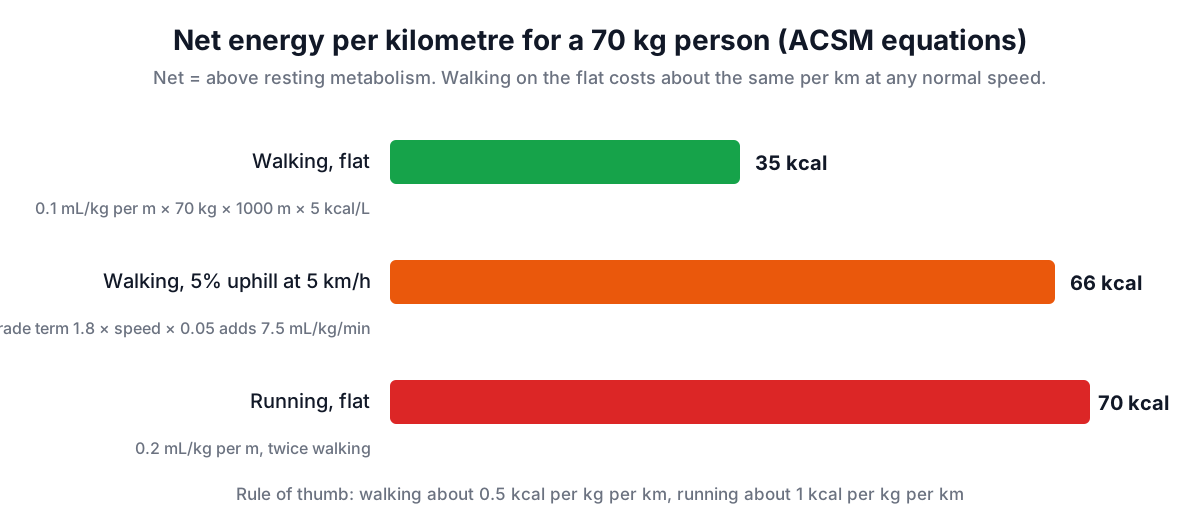
A neat consequence of the walking equation: on the flat, net cost per kilometre does not depend on speed. It works out at 0.1 mL/kg per metre, or about 0.5 kcal per kg per km. For running the factor is doubled, about 1 kcal per kg per km, which is why running a kilometre costs roughly twice as much as walking it.
Where the estimate goes wrong
- Speed range. The walking equation is validated for about 50 to 100 m/min (3 to 6 km/h). Very slow walking costs relatively more; above about 7 to 8 km/h most people find jogging easier than walking. The running equation is meant for speeds above about 134 m/min (8 km/h).
- Hills cost much more. A 5% incline at 5 km/h raises gross walking energy by more than half.
- Steps you do not walk continuously. A day's step count includes thousands of slow steps around the house. Applying a brisk walking speed to all of them overstates calories.
- Individual efficiency. Economy differs between people by 10% or more.
How many steps a day?
The 10,000 figure did not come from a study. In 1965 the Japanese company Yamasa sold a pedometer called the manpo-kei, literally "10,000 steps meter", and the round number stuck.
Research since then supports a more nuanced answer. A 2022 meta-analysis in The Lancet Public Health by Amanda Paluch and colleagues pooled 15 cohorts with about 47,000 adults. Risk of death fell steadily with more daily steps and levelled off at about 6,000 to 8,000 steps for adults aged 60 and over, and about 8,000 to 10,000 for younger adults. Even modest increases from a low base, such as going from 4,000 to 6,000, were associated with meaningful benefit.
So 10,000 is a reasonable target for many younger adults, but it is not a threshold. More is generally better up to a point, and any increase helps if you start low.
Getting accurate counts
- Wear the device consistently in the same place. Wrist trackers can count arm movements as steps and miss steps when you push a trolley; hip devices are usually more accurate for walking.
- Phones in a bag miss steps. In a front trouser pocket they do better.
- Calibrate once. Walk a measured 1 km or 1 mile and compare the device's distance with the true distance; most apps let you correct the step length.
- Do not expect two devices to agree. Differences of 5 to 10% between trackers are normal.
Summary
Steps become distance through step length, which you can estimate from height (about 0.41 × height for walking), measure over a known distance, or calculate from speed and cadence. Distance becomes calories through speed and body weight, with the net cost of walking close to 0.5 kcal per kg per km on the flat. The evidence supports getting more steps, with benefits levelling off around 8,000 to 10,000 a day for most adults. Try your own numbers in the Steps to Distance and Calories Calculator, compare activities in the Calories Burned Calculator, and see our guide to calorie deficits for how activity fits into weight management.
Sources: American College of Sports Medicine, ACSM's Guidelines for Exercise Testing and Prescription (metabolic equations); Tudor-Locke C et al., Int J Behav Nutr Phys Act 2018 and 2019 (cadence thresholds, CADENCE-Adults); Paluch AE et al., Lancet Public Health 2022;7:e219-28.
Related searches
- steps to miles conversion
- average step length by height
- how many steps per day
- where 10000 steps came from
- walking cadence 100 steps per minute
- calories per step
- acsm walking equation
- step vs stride length