
Waist-to-Hip Ratio and Waist-to-Height: Measuring Belly Fat Risk
How to measure waist and hips the WHO way, what the 0.90 and 0.85 cut-offs mean, why waist-to-height under 0.5 is the simplest rule, and where BMI misses.
· 8 min read
Two people can have the same height, weight and BMI and very different health risks. The difference is often where their fat sits. Fat packed around the abdominal organs behaves differently from fat under the skin of the hips and thighs, and a tape measure is the cheapest way to tell them apart. This guide covers how to measure waist and hips properly, what the World Health Organization cut-offs mean, why waist-to-height ratio has become the simplest rule, and what these numbers can and cannot tell you. The Waist-to-Hip Ratio Calculator applies all three checks from your measurements.
Why fat distribution matters
Body fat comes in two broad kinds. Subcutaneous fat sits under the skin everywhere, and on the hips and thighs it is relatively harmless and may even be protective. Visceral fat sits inside the abdomen, around the liver, intestines and other organs. It releases fatty acids and inflammatory signals straight into the circulation that feeds the liver, and it is closely linked with insulin resistance, high triglycerides, low HDL cholesterol, raised blood pressure and type 2 diabetes.
BMI cannot see this. It treats a kilogram of muscle, hip fat and visceral fat the same. Waist circumference rises with visceral fat, which is why it adds information. In the INTERHEART study, published in The Lancet in 2005, researchers compared 27,000 people from 52 countries with and without a first heart attack. Waist-to-hip ratio was a much stronger and more consistent predictor of heart attack than BMI across ethnic groups, and once waist-to-hip ratio was taken into account BMI added little.
How to measure
Measurement technique changes the result by several centimetres, so it is worth doing it the same way every time. The WHO method, used in its STEPS surveys, is:
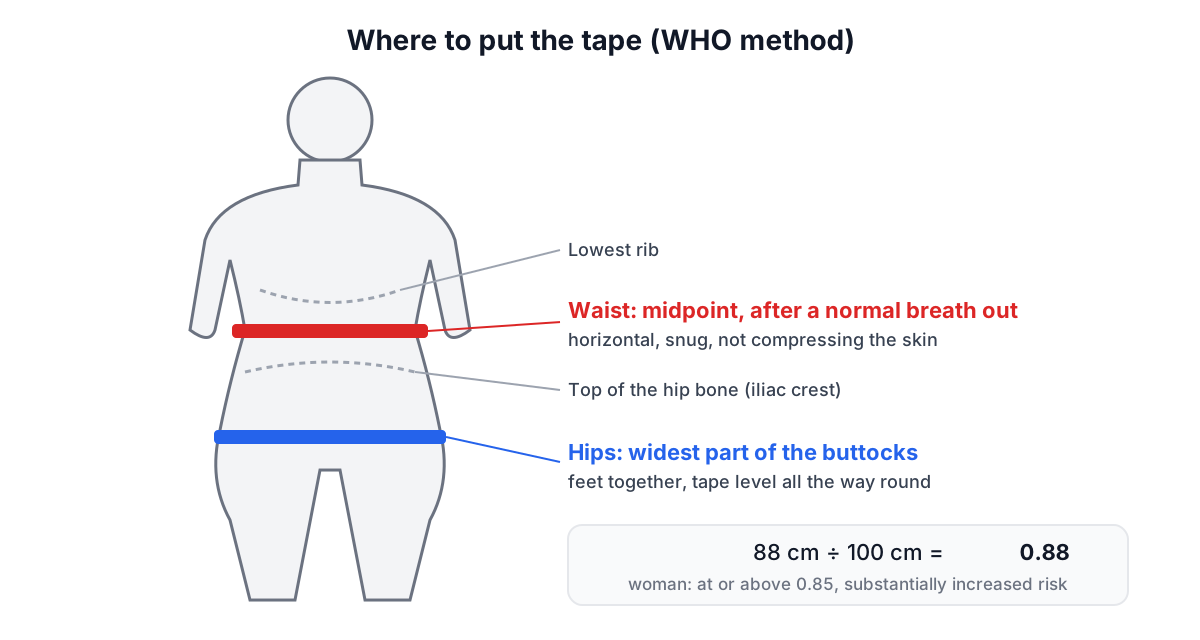
- Waist: stand with feet close together and arms relaxed. Find the lowest rib and the top of the hip bone (iliac crest) on your side, and measure horizontally around the midpoint between them, at the end of a normal breath out.
- Hips: measure around the widest part of the buttocks, keeping the tape level.
- Use a non-stretch tape, snug against the skin but not compressing it. Read to the nearest 0.1 cm or 1/8 inch.
Other protocols measure at the navel or at the narrowest point of the torso. Navel measurements tend to be larger in people with a protruding abdomen. Any site works for tracking your own trend as long as you stick with it, but the WHO cut-offs were built around the midpoint method.
The WHO cut-offs
In December 2008 the WHO held an expert consultation on waist circumference and waist-hip ratio in Geneva. Its report keeps two sets of thresholds for adults of European descent:
| Measure | Men | Women | Risk of metabolic complications |
|---|---|---|---|
| Waist circumference | over 94 cm (37 in) | over 80 cm (31.5 in) | Increased |
| Waist circumference | over 102 cm (40 in) | over 88 cm (34.6 in) | Substantially increased |
| Waist-to-hip ratio | 0.90 or more | 0.85 or more | Substantially increased |
The calculator rounds the ratio to two decimals before comparing, so 89.6 / 100 = 0.896 shows as 0.90 and counts as at the male cut-off.
The waist thresholds were never meant to be universal. At the same waist size, people of South Asian, Chinese and Japanese origin tend to carry more visceral fat and develop type 2 diabetes at lower body weights. The International Diabetes Federation therefore uses 90 cm for men and 80 cm for women in these groups, and the calculator offers that threshold as an option.
Waist-to-height ratio: the half-your-height rule
Waist-to-hip ratio has a weakness: it is a ratio of two things that can both change. Someone with large hips can have a reassuring ratio despite a big waist, and losing weight from both sites may leave the ratio unchanged. Waist-to-height ratio avoids this, because adult height does not change.
The idea, championed by Margaret Ashwell and colleagues, is captured in one sentence: keep your waist to less than half your height. In 2022 NICE added it to its obesity guidance for adults with a BMI under 35:
| Waist-to-height ratio | NICE description |
|---|---|
| 0.4 to 0.49 | No increased health risk |
| 0.5 to 0.59 | Increased health risk |
| 0.6 or more | High health risk |
The same thresholds apply to men and women and across ethnic groups, which makes it easy to use. A 165 cm woman should keep her waist under 82.5 cm; a 178 cm man under 89 cm.
Worked examples
A woman with a pear shape. Waist 78 cm, hips 100 cm, height 165 cm. Waist-to-hip is 78 / 100 = 0.78, below 0.85. Waist is under 80 cm. Waist-to-height is 78 / 165 = 0.47. All three measures are in the lower-risk bands, even if her BMI happened to be in the overweight range.
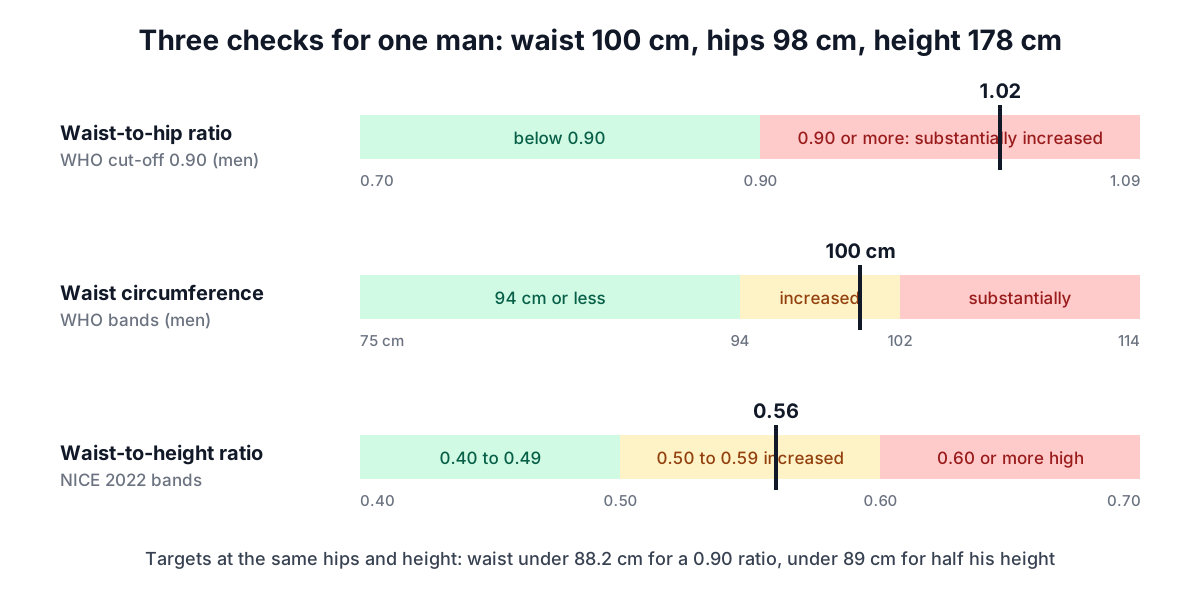
A man with central fat. Waist 100 cm, hips 98 cm, height 178 cm. Waist-to-hip is 1.02, well above 0.90. Waist is over 94 cm (increased) but not over 102 cm. Waist-to-height is 0.56, increased risk. To bring the ratio down to 0.90 at the same hip size, his waist would need to be 88.2 cm, about 12 cm smaller. To get waist-to-height under 0.5 he would need a waist under 89 cm. Both targets point the same way.
The same body in inches. Waist 33 in, hips 40 in: 33 / 40 = 0.825, which rounds to 0.83. Ratios have no units, so a measurement in inches gives the same answer as one in centimetres.
What these numbers do not tell you
- They are risk markers, not diagnoses. A high ratio says your risk is higher on average; blood tests (glucose or HbA1c, lipids) and blood pressure tell you what is actually happening.
- They do not apply in pregnancy and need age-specific charts for children.
- Muscle can confuse them a little. Very muscular people with thick trunks can have a higher waist without much visceral fat, though this is less of a problem than it is for BMI.
- Measurement error is real. A 1 to 2 cm difference between two readings is common. Average two measurements and do not chase small changes.
- The best measure of visceral fat is imaging. CT, MRI and DEXA can quantify it; a tape cannot, but it costs nothing and correlates reasonably well.
Bringing waist size down
There is no exercise that removes fat from the waist specifically; crunches strengthen muscles but do not burn the fat over them. What reduces visceral fat is an overall energy deficit, regular aerobic and resistance exercise, less alcohol and adequate sleep. Visceral fat often responds faster than fat elsewhere, so the waist can shrink before the scale shows much change, which makes the tape a motivating tool. For energy targets, see the Calorie Deficit Planner and our guide to calorie deficits.
Summary
Measure your waist midway between the lowest rib and the hip bone, your hips at their widest, and compare: under 0.90 (men) or 0.85 (women) for waist-to-hip, under 94 or 80 cm for waist alone, and under half your height for waist-to-height. Track the trend with the same technique, and use these numbers alongside BMI and blood tests rather than instead of them. The Waist-to-Hip Ratio Calculator does the arithmetic and shows the target waist for your size; the Body Fat Calculator uses the same tape measurements to estimate body fat percentage.
Sources: WHO, Waist circumference and waist-hip ratio: report of a WHO expert consultation, Geneva, 8 to 11 December 2008 (published 2011); Yusuf S et al., Obesity and the risk of myocardial infarction in 27,000 participants from 52 countries, Lancet 2005;366:1640-9; NICE guideline on overweight and obesity management, waist-to-height ratio update 2022; International Diabetes Federation consensus worldwide definition of the metabolic syndrome, 2006.
Related searches
- waist to hip ratio chart
- who waist hip ratio cut offs
- how to measure waist circumference
- waist to height ratio 0.5
- apple shape health risk
- visceral fat waist size
- interheart waist hip ratio
- waist size for asian men