
What Size Generator Do I Need? Running Watts, Surge and Headroom
The largest-start method step by step, why motors surge, portable versus standby ratings, 120/240 V outlets, soft starters, altitude derating and connecting safely through a transfer switch.
· 10 min read
Buy a generator that is too small and it stalls or trips the moment the well pump kicks in. Buy one far too large and you pay for fuel, noise and weight you never use. The right size comes from a short worksheet: the running watts of everything that must be on at once, plus the largest single starting surge, plus some headroom. This guide explains why motors surge, walks through the largest-start method with real numbers, covers what the ratings on a generator actually mean, and ends with the part that keeps people safe, connecting it properly. Every example can be reproduced in the Generator Size Calculator.
Running watts and starting watts
A resistive load such as a space heater, kettle, toaster or incandescent bulb draws the same power from the moment it is switched on. Its running and starting watts are the same.
An induction motor is different. At standstill it behaves almost like a short circuit: there is no back-voltage yet, so current is limited only by the winding impedance. That locked-rotor current is typically five to eight times the running current and lasts until the motor reaches speed, a fraction of a second for a fan and a second or two for a loaded compressor. Refrigerators, freezers, sump and well pumps, furnace blowers, air conditioners, garage door openers and air compressors all have motors, and that is where starting (surge) watts come from.
Generator makers publish worksheets of typical values. They vary widely between sources and between appliances of different age and efficiency, so treat these as starting points, not facts about your equipment:
| Load | Running W | Starting W |
|---|---|---|
| Refrigerator | 700 | 2,200 |
| Sump pump, 1/2 hp | 1,050 | 2,150 |
| Furnace blower, 1/2 hp | 800 | 2,350 |
| Well pump, 1 hp, 240 V | 2,000 | 4,000 |
| Window AC, 10,000 BTU | 1,200 | 3,600 |
| Central AC, 3 ton | 3,500 | 10,500 |
| Space heater | 1,500 | 1,500 |
The best data is on the nameplate. Watts = volts × amps for resistive loads, and many motor nameplates give locked-rotor amps (LRA) or a code letter from which starting kVA can be estimated. Air conditioners list LRA directly.
The largest-start method
The surge only lasts a moment, and motors rarely start at exactly the same instant, so you do not add every surge together. The method used in manufacturers' worksheets is:
- Add the running watts of everything that will be on at the same time.
- Find the load with the largest difference between starting and running watts, and add that difference once.
- Add headroom, typically 20 to 25% on the running load, so the generator is not run flat out for hours.
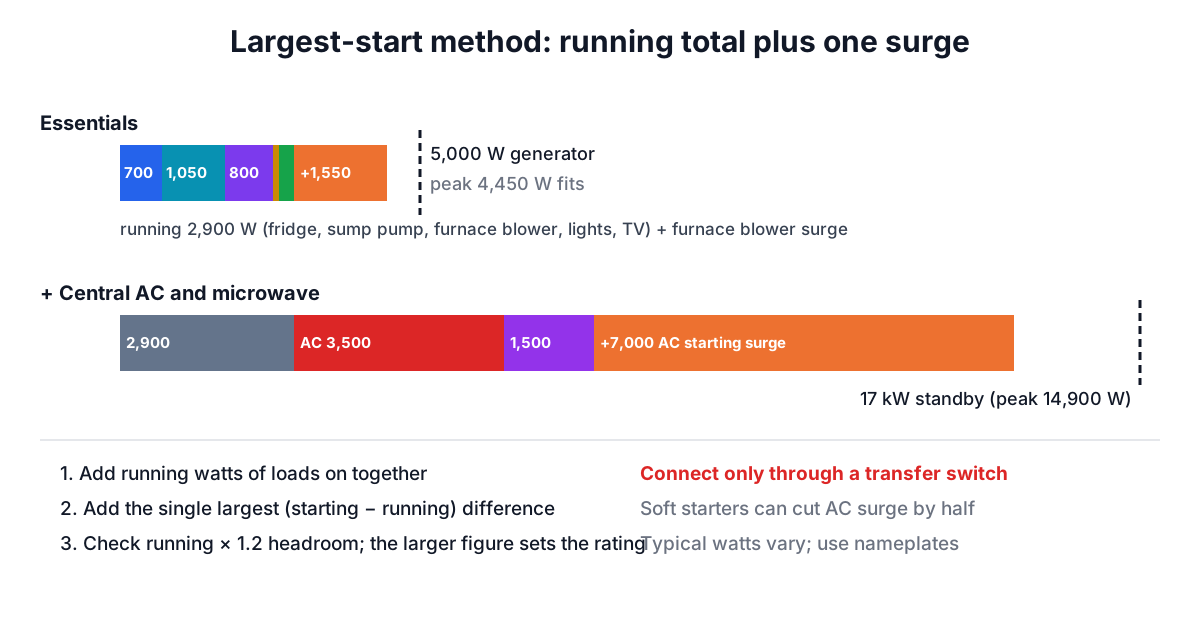
Worked example, a typical outage set: refrigerator 700 W, 1/2 hp sump pump 1,050 W, furnace blower 800 W, ten LED bulbs 100 W, TV and router 250 W. Running total: 2,900 W. The extra surges are 1,500 W (fridge), 1,100 W (sump) and 1,550 W (furnace blower), so the largest is 1,550 W and the peak is 4,450 W. Running load with 20% headroom is 3,480 W, so the peak governs, and a 5,000 W generator covers it.
Add a 1 hp well pump (2,000 W running, 4,000 W starting) and the running total becomes 4,900 W with a 2,000 W surge: peak 6,900 W, so a 7,500 W unit. Add a 3-ton central air conditioner and a microwave instead, and the running total is 7,900 W but the air conditioner's 7,000 W surge pushes the peak to 14,900 W: now you are into standby generators of 15 to 17 kW.
That last case shows where money is saved. A soft starter fitted to the air conditioner compressor typically cuts starting current by half or more and can bring the requirement down by several kilowatts. Staggering starts (letting the fridge start before turning on the well pump) keeps you to one surge at a time.
What the generator ratings mean
Portable generators list a rated (running) watts figure and a higher starting or surge watts figure, which the alternator can deliver for a few seconds. Conventional open-frame units often quote surge 15 to 30% above running; inverter generators electronically limit surge and typically allow 10 to 30% for a few seconds. The calculator does not count on any surge allowance by default, which is the conservative choice, but you can let it credit 20% or 50% if the generator's data sheet supports it.
Home standby generators are rated in kW at 0.8 power factor on natural gas or propane, with lower output on natural gas than propane for the same engine. Their motor-starting ability is published separately, often as the largest air conditioner in tons or as locked-rotor kVA at a stated voltage dip. Check that figure against your largest motor.
Voltage. A 240 V load such as a well pump, central AC or electric dryer needs a generator with a 240 V outlet or connection. Many small inverter generators are 120 V only. On a 120/240 V generator, try to balance 120 V loads across the two legs; each leg can only supply half the rating.
Altitude and heat. Engine output falls as air thins. A common rule of thumb is about 3.5% per 1,000 ft above sea level, and some makers also derate above 25 to 40 °C. A 5 kW generator at 5,000 ft may deliver little more than 4 kW.
Converting to amps and kVA
Running watts divided by voltage gives current: 2,900 W at 240 V is 12.1 A, which tells you what inlet and cord the generator needs. Three-phase standby sets are rated in kW at 0.8 power factor, so a 100 kW set is 125 kVA; the Three-Phase Power Calculator converts between them, and the Wire Size Calculator sizes the feeder from the generator to the transfer switch.
Connecting safely
A generator wired into a house without the right equipment can push power back through the service drop onto the utility's lines, where a transformer steps it up to thousands of volts. Line workers repairing the outage have been killed this way, and the utility power returning can also destroy the generator. That is why NEC 702.5 requires transfer equipment for optional standby systems: a listed transfer switch, or a listed interlock kit on the main panel, that makes it physically impossible for the generator and utility to be connected at the same time. Never use a "suicide cord" from a generator into a dryer or wall outlet.
Carbon monoxide kills more generator users than anything else. Run portable units outdoors, at least 20 ft from doors, windows and vents, with the exhaust pointing away from the house, and fit CO alarms indoors.
Common mistakes
- Adding every surge together, which oversizes the generator by a factor of two or more.
- Ignoring surges entirely, which leaves the generator unable to start the well pump.
- Forgetting 240 V loads when choosing a 120 V-only inverter generator.
- Using typical figures when the nameplate is right there.
- Planning to run the generator at 100% for hours. Leave headroom for engine life and fuel economy.
Alternatives and complements
For short outages and quiet loads, a battery system may beat a generator; see Battery Runtime and Peukert's Law and the Battery Runtime Calculator. For long-term resilience, solar plus battery can cut generator hours; see How Many Solar Panels Do I Need?. And to estimate running costs, the Fuel Cost Calculator helps compare fuel against grid electricity.