
Why Checklists Work, and How to Use One Properly
Surgical teams cut deaths by a third with a 19-item list. The evidence behind that, the two kinds of checklist, and why the one you edit beats the one you were handed.
By Redbison Dev · · 10 min read
In 2008 the World Health Organization tested a nineteen-item checklist in eight hospitals, from Toronto to Tanzania. The items were not clever. Confirm the patient's identity. Confirm which side you are operating on. Say out loud that antibiotics have been given. Count the instruments at the end.
Across nearly 4,000 operations, the rate of death fell from 1.5% to 0.8%, and major complications from 11% to 7%. No new equipment, no new drugs, no new skill. A list, read aloud.
That result is the strongest argument for checklists, and it also explains why most personal checklists fail. The surgical list worked because of how it was designed and used, not because writing things down is inherently powerful.
What a checklist is actually for
A checklist does not make you smarter. It protects against a specific, well-documented failure: forgetting a routine step while your attention is on a harder problem.
That failure is not a competence issue. It is what expertise does. When something becomes familiar, the brain stops allocating attention to it, which is exactly what frees you to think about the unusual part. The step you skip is almost never the difficult one; it is the one you have done a thousand times.
This is why checklists help most in precisely the situations people think they do not need one: familiar tasks, done under time pressure, by someone experienced.
The two kinds, and picking the right one
Aviation, where this discipline was formalised after a 1935 crash caused by a forgotten lock, distinguishes two types.
Read-do. You read each item and then do it. This suits work that is unfamiliar or rare: a first trip abroad, a process you run once a year.
Do-confirm. You do the work from memory, then stop at a defined point and confirm nothing was missed. This suits familiar work, and it is what the surgical checklist uses. The pause matters as much as the list.
Most personal checklists are written as read-do and then used as do-confirm, which is why they feel tedious. If you already know the job, do not read your way through it. Do the work, then run the list as a verification pass.
Length is the whole design problem
The aviation guidance is five to nine items per pause point. The surgical checklist used nineteen, split across three moments, so no single pause exceeded about seven.
Below that range a checklist adds little. Above it, something worse happens: people start ticking without reading. Once that begins the checklist is not merely useless, it is actively harmful, because it produces documented evidence that a check was performed when it was not.
This is the most common failure in practice. A long list gets completed faster each time until the ticking is pure ritual. If you catch yourself ticking in a rhythm rather than in response to anything, the list is too long.
That is why the lists on this site have an essentials filter. Finishing the five items that matter beats half-finishing twenty.
Why you should edit the list you were given
Here is the part most checklist advice omits. The WHO did not ship nineteen items and tell hospitals to obey them. The guidance explicitly expects local modification, and the research on implementation finds adaptation is associated with the lists actually being used.
The reasons are practical. A generic list contains items that do not apply to you, and every inapplicable item teaches you to skim. It also omits the thing you personally forget, which is the single most valuable item your list could contain.
So the first time you use any checklist, including the ones here, expect to change it. Delete what is not yours. Reword anything ambiguous. And when you forget something, add it immediately, while you still remember why it mattered. A checklist you have corrected once is worth more than any list you were handed, because it now encodes your actual failures rather than someone's idea of them.
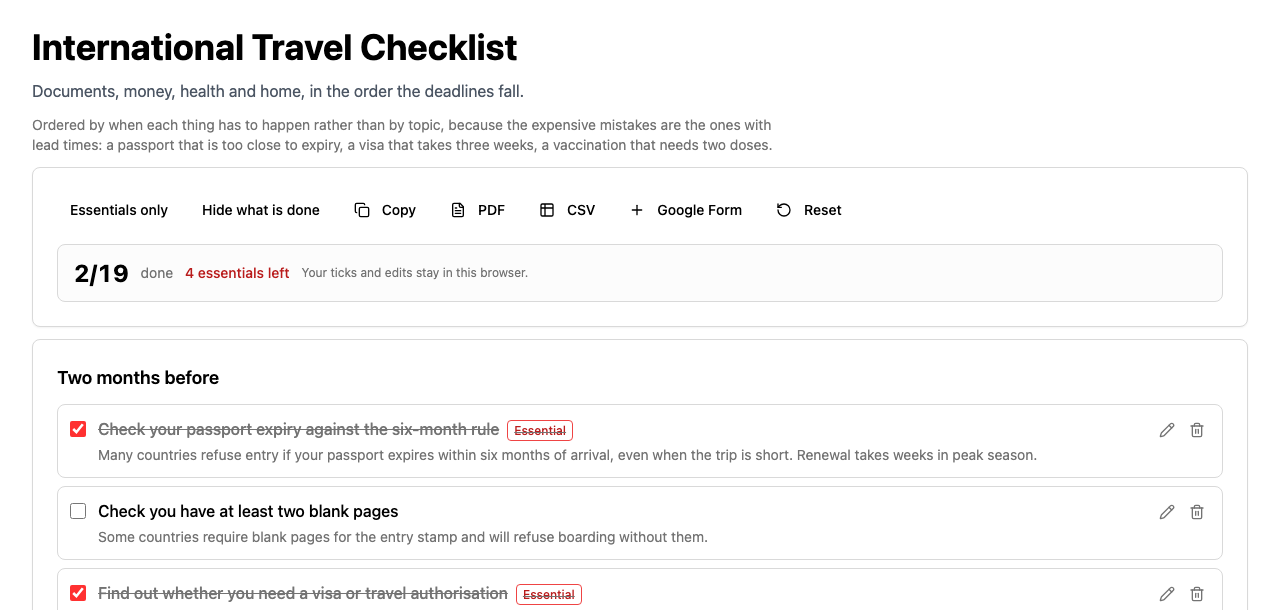
Every checklist on this site can be edited, reordered by relevance, stripped down and added to. Your version stays in your browser.
Where checklists do not help
They are poor at judgement. A checklist can confirm you considered something; it cannot decide for you. When the answer is "it depends", a checklist either oversimplifies or grows until nobody reads it.
They are also poor at genuinely novel situations, which is a strength rather than a weakness: a list of known steps is the wrong tool for an unknown problem, and reaching for one can delay the thinking the situation actually needs.
And they do not fix a culture where nobody speaks up. Part of the surgical checklist's effect came from a team introduction, each person saying their name and role, which made it easier for a junior nurse to raise a concern. The list created a moment where speaking was expected. Without that, a list is just paperwork.
Writing one that survives
Five rules that follow from the evidence:
Start from a failure. The best items come from something that actually went wrong. A list assembled from imagination is mostly filler.
Write actions, not topics. "Passport" is a topic. "Check the passport expiry is more than six months after arrival" is an action you can complete.
Put the killers first. Order by consequence, not by chronology or convenience. If someone only does the top third, that third should be the part that matters.
Name the pause point. A checklist with no defined moment to run it does not get run. "Before booking", "before the first frost", "before the deadline" are all moments; "sometimes" is not.
Keep it to one page. If it does not fit, it is two checklists with two pause points, which is how the surgical one was structured.
Frequently asked questions
Do checklists actually improve outcomes?
The clearest evidence is the WHO Surgical Safety Checklist study, where deaths fell from 1.5% to 0.8% and major complications from 11% to 7% across eight hospitals. Aviation has used them since 1935 for the same reason: they protect routine steps from being skipped under pressure.
How long should a checklist be?
Five to nine items per pause point, following aviation guidance. Longer lists get ticked without being read, which is worse than no checklist because it creates a record that a check happened. Split a long list into several shorter ones with their own moments.
What is the difference between read-do and do-confirm?
In read-do you read each item then perform it, which suits unfamiliar or rare tasks. In do-confirm you complete the work from memory, then pause and verify nothing was missed, which suits familiar work. Using read-do for routine work is what makes checklists feel tedious.
Should I edit a checklist someone else wrote?
Yes. The WHO guidance explicitly expects local modification, and adaptation is associated with lists actually being used. Items that do not apply to you teach you to skim, and the thing you personally forget is the most valuable item your list could contain.
When is a checklist the wrong tool?
When the task needs judgement rather than recall, or when the situation is genuinely novel. A checklist confirms you considered something but cannot decide for you, and reaching for a list of known steps during an unfamiliar problem can delay the thinking that situation requires.
Sources and further reading
- A Surgical Safety Checklist to Reduce Morbidity and Mortality in a Global Population, New England Journal of Medicine. The eight-hospital study and its results.
- WHO Surgical Safety Checklist, World Health Organization. The checklist itself and the guidance to adapt it locally.
- Human Factors of Flight-Deck Checklists: The Normal Checklist, NASA. Read-do versus do-confirm, and the length guidance.
- Crew Resource Management Training, Federal Aviation Administration. Why a briefing moment changes whether people speak up.
More Travel
Every tool in the Travel section, free and in your browser.
- International Travel Checklist
- Carry-On Packing Checklist
- Road Trip Checklist
- Flying With a Baby Checklist
- Camping Checklist
- Hiking Time Calculator
- Day Hike Checklist
- Travelling With Pets Checklist
- Long-Haul Flight Checklist
- Ski Trip Checklist
- Business Trip Checklist
- Beach Holiday Checklist
- Child Travel Documents Checklist
- Passport Renewal Checklist
- Winter Driving Checklist