
Car Loans, Balloons and Clearing Debt in Australia
How a balloon changes an Australian car loan, what the comparison rate includes, clearing cards and BNPL faster, and how APRA's debt-to-income limit works.
By Redbison Dev · · 10 min read
Australia edition. Australian edition in Australian dollars, with drive-away prices, balloon car loans, the comparison rate, ASIC's car loan findings, card repayment rules under the National Credit Act, and APRA's debt-to-income limit. US edition
On a A$45,000 drive-away car with a A$5,000 deposit and a A$495 establishment fee added to the loan, at 8.5% over five years, the repayment is A$830.82 a month. Add a 30% balloon and it falls to A$649.47, but total interest rises from A$9,354.02 to A$11,973.13 and A$13,500 is still owing at the end. On the debt side, a credit card, the rest of a car loan and a buy now pay later plan totalling A$18,200 take 51 months and A$5,751.08 of interest at the current repayments; A$850 a month aimed at the highest rate first clears them in 26 months for A$3,232.91.
This edition works through both with Australian rules: drive-away pricing, the comparison rate, what ASIC found in its 2026 review of car loans, how card repayments must be applied, and APRA's debt-to-income limit on home lending. Figures come from the Car Loan Calculator (Australia) and the calculators linked below. It explains the maths, not which loan to take. If repayments are already a struggle, the National Debt Helpline (1800 007 007) offers free, confidential financial counselling.
Car loans: drive-away price, fees and the comparison rate
A drive-away price already includes GST, stamp duty and registration, so there is no sales tax to add. If a dealer quotes a price "plus on-road costs", add those costs before you compare.
amount financed = drive-away price − deposit − trade-in equity + fees added to the loan
repayment       = P × r × (1 + r)^n ÷ ((1 + r)^n − 1),  r = rate ÷ 12, n = months
Fees matter more than they look. In ASIC's review of car loans, published in June 2026, loan establishment fees ranged from A$299 to A$995 and were often added to the loan, and finance arranged through a dealer or broker could carry further introducer fees. That is why lenders must show a comparison rate next to an advertised rate. Under regulations 97 to 100 of the National Consumer Credit Protection Regulations, the comparison rate folds the interest and most fees into one nominal annual rate, calculated on a benchmark loan such as A$30,000 over five years, with a warning that it is true only for that example. On a smaller or shorter loan, fixed fees push the real cost above the advertised comparison rate.
Trade-in equity works like a deposit. With a A$15,000 trade-in owned outright and no cash deposit, the same car needs A$30,495 of finance and A$625.65 a month over five years.
Balloons: lower repayments, more interest
A balloon, also called a residual, is a lump sum left owing at the end of the loan. ASIC found that lenders usually allow a larger balloon on a shorter loan and a newer car. Because none of the repayments reduce the balloon, you pay interest on it for the whole term.
| A$40,495 financed at 8.5% over 60 months | Monthly repayment | Total interest | Owing at the end |
|---|---|---|---|
| No balloon | A$830.82 | A$9,354.02 | nothing |
| 30% balloon | A$649.47 | A$11,973.13 | A$13,500 |
| 40% balloon | A$589.02 | A$12,846.16 | A$18,000 |
Each step up in the balloon saves less a month and costs more interest. The real question is what the car will be worth in five years. If it sells for less than the balloon, selling it will not clear the loan, and refinancing the balloon starts a new loan on an old car. Plan how you will pay it, and consider putting the monthly saving aside towards it.
Dealer finance and cooling off
ASIC's review found that dealers can earn commissions and fees from arranging finance, which creates a conflict of interest. Get a pre-approved quote from a bank or credit union first and compare total cost, not just the repayment. In NSW, a one-day cooling-off period applies to dealer-linked finance on a vehicle purchase.
Novated leases, offered through salary packaging, are a separate calculation: the payments come out of your pre-tax salary, the employer's fringe benefits tax position decides the saving, and a residual is due at the end just like a balloon. Ask the provider for the total cost including the residual and running costs before comparing it with a loan.
Paying down cards, car loans and BNPL
With several debts, the method matters less than a fixed monthly total above the minimum repayments. Pay every minimum, send the extra to one target, and when a debt is cleared keep the same total so its old repayment rolls to the next.
- Avalanche targets the highest rate first and always costs the least interest.
- Snowball targets the smallest balance first and clears accounts sooner.
Take a A$8,000 credit card at 20.99% (A$240 a month), A$9,000 left on a car loan at 12.5% (A$330) and A$1,200 of buy now pay later at no interest (A$100). These are the same debts the Debt Consolidation Calculator (Australia) uses.
| Plan | Debt-free | Interest |
|---|---|---|
| Repayments as now, A$670 a month falling as debts clear | month 51 | A$5,751.08 |
| A$850 a month, avalanche | month 26 | A$3,232.91 |
| A$850 a month, snowball | month 26 | A$3,342.87 |
| A$900 a month, avalanche | month 24 | A$2,979.13 |
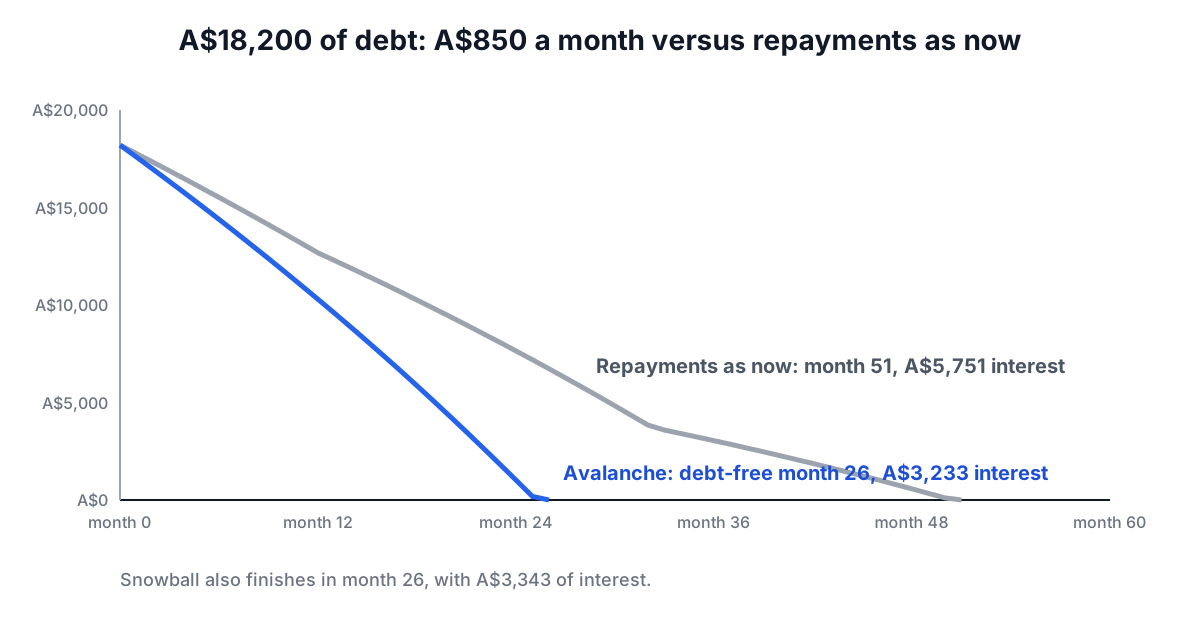
The snowball pays off the interest-free BNPL first, in month 5, which costs about A$110 more than letting it run at its own pace while the card is cleared. Adding A$180 a month to the current repayments saves A$2,518 and more than two years. The Debt Payoff Calculator runs both plans for your own debts.
If you keep using a card while paying it down, the law helps a little. Section 133BQ of the National Consumer Credit Protection Act requires card repayments to go first to the part of the balance with the highest annual percentage rate. That stops a 0% balance transfer soaking up your repayments while purchases build interest, but new spending still adds to what you owe.
Debt-to-income in Australia means a multiple, not a percentage
The US guide's debt-to-income ratio compares monthly repayments with monthly income. In Australia the term usually means something else: total debt divided by gross annual income, expressed as a multiple. Since 1 February 2026, APRA has limited the share of each bank's new home lending at a debt-to-income ratio of six times or more to 20%, separately for owner-occupiers and investors. Loans to build or buy a new dwelling and bridging finance are excluded.
The limit applies to a bank's lending as a whole, not to each borrower, so a DTI above six is not banned. But lenders ration those loans, and the car loan counts:
DTI = all debts (home loan + car loan + personal loans + other credit) ÷ gross annual income
A household on A$110,000 applying for a A$600,000 home loan with A$40,495 still owing on the car above has a DTI of 5.82. Another A$15,000 of other debt takes it to 5.96, close to the line. Paying off the car loan first, or buying the car after settlement, keeps the application clear of it. Lenders also run their own serviceability checks on your repayments and living costs, which a car repayment reduces directly.
Student debt is a different kind of debt
A HELP debt is not charged interest in the usual way. Its balance is indexed each year on 1 June, and compulsory repayments come out through the tax system once your repayment income passes the threshold set for the year. Because of that, extra voluntary repayments are rarely the best use of spare money while a credit card or car loan is charging double-digit interest. Clear those first, and check your HELP balance and the current thresholds in myGov.
Putting it together
- Compare car loans on total cost and the comparison rate, and ask what fees are added to the loan.
- Choose a balloon only with a plan to pay it, and check the car's likely value against it.
- Get finance pre-approved before visiting a dealer.
- For debts, fix a monthly total above the minimums and aim it at the highest rate.
- Before a home loan, work out your debt-to-income multiple and clear the car loan if you are near six.
To see what fees add to your own loan, the APR calculator (Australia) works out its comparison rate the way the regulations set out. For a 0% card offer, the Balance Transfer Calculator (Australia) shows what is left when the offer ends.
Frequently asked questions
Is a balloon payment on a car loan a good idea?
It lowers the monthly repayment, but you pay more interest and still owe a lump sum at the end. On A$40,495 at 8.5% over five years, a 30% balloon saves A$181 a month and costs A$2,619 more interest, with A$13,500 still due. It suits buyers with a clear plan to pay or refinance the balloon.
What does a comparison rate include?
The interest rate plus most up-front and ongoing fees, combined into one annual rate on a benchmark loan, such as A$30,000 over five years. It does not include every possible charge, and on a different loan size or term the true cost can differ, which is why it comes with a warning.
Should I pay off my credit card or car loan first?
Usually the credit card, because its rate is higher. In the example, paying A$850 a month with the card targeted first clears all three debts in 26 months for A$3,232.91 of interest.
What is APRA's debt-to-income limit?
Since 1 February 2026, no more than 20% of a bank's new owner-occupier lending, and 20% of its new investor lending, can be at a debt-to-income ratio of six times or more. Debt-to-income here is total debt divided by gross annual income.
Where can I get free help with debt?
The National Debt Helpline, on 1800 007 007, is a free, confidential, not-for-profit financial counselling service. Its counsellors do not lend money or sell products, and they can negotiate with lenders on your behalf.
Sources and further reading
- Lifting the bonnet: ASIC's review of car loans (REP 832), Australian Securities and Investments Commission. Balloons, establishment fees and dealer conflicts.
- National Consumer Credit Protection Regulations 2010, Federal Register of Legislation. Regulations 97 to 100 on the comparison rate.
- National Consumer Credit Protection Act 2009, Federal Register of Legislation. Section 133BQ on applying card repayments.
- Activation of debt-to-income limits as a macroprudential policy tool, Australian Prudential Regulation Authority.
- Vehicle finance and contracts, NSW Government. Balloons and the one-day cooling-off period.
- National Debt Helpline, Financial Counselling Australia. Free financial counselling.
- Can Small Victories Help Win the War? Evidence from Consumer Debt Management, Journal of Marketing Research. Gal and McShane on clearing small balances first.
More Loans & Mortgages
Every tool in the Loans & Mortgages section, free and in your browser.