
Income Replacement Ratio in Canada: CPP, OAS and Tax
How much of your pay you need in retirement in Canada: CPP and EI that stop, what CPP and OAS replace, and federal and Alberta tax on RRIF income.
By Redbison Dev · · 10 min read
Canada edition. Canadian edition in dollars for 2026: CPP and EI deductions, the CPP and OAS amounts, RRIF income, the age and pension income amounts, and the Government of Canada's 60% to 70% guideline. US edition
You have a statement from your group RRSP, an estimate in My Service Canada Account and a figure in your head of what you spend. The question is whether those add up. The Government of Canada's own rule of thumb is that most people need about 60% to 70% of their current income in retirement. For a single Albertan earning $60,000 who saves 10% in an RRSP and wants exactly today's spending at 65, the 2026 numbers say 78.5%; if a $12,000 a year mortgage ends first, 52.8%. The steps below get you your own ratio.
Figures are 2026 amounts from the CRA and Service Canada, with federal and Alberta tax. Alberta is used because its tax has no surtax or health premium, so every step can be shown; other provinces' brackets and credits differ. CPP and EI figures are for workers outside Quebec, where the QPP and Quebec's own EI rate apply instead. This is a planning method, not advice.
What stops when the paycheques stop
- CPP contributions. In 2026 an employee pays 5.95% on earnings between $3,500 and $74,600, at most $4,230.45 (CPP contribution rates), plus 4% on earnings from $74,600 to $85,000 (CPP2), at most $416 (CPP2 rates). CPP2 is deducted from income rather than credited. On April 28, 2026 the federal government announced its intention to cut the base CPP employee rate from 4.95% to 4.75% from January 1, 2027 (CRA payroll formulas, July 2026 edition).
- EI premiums. 1.63% on insurable earnings up to $68,900, at most $1,123.07 (EI premium rates).
- RRSP and pension saving. The examples save 10% of pay.
- Costs that end. A mortgage paid off, commuting, children who have left home.
What continues is income tax. CPP, OAS and RRIF withdrawals are all taxable, but at 65 two credits start: the federal age amount ($9,208 for 2026, reduced by 15% of net income above $46,432) and the pension income amount on RRIF income (2026 indexed amounts, line 31400). Alberta has its own versions, credited at its lowest rate of 8%: an age amount of $6,345, reduced between $47,234 and $89,534 of net income, and a pension amount of up to $1,753 (TD1AB 2026, CRA payroll deductions formulas).
What CPP and OAS pay
- CPP at 65: at most $1,507.65 a month as of January 2026; the average at 65 was $858.34 in July 2026 (CPP amounts). Your own figure depends on your contribution record and the age you start.
- OAS at 65 to 74: up to $762.50 a month for October to December 2026, $9,150 a year at that rate, for someone with 40 years in Canada after 18 (OAS payment amounts). It is recovered at 15% of net income above $95,323 for the 2026 income year (OAS recovery tax).
Because OAS is a flat amount and CPP stops growing at the earnings ceiling, the two together replace a falling share of pay as income rises.
Three salaries, the same spending
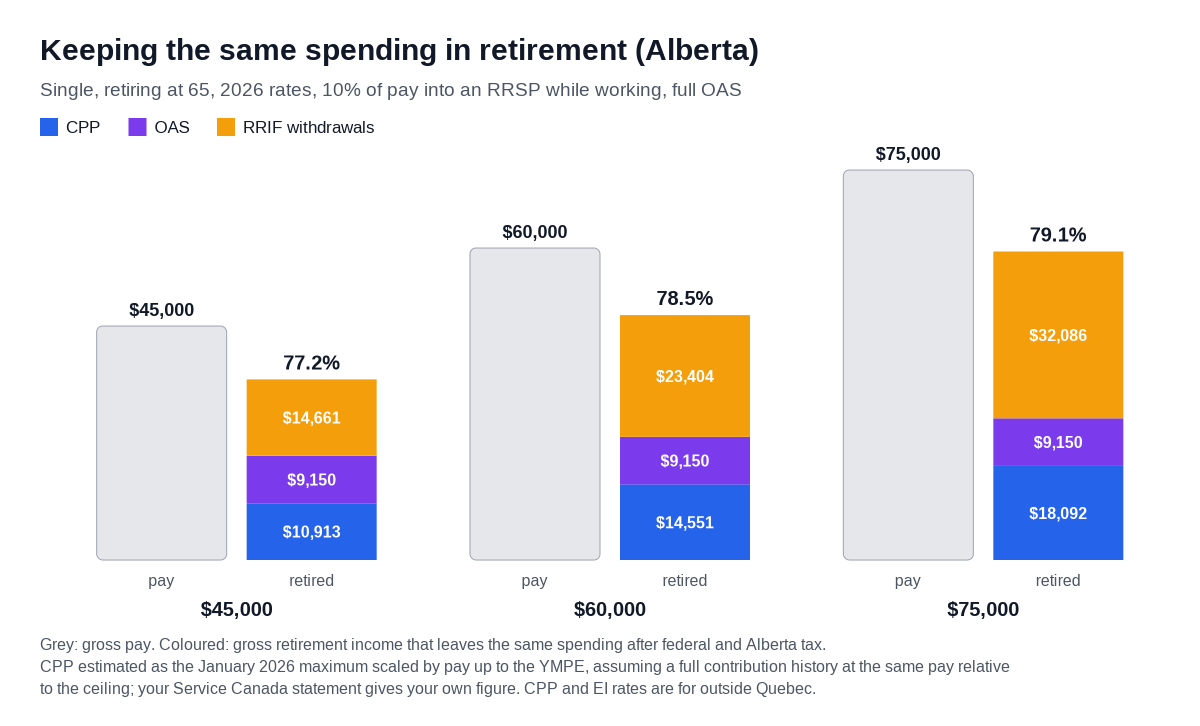
Each example: single, Alberta, retiring at 65, 10% of pay into an RRSP while working, full OAS, and CPP estimated as the January 2026 maximum scaled by pay up to the $74,600 ceiling. That simplification assumes a full contribution history at the same pay relative to the ceiling; your Service Canada statement is the real figure. The RRIF withdrawal is the smallest that leaves the same spending after federal and Alberta tax, using 2026 brackets and credits on both sides.
| $45,000 | $60,000 | $75,000 | |
|---|---|---|---|
| CPP contributions | $2,469.25 | $3,361.75 | $4,230.45 + $16 CPP2 |
| EI premiums | $733.50 | $978 | $1,123.07 |
| RRSP saving (10%) | $4,500 | $6,000 | $7,500 |
| Federal tax while working | $2,708 | $4,439 | $6,721 |
| Alberta tax while working | $1,162 | $2,151 | $3,260 |
| Spending today | $33,427 | $43,070 | $52,149 |
| CPP at 65 (a year) | $10,913 | $14,551 | $18,092 |
| OAS (a year) | $9,150 | $9,150 | $9,150 |
| CPP and OAS as a share of pay | 44.6% | 39.5% | 36.3% |
| RRIF withdrawals needed | $14,661 | $23,404 | $32,086 |
| Federal and Alberta tax in retirement | $1,298 | $4,036 | $7,179 |
| Gross retirement income | $34,724 | $47,106 | $59,328 |
| Replacement ratio | 77.2% | 78.5% | 79.1% |
| Ratio if a $12,000 a year mortgage ends | 47.6% | 52.8% | 57.8% |
What the table shows:
- Keeping today's spending needs more than 60% to 70%. CPP, EI and RRSP saving together are about 17% of each of these salaries. The rest of the gap between pay and spending is income tax, which shrinks in retirement but does not vanish. The government's range fits households whose costs fall, which is what the mortgage row shows.
- Tax falls sharply at 65. The $60,000 earner pays $6,590 of income tax while working and $4,036 in retirement on $47,106 of income. About $2,203 of the $2,554 drop is the federal and Alberta age and pension income amounts; the rest comes from lower taxable income, net of the CPP, EI and employment credits that end with the job. The RRSP saving is not the reason: it was deducted while working.
- The ratio rises slightly with pay in this range, against the usual assumption that higher earners need a lower share, because OAS is fixed and CPP is capped, so more of the income has to come from fully taxable RRIF money.
The arithmetic for $60,000, with the 2026 rates above:
working:  60,000 - 3,361.75 CPP - 978 EI - 6,000 RRSP - 4,439 federal - 2,151 Alberta = 43,070
retired:  14,551 CPP + 9,150 OAS + 23,404 RRIF = 47,106 gross, 4,036 tax, 43,070 spending
ratio:    47,106 / 60,000 = 78.5%
Work out your own ratio
- Gross pay. Box 14 of your T4, or a recent pay stub times the number of pays.
- Take off what stops. CPP (boxes 16 and 16A), EI (box 18) and your own RRSP or pension contributions. Income tax stays in for now.
- Adjust the budget. Remove the mortgage if it will be paid off, commuting and saving; add travel, health and dental costs no longer covered by an employer plan.
- Add the tax on retirement income. CPP, OAS and RRIF income are taxable; TFSA withdrawals are not, so a TFSA-funded gap lowers the ratio.
- Divide by gross pay. Subtract your CPP estimate and OAS; the rest is what your RRSP, TFSA and any workplace pension must produce each year.
Planning to stop before 65? The years before CPP and OAS start need the whole budget from savings; the FIRE Planner (Canada) tests that bridge.
From a ratio to a savings target
The Retirement Calculator (Canada) works before tax. For the $60,000 earner, enter monthly expenses 3,589.16, retirement income ratio 100, inflation 0, CPP and OAS 1,975.09, retirement age 65, CPP and OAS Start at Age 65 and plan to 90: the monthly gap is $1,614.07 and the savings needed come to $484,221, the gap times 25 years with no investment return counted after retirement. The RRIF actually has to pay $1,950.37 a month, because $336.30 of it goes in tax, so add your expected tax to monthly expenses or the target comes out short.
Tools for this job
- Retirement Calculator (Canada): turns the yearly gap into a savings target and checks your RRSP and TFSA against it.
- FIRE Planner (Canada): retiring before 65, with the bridge years funded from savings.
- Annuity Calculator (Canada): what a RRIF balance pays out over a set number of years.
- Budget Planner: today's spending by category, to mark what ends and what starts.
- Retirement Checklist (Canada): CPP and OAS start dates, RRIF conversion and the documents to gather.
Which account to draw from changes the tax line; see RRSP vs TFSA vs FHSA: where the tax falls. For the total savings behind the ratio, read how much you need to retire in Canada.
Frequently asked questions
What percentage of my income do I need to retire in Canada?
The Government of Canada's guideline is about 60% to 70% of current income. Keeping exactly today's spending needs more: 77.2% to 79.1% of gross pay for single Albertans on $45,000 to $75,000 who save 10% in an RRSP, using 2026 rates. If a $12,000 a year mortgage ends, the figure falls to 47.6% to 57.8%.
How much of my income will CPP and OAS replace?
In these 2026 examples, CPP plus a full OAS replace 44.6% of a $45,000 salary, 39.5% of $60,000 and 36.3% of $75,000. The maximum CPP at 65 was $1,507.65 a month in January 2026 and OAS up to $762.50 a month for October to December 2026; your own CPP depends on your contribution record.
Do I still pay CPP and EI in retirement?
Not on CPP, OAS or RRIF income: CPP contributions and EI premiums are charged on employment earnings. If you keep working after 65 while receiving CPP, contributions on those earnings depend on your age and choices, so check with Service Canada.
Is RRIF income taxed in retirement?
Yes, every dollar is taxable income. From 65 it qualifies for the federal pension income amount on up to $2,000 a year and Alberta's on up to $1,753, and the age amount reduces tax further at lower incomes. Above $95,323 of net income in 2026, OAS is clawed back at 15% of the excess.
Sources and further reading
- Prepare for retirement, Government of Canada. The 60% to 70% guideline.
- CPP retirement pension: how much you could receive, Government of Canada. Maximum and average CPP at 65.
- Old Age Security payment amounts, Government of Canada. October to December 2026 OAS.
- CPP contribution rates, maximums and exemptions, Canada Revenue Agency. 2026 rate, exemption and maximum.
- EI premium rates and maximums, Canada Revenue Agency. 2026 rate and maximum.
- Tax rates and income brackets for 2026, Canada Revenue Agency. Federal and Alberta brackets.
- Adjustment of personal income tax and benefit amounts, Canada Revenue Agency. 2026 basic personal amount, age amount and Canada employment amount.
- Old Age Security pension recovery tax, Government of Canada. 15% above $95,323.
- Payroll Deductions Formulas, 123rd edition, Canada Revenue Agency. Alberta's 0.0800 credit rate (K1P = lowest provincial rate × TCP) and the announced 2027 base CPP rate cut.
- TD1AB 2026 Alberta Personal Tax Credits Return, Canada Revenue Agency. Alberta basic personal amount, age amount and pension income amount for 2026.
- Second additional CPP contribution rates and maximums, Canada Revenue Agency. CPP2 at 4% up to $85,000.