
RRSP vs TFSA vs FHSA: Where the Tax Falls in Canada
How the RRSP, TFSA, FHSA, spousal RRSP and RRIF are taxed going in, growing and coming out, with this year's room limits and an Alberta RRSP-or-TFSA example.
By Redbison Dev · · 9 min read
Canada edition. Canadian edition in dollars for 2026: RRSP and TFSA room, the FHSA, spousal RRSPs, RRIF minimums at 71 and the OAS recovery tax, with federal and Alberta rates from the CRA. US edition
Every February the same question comes up: put this year's savings in the RRSP for the refund, or in the TFSA so the money comes out tax-free? Both shelter growth completely. The difference is only when the Canada Revenue Agency takes its share. An RRSP deducts the contribution now and taxes every dollar that comes out; a TFSA takes after-tax dollars and never taxes them again. So the answer turns on one comparison: your marginal rate the year you contribute against your rate the year you withdraw. For an Alberta employee on $70,000 in 2026, $5,000 of pay grown 25 years at 5% leaves $13,207 through an RRSP drawn at 22%, $11,768 through a TFSA, and $9,228 through an RRSP drawn while the OAS recovery tax applies.
Figures are 2026 amounts from the CRA. Provincial rates differ; the examples use Alberta's because its tax has no surtax or health premium, so each rate can be shown, and you can run your own province's brackets from the same CRA page. Payroll figures such as CPP and EI are for workers outside Quebec, where the QPP applies with different rates. This explains the rules, not your return; with a workplace pension, a business or U.S. connections, check with a tax professional.
Where the tax falls in each account
| Account | Going in | While invested | Coming out | Room in 2026 |
|---|---|---|---|---|
| RRSP (and group RRSP) | Deducted from income | No tax | Fully taxable as income | 18% of 2025 earned income, up to $33,810, less your pension adjustment, plus unused room |
| Spousal RRSP | Deducted by the contributor | No tax | Taxable to the spouse, unless attributed back | Uses the contributor's RRSP room |
| TFSA | No deduction | No tax | Tax-free | $7,000, plus unused room and last year's withdrawals |
| FHSA | Deducted from income | No tax | Tax-free for a qualifying first home; otherwise taxable | $8,000, $40,000 lifetime |
| RRIF | Transferred from an RRSP | No tax | Fully taxable; a minimum must come out each year | n/a |
The RRSP limit for 2027 is already set at $35,390 (CRA limits table). TFSA money withdrawn this year comes back as room on January 1 of next year, not before (withdrawing from a TFSA), and income and withdrawals in a TFSA do not affect federal income-tested benefits and credits such as OAS and the Guaranteed Income Supplement (what is a TFSA).
RRSP or TFSA: the marginal-rate test
Take $5,000 of gross pay. In an RRSP it goes in whole, because the deduction gives back the tax. In a TFSA, tax is paid first. For a 2026 Alberta employee on $70,000, the last dollars of income sit in the federal 20.5% bracket ($58,523 to $117,045) and Alberta's 10% bracket ($61,200 to $154,259), 30.5% together (2026 rates). So the TFSA receives $3,475.
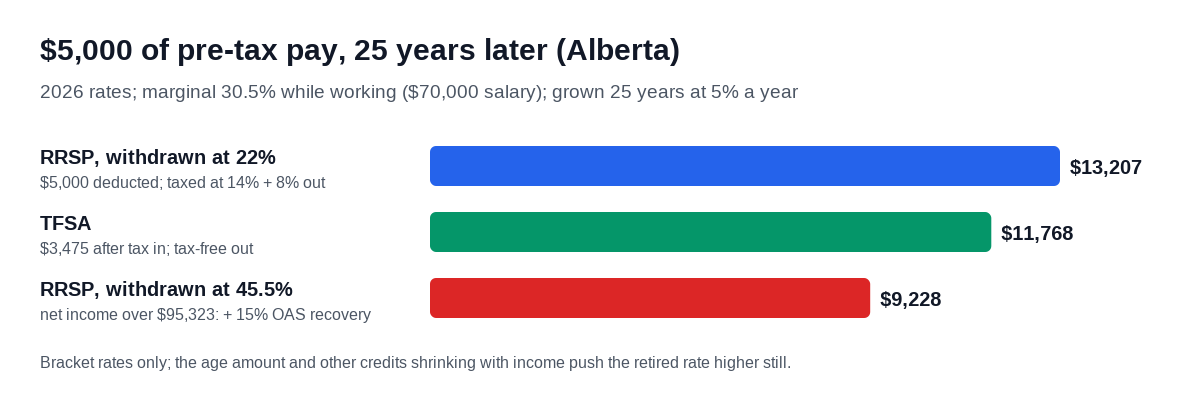
Both grow at the same rate: 5% for 25 years turns $5,000 into $16,932, the figure the compound interest calculator's function gives. Then:
- Retired on a modest income. With net income under $46,432 at 65, the withdrawal is taxed at 14% federal plus 8% Alberta, 22%, so the RRSP leaves $13,207, $1,439 more than the TFSA. The rule: the RRSP wins whenever your rate coming out is below your rate going in. That 22% understates the cost for a retiree on a low income: RRSP and other pension withdrawals count as income for the Guaranteed Income Supplement, paid only to a single person with income under $23,112 (OAS itself excluded), so each dollar withdrawn also reduces GIS and the real exit rate is far above 22%. If you expect to qualify for GIS, that tips the choice to the TFSA.
- Retired on a high income. Net income above $95,323 in 2026 triggers the OAS recovery tax of 15% on the excess. Add it to the 20.5% and 10% brackets and each RRSP dollar out costs 45.5%: $9,228 left, $2,540 less than the TFSA. The federal age amount also shrinks by 15% of net income above $46,432 until $107,819, which lifts the rate further in that range.
- Same rate both ends. The two accounts give exactly the same result, because the order of multiplying by the tax rate and by the growth does not matter. That is why the TFSA is the usual choice in low-income years, when the RRSP deduction is worth little.
Two traps on the RRSP side: the refund only matches the arithmetic if it is saved too rather than spent, and RRIF income counts in the net income that sets the OAS recovery tax, while TFSA withdrawals do not affect OAS or the Guaranteed Income Supplement.
The FHSA: a deduction and a tax-free exit
The first home savings account is the one account that is deductible going in and tax-free coming out, provided the money buys a qualifying first home. Participation room is $8,000 in the year you open it, unused room carries forward by up to $8,000, contributions are capped at $40,000 for life, and the account closes at the end of the year of its 15th anniversary, the year you turn 71 or the year after your first qualifying withdrawal, whichever comes first (participating in your FHSAs, FHSA definitions).
For the same $70,000 Alberta earner, $8,000 a year for five years earns $2,440 a year back at 30.5%, $12,200 in all. Deposited at the start of each year and grown at 5%, the account holds $46,415 at the end of year five. Transfers from an RRSP into an FHSA are not deductible (first home savings account), so fresh contributions beat moving old RRSP money.
Spousal RRSPs: splitting income in advance
With a spousal RRSP the higher earner contributes and takes the deduction, and the lower earner withdraws in retirement at their lower rate. The attribution rule is the catch: if you contributed to any spousal RRSP in the year your spouse withdraws or in either of the two preceding years, the withdrawal is taxed to you instead, up to those contributions (withdrawing from spousal or common-law partner RRSPs). Stop contributing three calendar years before the planned withdrawal.
Coming out: the RRIF from 71
An RRSP must mature by the end of the year you turn 71: withdraw it, buy an annuity or move it to a RRIF (RRSPs and other registered plans for retirement, T4040). A RRIF must pay a minimum each year from the year after it is set up: the January 1 value times a prescribed factor, which is 1 divided by (90 minus age) before 71 and 5.28% at 71 for most RRIFs (minimum amount from a RRIF). On $400,000 at 71 that is $21,120 of taxable income whether you need it or not, which is one reason to draw some RRSP money in your 60s and leave TFSA money for later.
From 65, RRIF income qualifies for the federal pension income amount (up to $2,000 of income, credited at 14%) and Alberta's (up to $1,753 for 2026, credited at Alberta's lowest rate of 8%) (line 31400, TD1AB 2026, CRA payroll deductions formulas). Converting part of an RRSP to a RRIF at 65 is one way to use it.
A working order for most employees
- Join the workplace pension or group RRSP to the full employer match. Matched dollars beat any account choice here.
- Saving for a first home? Use the FHSA first: deductible and tax-free.
- In a bracket of 30% or more now, expecting less later: RRSP.
- Low income now, expecting to qualify for the Guaranteed Income Supplement, or expecting high income in retirement (a defined benefit pension, large RRIF, OAS recovery): TFSA.
- Keep an emergency fund in the TFSA rather than the RRSP: withdrawn room comes back, and an RRSP withdrawal is taxed and its room is gone.
Tools for this job
- Retirement Calculator (Canada): the savings your spending, CPP and OAS call for.
- Compound Interest Calculator: the growth factor behind the comparison; try your own rate and years.
- FIRE Planner (Canada): retiring before CPP and OAS start, with RRSP and TFSA money split.
- Tax Year End Checklist: RRSP deadline, TFSA room and FHSA contributions before the year closes.
- Retirement Checklist: CPP and OAS timing, RRIF conversion and pension splitting decisions.
For the income these accounts need to produce, see the share of your income you need in retirement in Canada; for the total, how much you need to retire in Canada.
Frequently asked questions
Is an RRSP or a TFSA better?
Compare your marginal rate now with the rate you expect when you withdraw. If it is higher now, the RRSP wins; if lower, the TFSA. In the Alberta example, $5,000 of pay becomes $13,207 through an RRSP drawn at 22% against $11,768 in a TFSA, but only $9,228 through an RRSP drawn at 45.5% once the OAS recovery tax applies.
How much can I put in my RRSP and TFSA this year?
The RRSP limit is 18% of your 2025 earned income up to $33,810, minus any pension adjustment, plus unused room; your notice of assessment shows the exact figure. The TFSA dollar limit for 2026 is $7,000, plus any unused room and any amounts you withdrew in earlier years.
Should I use an FHSA or an RRSP for a first home?
The FHSA, if you qualify: contributions are deductible like an RRSP and a qualifying withdrawal is tax-free, with no repayment. You can put in $8,000 a year up to $40,000. A transfer from an RRSP into an FHSA gives no new deduction.
Are TFSA withdrawals taxable?
No. Income earned in a TFSA and withdrawals are generally tax-free, and they do not affect federal income-tested benefits and credits such as OAS, the Guaranteed Income Supplement and EI. The amount withdrawn is added back to your room on January 1 of the next year.
What is the RRIF minimum withdrawal at 71?
5.28% of the RRIF's value on January 1 for most RRIFs (5.26% for pre-March 1986 and qualifying RRIFs). Before 71 the factor is 1 divided by (90 minus your age), so 4% at 65. You can elect, when setting up the RRIF, to use your spouse's or common-law partner's age instead.
Sources and further reading
- MP, DB, RRSP, DPSP, ALDA, TFSA limits, YMPE and the YAMPE, Canada Revenue Agency. 2026 and 2027 RRSP limits, 2026 TFSA limit.
- Tax rates and income brackets for 2026, Canada Revenue Agency. Federal and Alberta brackets.
- RRSPs and other registered plans for retirement (T4040), Canada Revenue Agency. 18% of earned income, maturity at 71, spousal RRSPs.
- Minimum amount from a RRIF, Canada Revenue Agency. Prescribed factors.
- Withdrawing from spousal or common-law partner RRSPs, Canada Revenue Agency. The attribution rule.
- Participating in your FHSAs, Canada Revenue Agency. $8,000 annual room, $40,000 lifetime limit, carry forward.
- Old Age Security pension recovery tax, Government of Canada. 15% above $95,323 for the 2026 income year.
- Adjustment of personal income tax and benefit amounts, Canada Revenue Agency. 2026 age amount and its $46,432 threshold.
- TD1AB 2026 Alberta Personal Tax Credits Return, Canada Revenue Agency. Alberta's 2026 pension income amount of $1,753.
- Payroll Deductions Formulas, 123rd edition, Canada Revenue Agency. Alberta's 0.0800 credit rate (K1P = lowest provincial rate × TCP).
- Guaranteed Income Supplement: eligibility, Government of Canada. The $23,112 single income limit and RRSP withdrawals counted as income.