
15-Year vs 30-Year Mortgage: Payment, Interest and Flexibility
Monthly payment and total interest on the same loan at 15 and 30 years, and what happens if you take the 30-year loan and pay it like a 15-year one.
By Redbison Dev · · 10 min read
Your lender has sent two quotes for the same house: a 15-year fixed loan and a 30-year fixed loan, and you need to pick one. On a $320,000 loan at late-October 2026 US rates, the 15-year loan costs about $624 a month more but saves about $280,000 in interest, because it has a lower rate and half as many years of interest. The 30-year loan costs more in total but keeps the required payment low, and if you pay it as if it were a 15-year loan you recover most of that saving while keeping the option to fall back to the smaller payment.
The figures below come from the Mortgage Calculator and the EMI Calculator, using Freddie Mac's weekly survey rates, so you can repeat them with your own quotes.
The two loans side by side
Freddie Mac's Primary Mortgage Market Survey (PMMS) for the week ending 29 October 2026 put the US average 30-year fixed rate at 7.24% and the 15-year fixed rate at 6.60%. Rates change every week and your quote depends on your credit, down payment and lender, so treat these as a realistic example, not a forecast.
Take a $400,000 home with 20% down, a $320,000 loan. In the Mortgage Calculator, enter a home price of 400000 and a down payment of 20 (the field is a percentage by default; switch it to an amount and type 80000 if you prefer), an interest rate of 7.24 and a loan term of 30 years. Set property tax, home insurance, PMI rate and HOA dues to 0 so you see the loan alone; the calculator fills in typical tax and insurance figures otherwise. Then change the rate to 6.60 and the term to 15.
| 30-year at 7.24% | 15-year at 6.60% | |
|---|---|---|
| Monthly principal and interest | $2,180.79 | $2,805.17 |
| Total interest | $465,085.86 | $184,929.75 |
| Total paid | $785,085.86 | $504,929.75 |
| Interest in the first payment | $1,930.67 | $1,760.00 |
| Principal in the first payment | $250.13 | $1,045.17 |
| Balance after 5 years | $301,980.97 | $245,943.20 |
| Balance after 10 years | $276,130.20 | $143,025.65 |
Every figure is rounded to the cent from the calculator's unrounded values, so a sum of rounded parts can be a cent off (the first 30-year payment's $1,930.67 + $250.13 shows as $2,180.80).
The 15-year loan costs $624.38 a month more and saves $280,156.11 in interest. Two things produce that gap, as the Consumer Financial Protection Bureau explains: you pay interest for half as long, and shorter terms usually carry a lower rate, by as much as a full percentage point. Here the gap is 0.64 points.
The balance rows come from the amortization schedule in the EMI Calculator: enter a total amount of 400000, a down payment of 80000, the rate, and a tenure of 360 or 180 months, then read the balance after payment 60 and payment 120. On the 30-year loan, five years of payments totalling $130,847.64 reduce the balance by only $18,019.03, because early payments are mostly interest.
Property tax, homeowners insurance and any HOA dues are the same under both loans, so they do not change the comparison, but they do add to what you pay each month. Add them in the Mortgage Calculator before you decide whether the 15-year payment fits your budget.
Paying a 30-year loan like a 15-year loan
The middle route is to take the 30-year loan and add the difference, $624 a month, as extra principal. In the Mortgage Calculator, set the rate back to 7.24, the term to 30 years, and put 624 in Extra every month.
- The loan is paid off in 194 months, 16 years and 2 months.
- Total interest is $223,622.76, which is $241,463.09 less than the plain 30-year loan.
- It still costs $38,693.02 more than the real 15-year loan, because every dollar of balance is charged 7.24% instead of 6.60%.
Paying the same monthly amount does not finish in 15 years, because of the higher rate. To clear the 30-year loan in exactly 15 years at 7.24% you would need $2,919.36 a month, an extra $738.57 (rounded up to the cent; $738.56 leaves a small 181st payment). Put 738.57 in Extra every month and the payoff lands on month 180, with total interest of $205,483.48: still $20,553.73 more than the 15-year loan.
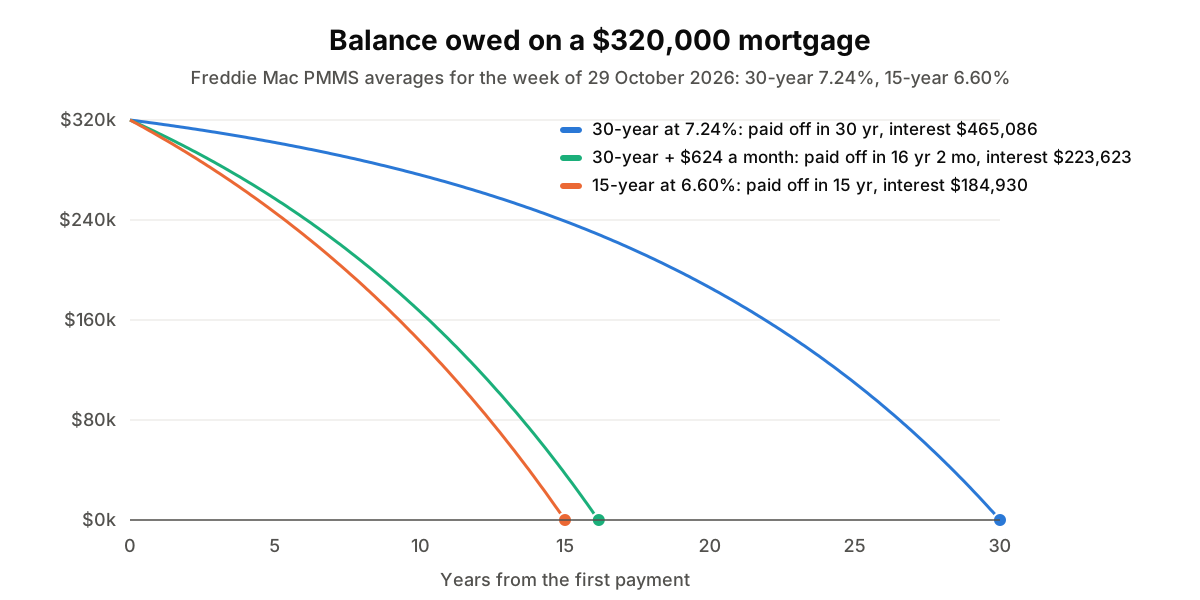
So the price of flexibility, in this example, is roughly $20,000 to $39,000 of extra interest over the life of the loan. What you get for it is a required payment of $2,180.79 instead of $2,805.17. If your income drops, a child arrives or a repair bill lands, you can stop the extra payments without asking anyone and without missing a payment.
The extra-payment plan only works if you keep it up. Many people mean to pay extra and then stop. A 15-year loan makes the higher payment compulsory, which is a feature if you know you would not stick to the plan.
Before you pay extra on a 30-year loan
Check three things first:
- Prepayment penalty. The Loan Estimate and Closing Disclosure both answer "Prepayment Penalty" with yes or no in the loan terms table. If it says yes, find out how much and for how long before you plan on extra payments.
- Where the extra money goes. Tell your servicer the extra is for principal, and check the next statement. Some servicers apply extra money sent without instructions to the next payment instead of to the balance.
- Whether a recast or refinance changes the picture. Paying extra shortens the loan but does not lower the required payment. If you want a lower payment later, you would need a recast, which some lenders offer for a fee, or a refinance at whatever rates are on offer then.
Pros and cons of each choice
15-year mortgage
- Lowest total interest in this example: $184,929.75.
- Builds equity fast: the balance after 10 years is $143,025.65, under half the original loan.
- Lower rate, usually.
- Higher required payment, which also means you qualify for a smaller loan on the same income, since lenders test your payment against your income.
- Less room in the monthly budget for savings, retirement contributions and emergencies.
30-year mortgage
- Lowest required payment, $624.38 less a month here.
- The option to pay it down early, as fast as you choose, as long as there is no prepayment penalty.
- Higher rate and by far the most interest if you only make the required payments: $465,085.86.
- Slow early equity: $18,019.03 of principal in the first five years.
The interest saving is real money, but it is not the only use for $624 a month. People weighing the two usually also consider whether they have emergency savings, any debt at a higher rate than the mortgage, and their retirement saving. That trade-off depends on your own finances, not on a calculator.
This comparison is for fixed-rate loans. It does not fit adjustable-rate mortgages, interest-only loans or loans with prepayment penalties, and it ignores taxes. If you are unsure which term fits your situation, a HUD-approved housing counselor (free or low cost, listed through the CFPB) or a fee-only financial planner can go through your numbers with you.
Tools for this job
- Mortgage Calculator: compare the monthly payment and total interest at 15 and 30 years, add tax, insurance, PMI and HOA, and test extra monthly, yearly or one-time payments to see the payoff date and the interest saved.
- EMI Calculator: the month-by-month amortization schedule for any rate and term, so you can read the balance after any payment and see how much of each payment is interest.
For the payment formula, PMI rules and refinance break-even, read the Mortgage Maths: Payments, PMI, Affordability, Refinancing and APR. For why early payments are mostly interest and why early prepayments save the most, see EMI and Loan Amortization: Where Each Payment Goes.
Frequently asked questions
How much more is a 15-year mortgage payment than a 30-year one?
On a $320,000 loan at Freddie Mac's late-October 2026 averages, 6.60% for 15 years and 7.24% for 30 years, the 15-year payment is $2,805.17 a month and the 30-year payment $2,180.79, a difference of $624.38 before taxes and insurance. The 15-year loan saves $280,156.11 in interest over its life.
Does paying a 30-year mortgage like a 15-year save as much as a 15-year loan?
Not quite, because the 30-year loan usually has a higher rate. Adding $624 a month to a $320,000 loan at 7.24% pays it off in 16 years and 2 months with $223,622.76 of interest, about $38,693 more than a 15-year loan at 6.60%. In return the required payment stays $624 lower if money gets tight.
How much extra do I need to pay to finish a 30-year mortgage in 15 years?
Find the 15-year payment at your 30-year rate and subtract your current payment. For $320,000 at 7.24%, the payment that clears the loan in 180 months is $2,919.36, so the extra is $738.57 a month on top of the $2,180.79 required payment. Total interest then comes to $205,483.48.
Why is the rate on a 15-year mortgage lower?
Lenders take less risk over a shorter loan: their money comes back sooner and there are fewer years for rates or the borrower's finances to change. The Consumer Financial Protection Bureau notes that shorter terms usually carry a lower rate, by as much as a full percentage point. In Freddie Mac's survey for late October 2026 the gap was 0.64 points.
Sources and further reading
- Primary Mortgage Market Survey, Freddie Mac. Weekly US averages for 30-year and 15-year fixed rates; 7.24% and 6.60% for the week of 29 October 2026.
- Understand loan options, Consumer Financial Protection Bureau. Shorter versus longer loan terms and why shorter terms usually cost less overall.
- Your home loan toolkit, Consumer Financial Protection Bureau. Choosing a loan, reading the Loan Estimate and the prepayment penalty question.
- Find a housing counselor, Consumer Financial Protection Bureau. HUD-approved housing counseling agencies near you.