
EMI and Loan Amortization: Where Each Payment Goes
The EMI formula worked through by hand, why early payments are mostly interest, how tenure and prepayment change total cost, and the flat-rate trap.
· 6 min read
On a 30-year home loan of 160,000 at 6.5%, your first monthly payment is 1,011.31. Of that, 866.67 is interest and 144.64 pays down the loan. You will not reach the month where principal outweighs interest until payment 233, more than 19 years in. By the end you will have paid 204,071 in interest, more than the loan itself.
None of that is a trick by the bank. It falls straight out of the EMI formula. This guide works through the formula by hand, shows why the schedule is shaped the way it is, and covers the decisions where understanding it saves real money: tenure, prepayment and flat-rate quotes. Every figure can be reproduced in the EMI Calculator. It explains how loans work; it is not a recommendation about any particular loan.
The EMI formula
An equated monthly instalment (EMI) is a fixed payment that, made every month for n months, pays off the principal and all interest exactly. It is the same annuity formula used for mortgages worldwide:
EMI = P × r × (1 + r)^n / ((1 + r)^n − 1)

P = amount borrowed
r = monthly interest rate = annual rate / 12 / 100
n = number of monthly payments
Worked through for a 100,000 personal loan at 10% over 12 months:
- r = 10 / 12 / 100 = 0.0083333
- (1 + r)^n = 1.0083333^12 = 1.104713
- EMI = 100,000 × 0.0083333 × 1.104713 / (1.104713 − 1) = 920.59 / 0.104713 = 8,791.59
Twelve payments of 8,791.59 total 105,499.06, so the interest cost is 5,499.06. That is less than 10% of 100,000 because you are not borrowing the full amount for the whole year; the balance falls every month.
One edge case: at a 0% rate the formula becomes 0 / 0. The answer is simply P / n, which is what "no-cost EMI" retail offers charge. The calculator handles that case directly.
Where each payment goes
Each month the lender charges interest on whatever you still owe. The rest of the EMI reduces the balance:
interest this month  = balance × r
principal this month = EMI − interest
new balance          = balance − principal
At the start the balance is at its largest, so interest takes most of the payment. As the balance falls, interest shrinks and the principal portion grows, while the EMI stays fixed.
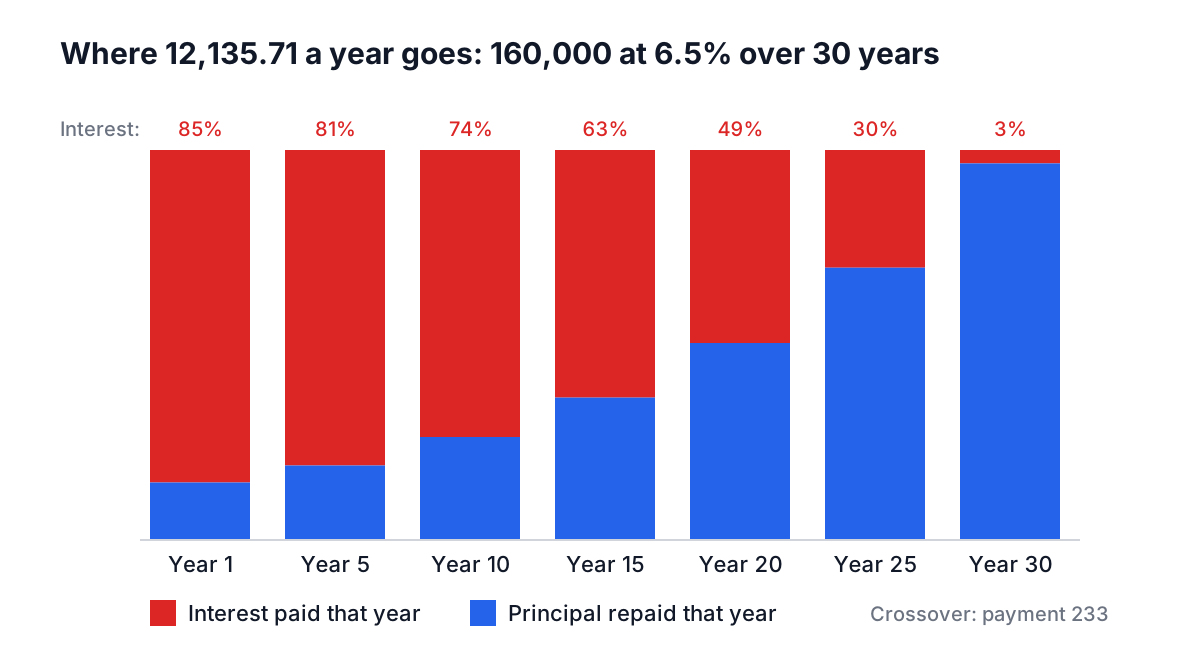
Here is the same 160,000 loan at 6.5% for 360 months, year by year (each year's payments total 12,135.71):
| Year | Interest paid | Principal repaid | Balance at year end |
|---|---|---|---|
| 1 | 10,347.35 | 1,788.36 | 158,211.64 |
| 5 | 9,817.95 | 2,317.75 | 149,777.56 |
| 10 | 8,930.68 | 3,205.03 | 135,641.80 |
| 15 | 7,703.74 | 4,431.97 | 116,094.63 |
| 20 | 6,007.10 | 6,128.60 | 89,064.45 |
| 25 | 3,660.97 | 8,474.74 | 51,686.66 |
| 30 | 416.69 | 11,719.01 | 0.00 |
After ten years of payments, you still owe about 85% of the original loan. People who sell a house after a few years are often surprised by this. The EMI Calculator prints this schedule month by month; click Show All in the Amortization Schedule to see all 360 rows.
Tenure: lower payment, higher total
Stretching the tenure lowers the EMI, but you pay interest on a larger balance for longer:
| Tenure | EMI | Total interest |
|---|---|---|
| 15 years (180 months) | 1,393.77 | 90,878.92 |
| 30 years (360 months) | 1,011.31 | 204,071.18 |
The 30-year loan costs 382 less a month and 113,000 more in total. Neither is wrong. A lower fixed commitment can be worth paying for if your income is uncertain. Just make the trade knowingly, with the total interest figure in front of you rather than only the monthly payment.
Prepayment: why early beats late
Because interest is charged on the outstanding balance, any extra principal you pay stops generating interest for the rest of the loan. The earlier you pay it, the longer that saving runs.
On the 160,000 loan, a single extra 10,000 paid after the 12th instalment, keeping the EMI unchanged, ends the loan at month 305 instead of 360. That is 55 fewer payments and about 46,300 less interest, from one 10,000 payment. The same 10,000 paid in year 25 would save only a few thousand.
Two things to check with your lender before prepaying: whether there is a prepayment penalty (common on fixed-rate loans in some countries), and whether the prepayment reduces your tenure or your EMI. Reducing tenure saves more interest; reducing the EMI improves monthly cash flow.
The flat-rate trap
Some car and personal loans are quoted at a flat rate. A flat rate charges interest on the original amount for the whole term, ignoring the fact that you are repaying it every month.
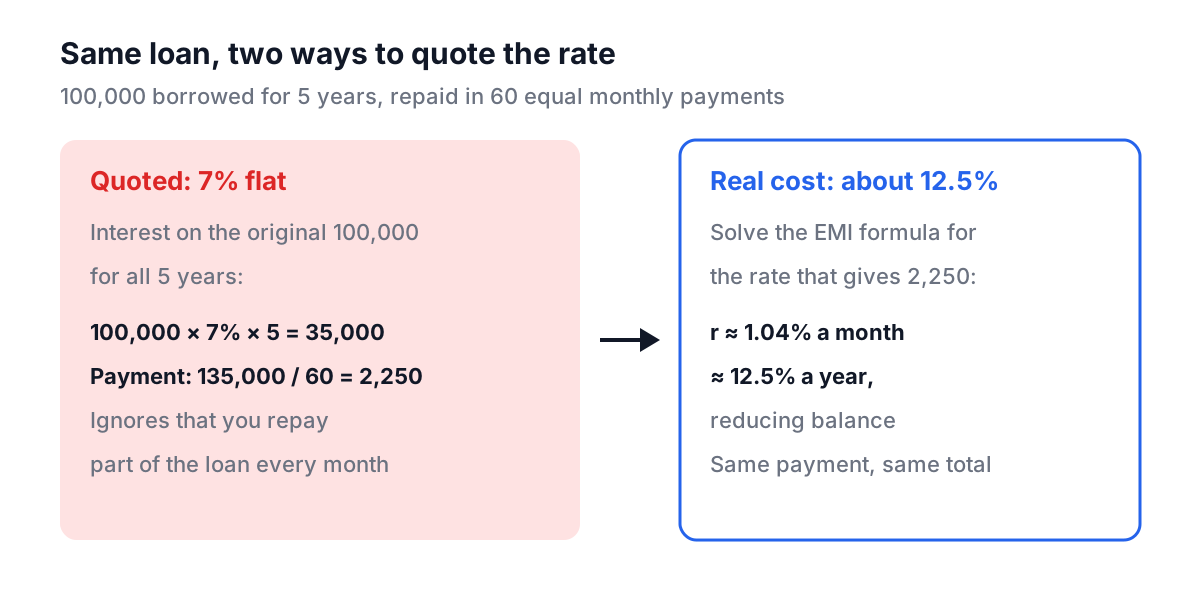
Take 100,000 at "7% flat" over five years. Interest is 100,000 × 7% × 5 = 35,000, and the monthly payment is 135,000 / 60 = 2,250. Solve the EMI formula backwards for the rate that produces a 2,250 payment and you get about 12.5% on a reducing balance. The headline rate was barely more than half the real cost. The Simple Interest Calculator gives you the flat-rate interest; the EMI Calculator gives you the reducing-balance comparison.
The rest of the monthly bill
For a home, the EMI is only part of the monthly cost. The EMI Calculator lets you add insurance, property tax and maintenance, monthly or yearly, plus any custom cost such as association fees. With the defaults (150 insurance, 400 tax and 100 maintenance a month), the total monthly payment is 1,661.31 against an EMI of 1,011.31. Those extra costs are kept out of the Total Interest figure so you can compare loans on loan cost alone. If you are weighing ownership against renting, the Rent vs Buy Calculator takes those numbers further.
Common mistakes
- Entering years as months. Tenure is in months. A 20-year loan is 240.
- Comparing EMIs instead of total cost. A lower EMI on a longer tenure almost always costs more.
- Treating a flat rate as comparable to a reducing rate. Convert first.
- Forgetting fees. Processing fees and bundled insurance raise the effective cost even if the rate is unchanged.
- Expecting cent-perfect agreement with the bank. Banks round each instalment and may use daily interest, so small differences are normal.
Using the schedule
Before you sign, put the lender's numbers into the EMI Calculator and check that the EMI matches to within a unit or two. Then look at three figures: total interest, the balance after the number of years you expect to keep the loan, and how much a modest early prepayment would save. If your loan has deposits building on the other side of the ledger, the compound interest guide covers how those grow.