
AI Voice Cloning Scams: A Family Code Word Plan
How cloned-voice emergency calls work, what the FTC and FBI tell families to do, and how to pick, test and use a code phrase a scammer cannot find online.
By Redbison Dev · · Updated · 10 min read

Your phone rings and it is your son's voice, crying, saying he has been in a car accident and needs money for bail before a lawyer will help him. AI voice cloning scams work exactly like this: a criminal takes a short clip of a relative's voice from a video posted online, generates new speech in that voice, and calls you with an emergency that needs money now. The defence that works is a plan you agree before the call ever comes: a secret code phrase that only your family knows, plus a rule that nobody sends money until they have hung up and called the person back on a number they already have.
This post explains how these calls work according to the FTC and the FBI, then sets up that plan step by step. The Password Strength Checker tests whether your chosen phrase could be guessed or found, and the Password Generator secures the accounts a scammer would raid for material.
How a cloned-voice emergency call works
The family emergency scam is old. Someone calls an older relative, claims to be a grandchild in trouble, and asks for money quickly and quietly. What has changed is the voice. In a March 2023 consumer alert, the Federal Trade Commission (FTC) warned that a scammer could use AI to clone a loved one's voice and that all he needs is a short audio clip, which he could get from content posted online. In its December 2024 public service announcement on generative AI fraud (I-120324-PSA), the FBI's Internet Crime Complaint Center (IC3) described criminals generating short audio clips of a loved one's voice to impersonate a close relative in a crisis, asking for immediate financial help or demanding a ransom.
The script is built to stop you thinking:
- A crisis. An arrest, a car crash, a hospital, a kidnapping. Sometimes a second person takes over the call, posing as a police officer, lawyer or doctor.
- Secrecy. "Don't tell Mom and Dad." The point is to stop you checking with anyone.
- Hard-to-reverse payment. The FTC lists the requests to treat as warnings: wire transfers, cryptocurrency and gift cards, especially reading out a card's number and PIN.
The FTC's first piece of advice is blunt: don't trust the voice. The losses behind these scams are large. The FTC says US consumers reported losing more than $12.5 billion to fraud in 2024, and imposter scams, the group that includes people pretending to be family as well as government and business impersonators, had the second-highest reported losses at $2.95 billion.
What the law already says
Calling someone with a cloned voice to take their money is fraud whatever technology is used. On top of that, the Federal Communications Commission (FCC) confirmed in a February 2024 declaratory ruling (FCC 24-17) that AI-generated voices count as an "artificial or prerecorded voice" under the Telephone Consumer Protection Act, so robocalls using them need the called person's prior express consent. The ruling gives regulators and state attorneys general another enforcement tool. It does not stop a criminal from calling you, which is why the defence has to be at your end.
The family plan in four parts
The FBI's December 2024 announcement puts it in one line: create a secret word or phrase with your family to verify their identity. A phrase on its own is not enough, though, because a frightened person can forget it or a scammer can talk around it. Write down the whole plan:
- The code phrase. Two or three unrelated words that every member of the family knows and nobody has ever posted, texted or emailed.
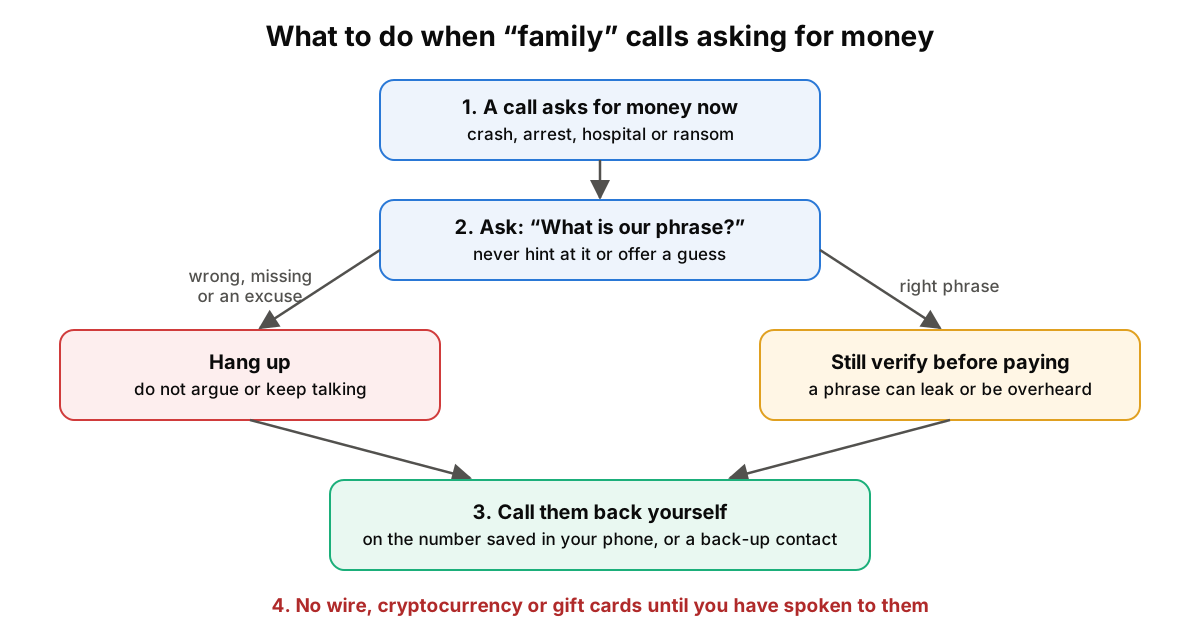
- The call-back rule. Any call asking for money ends with you hanging up and calling the person back on the number saved in your phone, not a number the caller gives you. The FTC advises calling the person on a phone number you know is theirs, and the FBI gives the same advice for calls claiming to be from a bank or other organization: hang up and call its real number directly. Caller ID can be faked, so an incoming call showing the right name proves nothing.
- The back-up contacts. If you cannot reach the person, the FTC suggests trying to reach them through another family member or their friends: a partner, a parent or a roommate who would know where they are.
- The payment rule. No wire transfers, cryptocurrency or gift cards for any family emergency, ever, without the steps above. A real lawyer or police department does not take bail in gift cards.
Agree it in person, or on a call you started yourself, rather than in a group chat that could be read by anyone who gets into one phone.
Choosing a phrase a scammer cannot find
A code phrase faces two different threats. One is guessing: on a live call the scammer gets one or two attempts before you hang up, so brute force is not the real risk. The other is finding: a pet's name, a street, a team or a family joke that appears in public posts can be dug up before the call. Most families pick something meaningful, and meaningful is exactly what is findable.
You can see both effects in the Password Strength Checker. It runs on your device and does not upload what you type, but it is still sensible to test candidates that resemble your phrase rather than the final phrase itself. Clear the sample password and try these three:
- Type
Biscuit2015in Password to test, then typebiscuitin Words about you (optional), as if Biscuit were the dog in your profile pictures and 2015 the year you got him. - Clear the personal words and type
purple elephant, the kind of playful phrase families like. - Type
velvet canyon oboe, three words that have nothing to do with each other or with you.
| Candidate phrase | Rating | Estimated guesses | Online, rate limited (100 guesses an hour) | What the checker found |
|---|---|---|---|---|
| Biscuit2015 (with "biscuit" as a personal word) | Weak (1 of 4) | about 10<sup>4.2</sup> | 6 days | one of your personal words, recent year |
| purple elephant | Strong (3 of 4) | about 10<sup>8.0</sup> | 1 century | common password (rank 162), common password (rank 344) |
| velvet canyon oboe | Very strong (4 of 4) | about 10<sup>14.1</sup> | centuries | velvet (common password, rank 1826), canyon (common Wikipedia word), " oboe" as random characters |
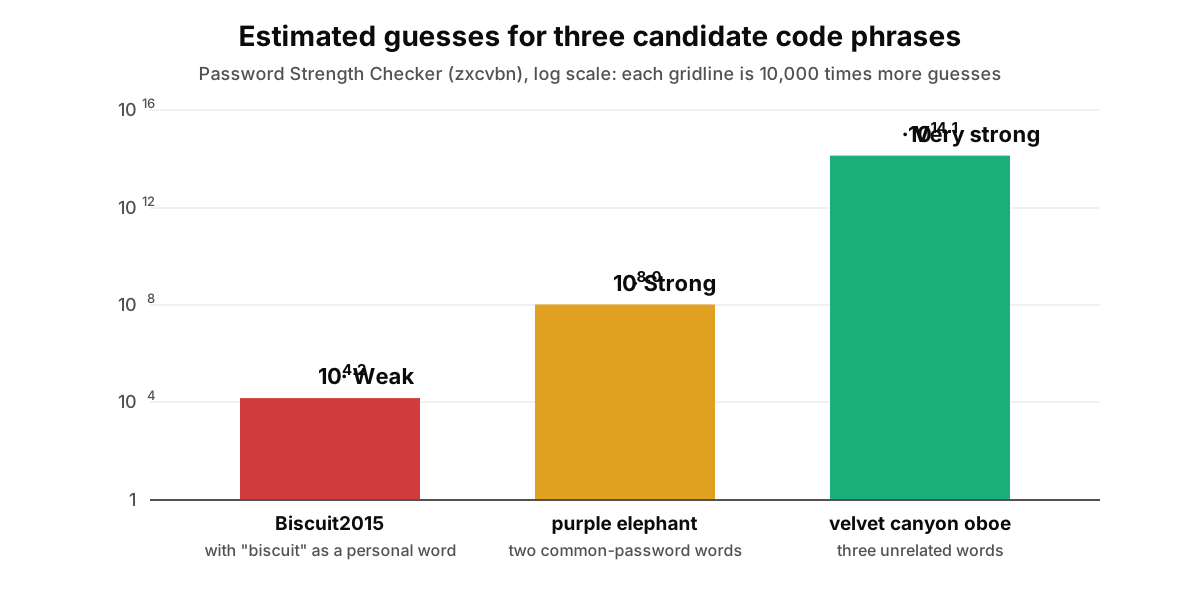
Read the table with the phone call in mind. Even the weak phrase would take days to guess at 100 tries an hour, and a scammer on a call gets nowhere near that. Biscuit2015 is still the worst choice, because the checker flags exactly what an attacker would do: start from your personal words. Anyone who scrolled your photos already has "Biscuit" and could ask a leading question to get the rest. "purple elephant" scores well, but the checker shows that both words sit high on lists of common passwords, so a phrase built from popular words is weaker than it sounds. The third phrase also uses ordinary words, but three unrelated ones with no link to you multiply into far more guesses.
Picking the words at random
The phrase is strongest when you do not choose the words yourself. The Electronic Frontier Foundation (EFF) publishes word lists for "diceware": roll five dice, look up the five-digit result in its large list of 7,776 words, and repeat. Three words chosen this way give 3 × log2(7,776), or about 38.8 bits, which is far beyond what anyone could guess on a phone call. Opening a dictionary at three random pages works too. Then check the result:
- every family member can say it and spell it, including children and grandparents;
- it does not appear in any of your posts, bios or family stories;
- it is different from every password you use.
If a word is hard to spell over a bad line, the NATO phonetic alphabet guide shows how to spell it letter by letter.
Using the phrase on a real call
The phrase only works if the person who answers asks for it, and asks the right way:
- Ask; never offer. Say "What's our phrase?" Do not say "Is it velvet canyon?" A scammer will happily agree with whatever you suggest.
- Do not accept excuses. "I'm too upset to remember" or "the police are listening" is your signal to hang up and call back.
- Call back before paying anyway, even after the right phrase. A phrase can leak, and the call back costs a minute.
- Do not argue or test the caller further. Every extra minute gives a scammer more of your voice and more information.
After a phrase has been used on a real call, or if you think someone overheard it, pick a new one. The same goes when someone leaves the household or a phone with the phrase in its notes is lost.
Protecting the accounts behind the plan
Cloned-voice calls are more convincing when the caller knows details: who is travelling, which school, the name of a friend. Much of that comes from social media and email accounts. The FBI suggests making social media accounts private and limiting followers to people you know, which also limits how much of your voice is public. A taken-over account is even more useful to a criminal, because a message from your real profile is far more convincing than a call.
Use the Password Generator to give every family member's email, phone carrier and social media account its own password. Its default of 16 characters with numbers and symbols is a good setting: the password strength guide explains why length and randomness matter more than clever substitutions, and the password generator guide covers how to store generated passwords. Add a second factor such as an authenticator app; how TOTP codes work explains what that protects against. Keep the code phrase out of the generator altogether: it needs to be something people can say from memory, not a random string.
If someone has already paid
Act fast, because the first hours matter. Contact the bank, wire service, gift card company or cryptocurrency exchange you used and ask them to stop or reverse the payment. Report the scam to the FTC at ReportFraud.ftc.gov and to the FBI at ic3.gov, with the phone number, times, amounts and payment details. If you handed over cash, also call your local police. This plan does not replace those steps, and it does not fit every family: for a relative with memory problems, agree with their bank or caregiver on extra checks before large payments rather than relying on a phrase.
Tools for this job
- Password Strength Checker: test candidate phrases with your personal words added, and see whether a phrase is built from common words or details about you.
- Password Generator: create unique, random passwords for the email and social media accounts that scammers mine for details or take over.
For more background, Password Strength and Entropy: What Crack-Time Estimates Mean covers how guess estimates work, and the NATO phonetic alphabet guide helps you spell a code word clearly on a bad line.
Frequently asked questions
Can a scammer really clone a voice from a short video?
Yes. The FTC warns that a scammer needs only a short audio clip of your family member's voice, which can come from content posted online, and the FBI describes criminals generating short clips in a loved one's voice. The clone does not have to be perfect, because the call is designed to make you panic and act before you notice anything odd.
Should the code phrase be the same for the whole family?
One phrase for the whole household is easiest to remember and use, and it works for calls between any two members. Larger families sometimes keep one phrase per household. What matters more is that everyone knows the call-back rule, so a forgotten phrase leads to a hang-up and call back instead of a payment.
What if the caller says they cannot remember the phrase?
Treat it as a failed check. Hang up and call the person on the number saved in your phone, then try your back-up contacts. A real relative in trouble will understand why you called back, and a scammer has no way to answer a call to someone else's phone.
Is it safe to store the code phrase in a notes app or group chat?
It is better kept in memory or on paper at home. A note or chat is exposed when any phone or account is compromised. If you must store it, put it in a password manager rather than a shared chat, and change the phrase if the device is lost.
Sources and further reading
- Scammers use AI to enhance their family emergency schemes, Federal Trade Commission. March 2023 consumer alert: voice cloning from short clips, the call-back advice and payment warnings.
- Criminals Use Generative Artificial Intelligence to Facilitate Financial Fraud, FBI Internet Crime Complaint Center. December 2024 PSA I-120324-PSA, including the advice to create a secret word or phrase with your family.
- Declaratory Ruling on AI-generated voices under the TCPA (FCC 24-17), Federal Communications Commission. Adopted February 2 and released February 8, 2024; AI voices are an "artificial or prerecorded voice".
- New FTC Data Show a Big Jump in Reported Losses to Fraud to $12.5 Billion in 2024, Federal Trade Commission. March 2025 release with the 2024 fraud and imposter-scam loss figures.
- EFF Dice-Generated Passphrases, Electronic Frontier Foundation. How to pick passphrase words with dice and the EFF word lists.
- What To Do if You Were Scammed, Federal Trade Commission. Steps by payment method for trying to get money back.