
Loading a Barbell, Training by RPE and Timing Intervals
From a set of 140 kg x 5 at RPE 8 to the load for today's triples, the plates on each side, the rest between sets and a 4-minute Tabata finisher, with the numbers checked.
By Redbison Dev · · Updated · 9 min read
Your program says "3 x 3 at RPE 8, then a Tabata finisher", and last week's top set was 140 kg for 5 reps at RPE 8. To use RPE in lifting, convert that set into an estimated one-rep max with an RPE chart, then read the load for today's reps and RPE off the same chart: here 147.5 kg. Then you need the plates for each side, a rest timer between sets, and an interval timer that keeps time for the finisher.
This guide works through that session with the RPE Calculator, the Barbell Plate Calculator and the Interval Timer, so you can repeat each step with your own numbers.
What RPE and reps in reserve mean
In strength training, RPE (rating of perceived exertion) is usually rated by reps in reserve (RIR): how many more good reps you could have done when you racked the bar. Zourdos and colleagues published this scale in 2016, and it is the one most programs mean:
- RPE 10: maximum effort, nothing left
- RPE 9.5: no more reps, but a little more weight was possible
- RPE 9: 1 rep left
- RPE 8.5: 1, maybe 2 reps left
- RPE 8: 2 reps left
- RPE 7.5: 2, maybe 3 reps left
- RPE 7: 3 reps left
- RPE 5 to 6: 4 to 6 reps left
So RIR versus RPE is not a choice between two systems. They are the same rating in different units: from RPE 7 up, RPE = 10 - RIR. Helms and colleagues note that a scale of this kind first appeared in Mike Tuchscherer's Reactive Training Systems manual in 2008.
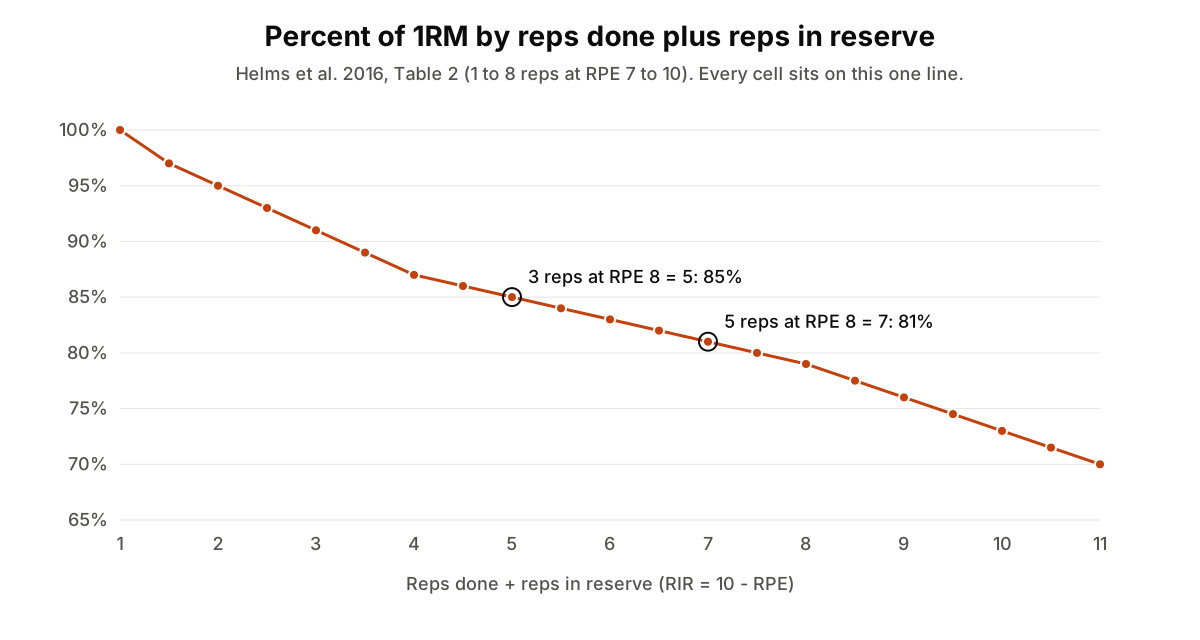
To turn an RPE into a load you need a chart that links reps, RPE and percentage of one-rep max (1RM). The RPE Calculator uses Table 2 of Helms, Cronin, Storey and Zourdos (2016), which covers 1 to 8 reps at RPE 7 to 10. It is built on mean values from experienced squatters: a single at RPE 10 is 100%, a single at RPE 8 is 91% and 8 reps at RPE 7 is 70%, with the other cells estimated between them.
The useful property of that chart is that each cell depends only on reps done plus reps in reserve. Five reps at RPE 8 means you could have done 7, so it sits where 7 reps at RPE 10 does: 81%. Three reps at RPE 8 counts as 5, which is 85%.
Worked example: from last week's set to today's load
Open the RPE Calculator. Its default inputs are this example:
- Weight lifted 140 (kg)
- Reps completed 5
- RPE of the set: RPE 8 (2 in reserve)
- Target reps 3 and Target RPE RPE 8
The calculator looks up 81% for 5 reps at RPE 8 and divides: 140 / 0.81 = 172.8 kg estimated 1RM (e1RM). Next to it, Epley's formula with the reps in reserve counted, 140 x (1 + 7/30), gives 172.7 kg, so the two methods agree within 0.2 kg here.
For the triples, 3 reps at RPE 8 is 85% of 172.8 kg, which is 146.9 kg, rounded to 147.5 kg so you can load it with standard plates. The chart under the result prints a load in every cell, so back-off sets come from the same table: 5 reps at RPE 7 is 79%, or 137.5 kg after rounding.
In pounds the steps are the same. Switch the units to lb and enter 315 x 5 at RPE 8: the e1RM is 388.9 lb, and 3 reps at RPE 8 is 330.6 lb, which rounds to 330 lb on 5 lb steps.
The mistake that costs the most: ignoring the reps you had left
If you put 140 x 5 into the One Rep Max Calculator as if it were an all-out set, its seven formulas average 161.7 kg, about 11 kg below the RPE estimate, and every load you take from it will be too light. Enter the reps you could have done instead (140 kg, 7 reps) and the average is 170.3 kg, close to the chart. The One Rep Max Calculator is the right tool when a set really went to failure; the RPE Calculator is the right one when it did not.
The chart is an average. For 8 reps at 70% of 1RM the standard deviation of reported RIR was 1.2, from which Helms and colleagues infer that about two-thirds of lifters would report 2 to 4 reps left, and some as few as 1 or as many as 5. Treat the e1RM as a starting point for the day, and if the first triple at 147.5 kg feels like RPE 9, take the weight down rather than forcing the plan.
Loading the bar: plates per side
The plates on each side are (target - bar - both collars) / 2. With the 20 kg bar and the 2.5 kg collars the IPF requires in competition, the empty bar already weighs 25 kg.
Open the Barbell Plate Calculator, set Target weight to 147.5 and tap Competition: 20 kg bar + 2.5 kg collars. Each side needs 61.25 kg, loaded as 25 + 25 + 10 + 1.25. With spring clips instead (leave Collar weight (each) at 0), each side needs 63.75 kg: 25 + 25 + 10 + 2.5 + 1.25. Forgetting that competition collars weigh 5 kg together is an easy way to lift 152.5 kg by mistake.
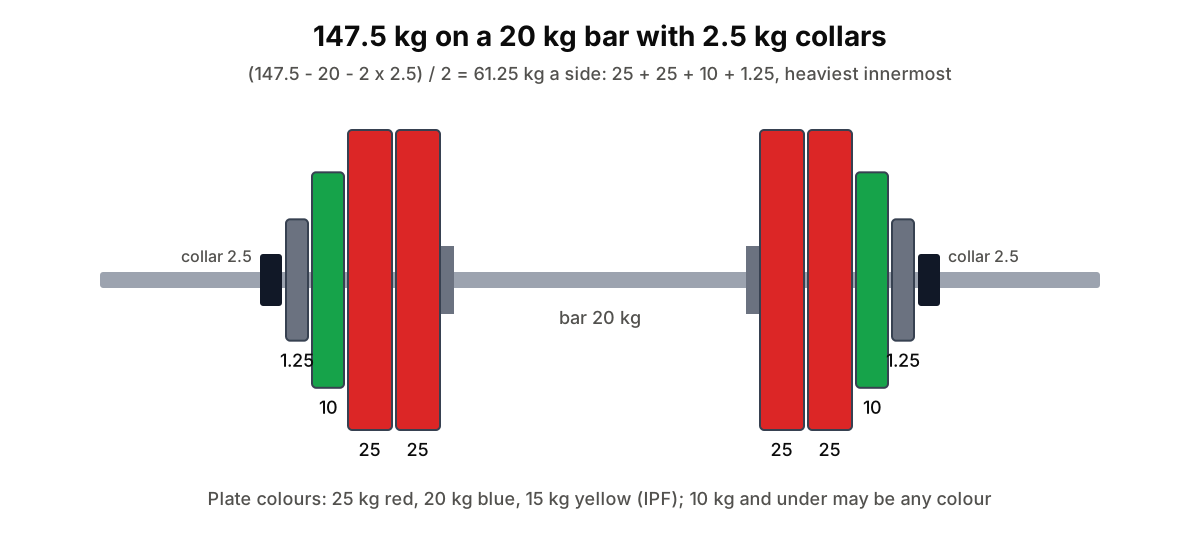
The IPF Technical Rules (2026 edition) set the loading order: heaviest discs innermost, smaller discs in descending order. They also fix three colours, 25 kg red, 20 kg blue and 15 kg yellow, and allow any colour for 10 kg and under. In a pound gym, 330 lb on a 45 lb bar is 142.5 lb a side: 45 + 45 + 45 + 5 + 2.5.
When your plates are limited
At home you may own only a few pairs. Say you have one pair of 25s, two pairs of 15s and no 5s, and you want 80 kg on a 20 kg bar. Picking the biggest plate first loads a 25 and then needs 5 kg that you do not have. Under Plates you have, set Blank boxes mean to None (only the plates I list), then enter 1 for 25 kg pairs and 2 for 15 kg pairs: the calculator searches every combination and returns 15 + 15.
Sometimes there is no exact answer. With one pair each of 25, 2.5 and 1.25 kg plus two pairs of 15s (same setting), 90 kg needs 35 kg a side, which those plates cannot make. The calculator shows the nearest loads instead: 87.5 kg (15 + 15 + 2.5 + 1.25 a side) or 100 kg (25 + 15). A pair of 5s would fill that gap.
Rest between heavy sets
The ACSM position stand on progression in resistance training (2009) recommends 3 to 5 minutes of rest between sets of heavy loading (1 to 6 repetitions maximum), and 1 to 2 minutes for hypertrophy work in the 6 to 12 RM range. For the triples at 147.5 kg, set the Countdown Timer to 3 minutes and start it when you rack the bar. Cutting the rest short pushes the next set's RPE up for reasons unrelated to your strength.
Timing the intervals: Tabata, HIIT and EMOM
The Tabata protocol comes from Tabata and colleagues (1996): seven to eight bouts of 20 seconds at about 170% of VO2max on a cycle ergometer, with 10 seconds of rest between them. Seven subjects did it 5 days a week for 6 weeks, and their anaerobic capacity rose by 28% and VO2max by 7 mL/kg/min. Most "Tabata" workouts today keep the 20/10 timing with other exercises; the timing transfers, the intensity depends on what you can reach.
Open the Interval Timer. The Tabata 20/10 x 8 preset is selected, with a 10-second get-ready countdown, and the total reads 4:00. The workout itself is 3:50, not 4:00, because there are only seven rests: the last round ends the workout. Work time is 2:40.
For a longer session, choose HIIT 40/20 x 8, 3 sets: 40 seconds on, 20 off, 8 rounds, 3 sets and 60 seconds between sets. The timer shows 25:10 in total and 16:00 of work. The formula behind it is get ready + sets x (rounds x (work + rest) - rest) + (sets - 1) x set rest, which here is 10 + 3 x 460 + 120 = 1,510 seconds. For an EMOM, pick the EMOM 10 min preset (60 s work, 0 rest, 10 rounds) and set Rounds per set to the number of minutes.
A browser timer can drift when you switch apps: Chrome runs timers in hidden tabs at most once a second, and repeated timers in a tab hidden for five minutes and silent for 30 seconds only once a minute. The Interval Timer stores when you pressed Start and reads the clock, so the display is right the moment you look again, and it queues its beeps on the Web Audio clock. Tap Start once so the browser allows sound, and keep the screen on, since a locked phone can suspend the page.
Who this does not fit
These charts and timers describe trained adults on average. If you are new to lifting, the RPE scale takes practice: in the Zourdos study, novices rated a true one-rep max lower than experienced lifters did. If you have a heart condition, high blood pressure, an injury or are pregnant, talk to your doctor before maximal lifting or high-intensity intervals.
Tools for this job
- RPE Calculator: turn a set's reps and RPE into an e1RM and the load for your next set.
- Barbell Plate Calculator: the plates for each side, with collars and the plates you actually own.
- One Rep Max Calculator: when a set went to failure, seven formulas and a percentage table.
- Countdown Timer: a plain rest timer between heavy sets.
- Interval Timer: Tabata, HIIT and EMOM with sound cues, accurate in a background tab.
For the formulas behind 1RM estimates, heart rate zones and pace, read Training Numbers Explained. For why some online timers fall behind in a background tab, see Stopwatches, Countdown Timers and Clocks in the Browser.
Frequently asked questions
Should I program by RPE or by percentages?
Both work, and they can be combined. Percentages are simple and repeatable, but they assume your max has not changed since you tested it. RPE adjusts to the day, which helps when sleep or stress make you weaker or stronger than usual. A common approach is a top set by RPE, then back-off sets taken from that day's e1RM.
Does a 4-minute Tabata count towards weekly exercise targets?
Yes. The Physical Activity Guidelines for Americans, 2nd edition (US HHS, 2018) set 150 to 300 minutes of moderate or 75 to 150 minutes of vigorous aerobic activity a week, plus muscle-strengthening on 2 or more days, and they no longer require bouts to last at least 10 minutes. A Tabata counts as vigorous minutes, but at under 3 minutes of work it is a small part of the weekly total.
My program is in kilograms but my gym has pound plates. What do I do?
Convert the target and load the nearest weight you can. 147.5 kg is 325.2 lb, so on a 45 lb bar you would load 325 lb (45 + 45 + 45 + 5 a side). Run the RPE Calculator in pounds from the start and it rounds to 5 lb steps for you.
How do I know what RPE a set was?
Ask yourself at the end of the set how many more clean reps you could have done with the same form. Two left is RPE 8, one is RPE 9. Ratings are more accurate close to failure and in lower-rep sets, so check yourself against those first.
Sources and further reading
- Application of the Repetitions in Reserve-Based Rating of Perceived Exertion Scale for Resistance Training, Strength and Conditioning Journal. Helms, Cronin, Storey and Zourdos 2016; Table 2 is the RPE chart used here.
- Novel Resistance Training-Specific Rating of Perceived Exertion Scale Measuring Repetitions in Reserve, Journal of Strength and Conditioning Research. Zourdos et al. 2016; the RIR-based RPE scale.
- IPF Technical Rule Book (effective 1 March 2026), International Powerlifting Federation. Disc sizes, colours, loading order and 2.5 kg collars.
- American College of Sports Medicine position stand: Progression models in resistance training for healthy adults, Medicine and Science in Sports and Exercise. 2009; rest periods by training goal.
- Effects of moderate-intensity endurance and high-intensity intermittent training on anaerobic capacity and VO2max, Medicine and Science in Sports and Exercise. Tabata et al. 1996; the 20 s / 10 s protocol.
- Physical Activity Guidelines for Americans, 2nd edition (2018), US Department of Health and Human Services. Weekly aerobic and muscle-strengthening targets.
- Heavy throttling of chained JS timers beginning in Chrome 88, Chrome for Developers. Why tick-counting timers drift in background tabs.
More Fitness Calculators
Every tool in the Fitness Calculators section, free and in your browser.
- BMI Calculator
- Calorie Calculator
- Protein Calculator
- Hydration Calculator
- Calorie Deficit Planner
- Body Fat Calculator
- Ideal Weight Calculator
- Running Pace Calculator
- Target Heart Rate Calculator
- One Rep Max Calculator
- Barbell Plate Calculator
- RPE Calculator
- Interval Timer
- Calories Burned Calculator
- Body Surface Area Calculator
- Waist-to-Hip Ratio Calculator
- VO2 Max Calculator
- Steps to Distance & Calories Calculator