
Cap Table Dilution and the Option Pool Shuffle, Step by Step
Two founders through a seed and a Series A with a pool top-up in each: who owns what after every round, and why a $30M pre-money is effectively $25.57M.
By Redbison Dev · · Updated · 10 min read
You have a Series A term sheet in front of you: $10 million at a $30 million pre-money valuation, with an option pool of 15% of the post-closing fully diluted shares counted in the pre-money. Every priced round dilutes the existing holders by the investment divided by the post-money, and a pool top-up counted in the pre-money takes more on top. In the example below, two founders go from 45.5% each to 22.38% each across a seed and a Series A, and the $30 million headline pre-money is effectively $25,573,770 once the new pool shares are paid for.
The Cap Table and Dilution Calculator and the Option Pool Shuffle Calculator both open with this example loaded, so you can follow every number and then replace it with your own. The pool mechanics are checked against the worked Series A in Y Combinator's post-money SAFE user guide.
The cap table before the first round
Two founders split the company equally and keep 9% back for an employee option pool. In the Co-founder Equity Allocation tool, the Setup tab starts with one co-founder, so click Add Co-founder for the second. The two start with different defaults, so set both to Role CEO, Primary Contribution Execution, Time Commitment (%) 100, Cash Investment ($) 0, Experience (Years) 5 and Risk Tolerance Medium. Set Total Equity Pool (%) to 91 and Allocation Method to Contribution-Based (points), then click Calculate Equity Allocation on the Calculate tab and open Results: each founder gets 45.5%. On 10,000,000 shares that is:
| Holder | Shares | Fully diluted |
|---|---|---|
| Founder A | 4,550,000 | 45.50% |
| Founder B | 4,550,000 | 45.50% |
| Unallocated option pool | 900,000 | 9.00% |
| Total | 10,000,000 | 100.00% |
"Fully diluted" counts every issued share, every option already granted and the unallocated pool, because term sheets price the company on that basis. A pool share that has not been granted to anyone still counts.
How dilution works in a priced round
A priced round sets one number, the price per share, and everything else follows from it:
- price per share = pre-money valuation ÷ fully diluted shares before the round
- new investor shares = investment ÷ price per share
- post-money valuation = pre-money + investment
Take a seed round of $2,000,000 at an $8,000,000 pre-money with no change to the pool. The price is $8,000,000 ÷ 10,000,000 = $0.80, the seed investors receive 2,500,000 shares, and every existing holder keeps 8 ÷ 10 of their percentage. Each founder drops from 45.5% to 36.4%.
Now add a pool. YC's SAFE guide notes that priced seed rounds adopt an option pool that does not dilute the seed investors, so suppose the term sheet asks for an unallocated pool of 10% of the post-closing shares, created before the money arrives. That is how the NVCA model term sheet words it: the pre-money includes an unallocated and uncommitted employee option pool equal to a percentage of the fully diluted post-money capitalization. The existing 900,000-share pool would be only 7.2% of the 12,500,000 shares after the round, so it has to grow. Because the new pool shares are counted in the pre-money, the price falls to $8,000,000 ÷ 10,400,000 = $0.7692, and the cap table after the seed becomes:
| Holder | Shares | Fully diluted |
|---|---|---|
| Founder A | 4,550,000 | 35.00% |
| Founder B | 4,550,000 | 35.00% |
| Unallocated option pool | 1,300,000 | 10.00% |
| Seed investors | 2,600,000 | 20.00% |
| Total | 13,000,000 | 100.00% |
The seed investors still own exactly $2 million ÷ $10 million = 20%. The 400,000 new pool shares came entirely out of the founders, who end at 35.00% instead of 36.40%. That 1.4-point gap is the option pool shuffle in miniature.
The option pool shuffle at the Series A
Between the rounds the company hires and grants 500,000 options from the pool, leaving 800,000 unallocated. Granting options does not dilute anyone on a fully diluted basis: the shares move from the pool line to the granted-options line and the total stays at 13,000,000.
The Series A term sheet then asks for $10,000,000 at a $30,000,000 pre-money with an unallocated pool of 15% after the closing, in the pre-money. With F the shares before the round, U the unallocated pool, V the pre-money, I the investment and t the target, the new pool P has a closed form:
- k = t × (V + I) ÷ V = 0.15 × 40 ÷ 30 = 0.2
- P = (k × F − U) ÷ (1 − k) = (2,600,000 − 800,000) ÷ 0.8 = 2,250,000 new pool shares
- price = $30,000,000 ÷ 15,250,000 = $1.9672
- Series A shares = $10,000,000 ÷ $1.9672 = 5,083,333
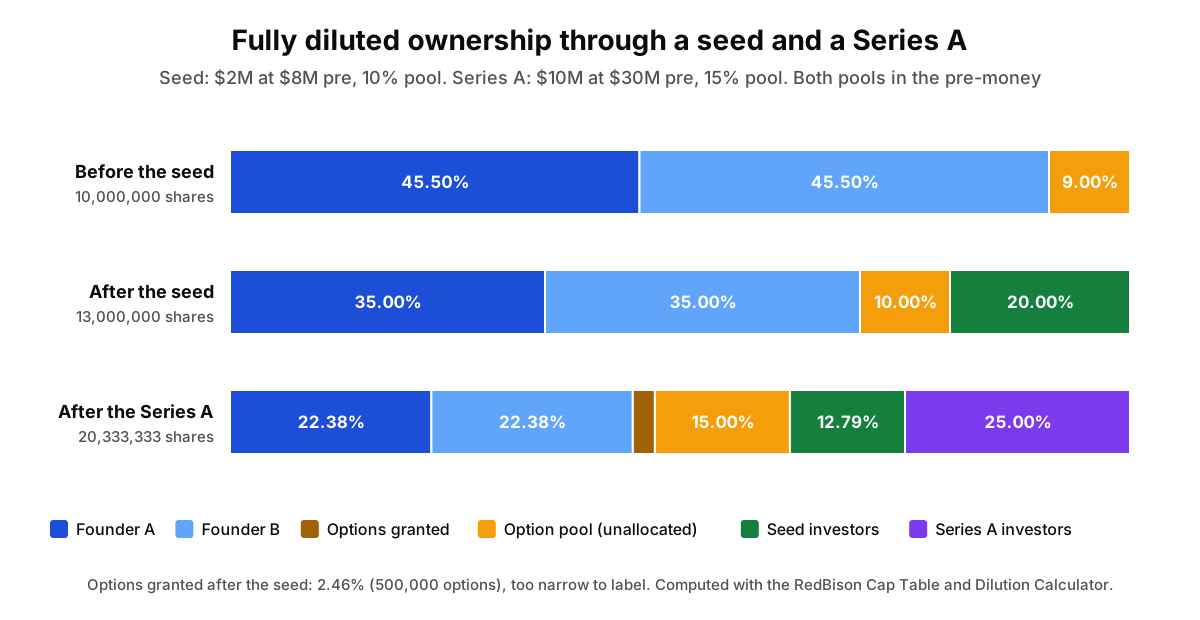
After the Series A there are 20,333,333 fully diluted shares. The Series A investors own exactly 25.00% ($10 million of a $40 million post-money), the pool is 15.00%, the seed investors 12.79%, the granted options 2.46%, and each founder 22.38%.
How much of that is the pool? Run the same round three ways and look at one founder:
| Series A pool | Founder's stake after the round |
|---|---|
| No top-up | 26.25% |
| 15% pool added after the round | 23.39% |
| 15% pool in the pre-money (the term sheet) | 22.38% |
Adding the pool after the round would spread its cost over the new investors too, which is why investors ask for it in the pre-money. Across both rounds each founder has lost 50.82% of their starting stake: 1 − 22.38 ÷ 45.5, computed on the unrounded figures.
Effective pre-money: two figures, each subtracted once
The headline $30,000,000 pays for everything in the pre-money share count, including 2,250,000 pool shares that nobody owns yet. At $1.9672 a share those new pool shares are worth $4,426,230, so the effective pre-money is $30,000,000 − $4,426,230 = $25,573,770. That is the value, at the round price, of the 13,000,000 shares that existed before the Series A, the old 800,000-share pool included.
A second figure is sometimes quoted: the pre-money with the whole post-round pool taken out. The pool is 15% of the $40,000,000 post-money, $6,000,000, which leaves $24,000,000, the value of issued shares and granted options only. Both figures are legitimate as long as you say which one you mean. The mistake to avoid is subtracting the old pool twice: $30,000,000 − $6,000,000 − $1,573,770 for the old 800,000 pool shares gives $22,426,230, which double counts shares already inside the $6,000,000.
If you accept the investors' 15% pool but want the existing shares priced at a real $30 million, the Option Pool Shuffle Calculator gives the headline to ask for: $34,886,878 pre-money, with the pool still in the pre-money, leaves an effective pre-money of $30,000,000. The seed round had the same effect on a smaller scale: its $8,000,000 pre-money was effectively $7,692,308.
Run the example yourself
Open the Cap Table and Dilution Calculator. Its defaults are this example, so check them rather than retyping:
- Under Cap table before the first round, the three rows are Founder A and Founder B (Type Common (founders), Shares 4550000) and Unallocated option pool (Type Unallocated pool, Shares 900000).
- In the Seed round, Pre-money valuation is 8000000, the investor's Amount 2000000, Option pool target 10, and Pool top-up counted in is set to Pre-money (shuffle).
- In the Series A round, Pre-money valuation is 30000000, Amount 10000000, Option pool target 15, and Options granted before this round 500000.
- Read Price per share ($0.7692 and $1.9672) and Effective pre-money ($7,692,308 and $25,573,770) for each round, then the cap table and the dilution table, which shows 50.82% for each founder.
Then open the Option Pool Shuffle Calculator. Its defaults are the Series A on its own: Pre-money valuation 30000000, Investment 10000000, Fully diluted shares before the round 13000000, Unallocated pool before the round 800000 and Pool target after the round 15. It shows the 2,250,000 new pool shares, both effective figures, the 60.00% that existing holders keep against 62.72% with the pool added after the round, and the $34,886,878 counter-offer.
To check a single stake by hand, use the "What percent one number is of another" row of the Percentage Calculator: 4,550,000 is about 22.377% of 20,333,333.
If your seed round was a post-money SAFE
Y Combinator's post-money SAFE converts at the Series A at the valuation cap divided by the "Company Capitalization". Its user guide says that figure includes the existing options and unissued pool but excludes any pool increase made in connection with the financing, so the Series A pool shuffle dilutes the converted SAFE holders along with the founders. In YC's own example, an investor that held 10% after the SAFEs bought its pro rata share of the Series A and still ended at 9.06%. The calculators here do not convert SAFEs: convert them first and enter the conversion shares as a holder in the starting cap table.
Mistakes that cost founders points
- Comparing headline valuations. A $32 million pre-money with a 20% pool can price the existing shares lower than $30 million with 15%. Compare effective pre-money.
- Counting granted options in the pool. The target is the unallocated pool. Options already granted, or promised in offer letters, do not count toward it.
- Accepting a round number for the pool. A pool sized to the hires planned before the next round is easier to defend, and every unused share was paid for by the existing holders.
- Forgetting the pool when you plan the next round. Each round's top-up dilutes the earlier investors too, as the seed investors' fall from 20.00% to 12.79% shows.
This is arithmetic for planning and negotiating, not legal or tax advice. The closing documents round the price and share counts, and liquidation preferences, anti-dilution terms and vesting change what each holder actually receives, so have a startup lawyer check the pro forma cap table before you sign.
Tools for this job
- Cap Table and Dilution Calculator: run the whole cap table through several priced rounds and see everyone's ownership and dilution.
- Option Pool Shuffle Calculator: size one round's pool top-up, get both effective pre-money figures and a headline to counter with.
- Co-founder Equity Allocation: agree the founders' split and how much to hold back for a pool before the first round.
- Percentage Calculator: check a holder's stake or the percent change between two cap tables by hand.
The 409A valuation guide covers how the strike price for options from that pool is set, and the co-founder equity split guide covers the split you start from.
Frequently asked questions
Does dilution make my shares worth less?
Not if the round is priced higher than the last one. Each founder's 4,550,000 shares are worth $3,500,000 at the seed price of $0.7692 and $8,950,820 at the Series A price of $1.9672, even though the percentage fell from 35.00% to 22.38%. Dilution reduces your share of the company; a down round is what reduces the value per share.
Should founders negotiate the pool size or the valuation?
Both move the same number, the effective pre-money. Once the headline valuation is agreed, a smaller pool backed by a hiring plan is often an easier conversation than a higher valuation, and every point of pool taken out of the pre-money is ownership the founders keep.
Is the pool percentage measured before or after the round?
Term sheets normally state it as a percentage of the fully diluted shares after the closing. The NVCA model Series A term sheet puts the pool inside the pre-money and sizes it as a percentage of the fully diluted post-money capitalization, and YC's example uses an unallocated pool of 10% of the post-closing capitalization. A pool of 15% before the round would be smaller after it, so check which one the term sheet means.
Sources and further reading
- Post-Money SAFE User Guide, Y Combinator. Appendix II works a Series A with a 10% post-closing pool in the pre-money and explains why the pool increase is left out of Company Capitalization.
- The SAFE, Y Combinator. The current post-money SAFE forms, the pro rata side letter and the user guide.
- The Option Pool Shuffle, Venture Hacks. The 2007 article that named the shuffle, with an $8 million pre-money that is effectively $6 million.
- Term Sheet: Price, Brad Feld. How the price section of a VC term sheet is written and how the pool lowers the true pre-money.
- Term Sheet: Voting Rights and Employee Pool, Brad Feld. The employee pool clause, stated as a percentage of fully diluted stock after the financing.
- NVCA 2020 Term Sheet, National Venture Capital Association. The model Series A term sheet; its Pre-Money Valuation provision includes an unallocated and uncommitted employee option pool equal to a percentage of the fully diluted post-money capitalization.
Open the Cap Table and Dilution Calculator
More Fundraising & Equity
Every tool in the Fundraising & Equity section, free and in your browser.